
What Is a Lead Magnet and Why It Works: The Marketer’s Guide
A lead magnet is a valuable offer you give in exchange for contact information. It turns casual visitors into potential customers by delivering something people want while starting a connection with your brand.
This guide explains what makes an effective lead magnet, the different types available, and how to measure results. You’ll learn how to design offers that match your goals, attract the right audience, and keep your marketing pipeline full.
What Is a Lead Magnet?
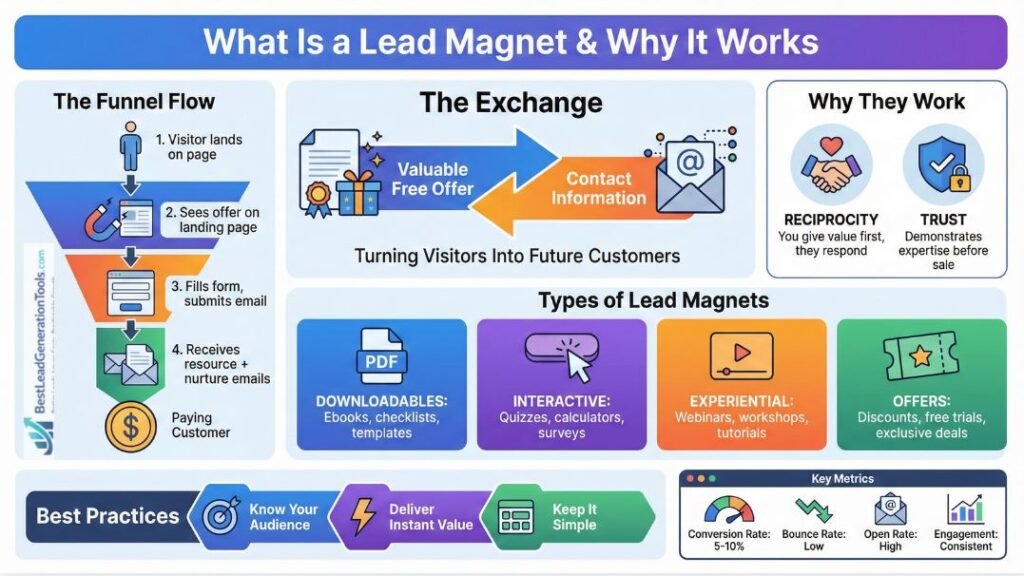
A lead magnet is a free resource you offer in exchange for contact information like an email address or phone number. It helps you build trust while creating an entry point into your sales funnel.
The exchange works because your audience receives useful content that addresses a specific problem or goal. Your lead magnet should align with your brand and reflect your expertise. For example, a digital design company might create a free template pack, while a marketing firm could share a guide to campaign tracking.
Common types include:
- Guides or ebooks that explain a concept clearly
- Templates or worksheets that save time
- Free trials or demos that offer firsthand experience
A lead magnet can be any free item or service designed to collect contact details. Its value lies in how well it connects your offer to genuine buyer interest.
How Lead Magnets Work
Lead magnets help you collect data, nurture leads, and improve conversion rates through targeted follow-ups.
The Exchange Process
The process follows a simple funnel:
- Visitors arrive at a landing page promoting your offer
- They complete a form, submitting details like their email address
- They receive access to the promised resource through a thank-you page or automated email
- You continue engagement through personalized email campaigns that guide them toward a purchase
This exchange turns visitors into leads and starts your lead generation workflow. When visitors see clear benefits, they’re more willing to share their information. Offering immediate access increases trust and signals professionalism.
Effective lead magnets are helpful, accessible, and relevant to your product or service. Each of these qualities raises your chance of turning casual visitors into qualified leads.
Why Lead Magnets Are Effective
Lead magnets work because they exchange clear value for contact information. They help you attract qualified leads, boost conversion rates, and build lasting customer relationships.
Psychology of Reciprocity
When you give away valuable content—like a useful checklist, free trial, or mini course—you trigger the principle of reciprocity. People feel motivated to respond positively when they receive something helpful first.
Users engage more when lead magnets solve a direct problem or address an immediate need. A short guide that saves users time or money builds early trust and encourages continued interaction with your brand.
Relevant and easy-to-use resources also filter out unqualified traffic. Only visitors genuinely interested in your solutions will opt in, leading to higher-quality leads and more efficient use of your marketing resources.
Building Trust and Authority
Lead magnets demonstrate expertise before any sale happens. When your audience downloads a free template, joins a webinar, or accesses an educational video, they see firsthand how knowledgeable and reliable you are.
Actionable content that delivers immediate value helps establish your brand as an authority. When people believe your advice works, they are more likely to buy your products or recommend your business to others.
Maintain consistency in tone, accuracy, and helpfulness across all materials. Use data, step-by-step guidance, or real examples to show credibility. Each positive interaction turns casual readers into confident prospects who view your business as a trusted partner.
Types of Lead Magnets
Different lead magnets attract and qualify potential customers in unique ways. Choosing the right type depends on your goals and your audience’s needs.
Downloadable Resources
Downloadable resources remain one of the most common and effective lead magnets. You can offer ebooks, guides, checklists, or templates that solve specific problems. A PDF report or whitepaper helps professionals understand a complex topic. A cheat sheet or toolkit works well for providing quick steps or ready-to-use materials.
People value these resources because they deliver instant access to helpful information. Well-structured PDFs, videos, or checklists make strong incentives. Ensure your downloads address one clear need instead of being overly broad.
Interactive and Experiential Magnets
Interactive magnets invite users to participate rather than passively consume content. Quizzes, calculators, and surveys help people measure their current situation or assess their needs. They also help you learn more about each person’s interests, making your follow-up marketing more personalized.
Experiential magnets like webinars and workshops build engagement further. A live webinar lets viewers ask questions and interact in real time. When recorded, it becomes a reusable video asset that can draw new leads for months.
Incentives and Exclusive Access
Discounts, coupon codes, and free shipping offers give immediate savings. These work well for e-commerce businesses or service providers looking to convert price-sensitive customers quickly.
Exclusive content—like members-only resources, early product access, or VIP newsletters—creates a sense of belonging. Free trials or demos let users experience your product firsthand, building confidence before purchase.
Creating an Effective Lead Magnet
An effective lead magnet solves a specific problem for your target audience and delivers value immediately.
Know Your Audience
Start by identifying who you want to reach. Research their challenges, preferences, and goals. Align every offer with a clear pain point or goal. A small business audience might respond best to a budgeting template, while marketers may prefer a checklist for campaign tracking.
When you know your audience’s problems, you can create relevant solutions that improve conversion rates. Personalized content can raise engagement significantly by delivering materials that feel designed for each person.
Deliver Immediate Value
Your lead magnet must provide instant gratification. Users are more likely to engage when they see clear benefits right away. Avoid vague promises or long delays before they can access the content.
Provide something they can use immediately—like a checklist, calculator, or quick-start guide. High-performing lead magnets often include downloadable tools, short video tutorials, or interactive resources like quizzes.
Quick and easily downloadable offers outperform those that require major time commitments. Simple content keeps engagement rates high and moves users faster through your funnel.
Keep It Accessible and Simple
An effective lead magnet should be easy to use. Complicated designs or confusing layouts discourage sign-ups. Use a clean, mobile-friendly format that loads quickly and works across devices.
Keep your copy clear and your instructions short. Guide users through the next step, whether that’s downloading a file, joining a webinar, or taking a quiz. Simple navigation paired with valuable content builds confidence and encourages more conversions.
Promoting and Delivering Your Lead Magnet
Clear landing pages and smooth email automation help you capture contacts, maintain interest, and move new leads into your marketing campaigns.
Landing Pages and Forms
A dedicated landing page gives visitors one clear choice—sign up or download your offer. Keep the copy short and focused on value. Use a clear headline, one visual, and a visible call-to-action button. Highlight what the lead magnet solves instead of listing features.
Your form should match your goal. Fewer fields often lead to more sign-ups, while more fields can bring higher-quality leads. Use A/B testing to adjust field placement, button color, or layout.
Checklist for effective landing pages:
- Use mobile-responsive design
- Keep the call to action above the fold
- Include social proof, such as testimonials or download counts
- Test form length and layout regularly
Email Marketing and Automation
After a lead opts in, prompt email delivery builds trust. Set up automated email marketing so subscribers immediately receive access to the lead magnet. Tools like HubSpot or Constant Contact simplify this process and help maintain consistent messaging.
Send a brief thank-you note first, then a follow-up sequence introducing useful content, free trials, or related resources. The goal is to guide each contact toward the next step in your marketing funnel.
Automate segmentation using behavior triggers, like email opens or link clicks. Promoting your asset through ongoing campaigns increases reach and keeps your brand top of mind.
Measuring and Improving Results
Evaluating your lead magnet’s effectiveness helps you see if your audience engages and converts. Tracking metrics and running structured experiments allow you to adjust your offers and improve performance.
Track Key Metrics
Review metrics that reveal how well your lead magnet turns visitors into leads. Focus on conversion rate, calculated as total leads ÷ total visitors × 100%. A low rate suggests that your value offer or call-to-action may need improvement.
Use analytic tools such as Google Analytics to track where signups originate—email, social media, or organic search. This helps you understand which channels deliver qualified leads and where traffic may drop off.
Key metrics to monitor:
| Metric | Description | Goal |
|---|---|---|
| Conversion Rate | % of visitors who share contact info | 5–10% or higher |
| Bounce Rate | % who leave after viewing one page | Below 50% |
| Click-Through Rate | % who click to access your offer | Varies by medium |
Review these results weekly or monthly to identify patterns and decide whether your lead magnet meets expectations.
Test and Optimize
Use A/B testing to experiment with variations of your lead magnet. Test different headlines, visuals, or CTA wording to see which version earns more conversions. Tools like Google Optimize or ConvertKit can automate this process and give you measurable insights.
Always test one change at a time to isolate its effect. Keep both versions active for enough time to collect reliable data. Even small changes—button color, headline phrasing, or email subject line—can shift results significantly.
Continuous improvement involves comparing each test result, adopting what works, and adjusting based on audience behavior. A consistent testing approach strengthens strategy and ensures your campaigns evolve with audience expectations.
Conclusion
Lead magnets are a practical marketing tool that exchanges value for contact information. They work because they solve real problems, demonstrate expertise, and start relationships with potential customers.
Choose the right type for your audience, deliver immediate value, and make the experience simple. Promote your lead magnet through optimized landing pages and follow up with automated email campaigns. Track results regularly and test improvements to keep your strategy effective.
By creating lead magnets that align with your audience’s needs, you build trust, attract qualified leads, and grow your business over time.Key metrics to monitor: