
How Much Should You Pay for Leads in 2026? (Industry Cost Benchmarks & Smart Pricing Guide)
Most businesses are quietly overpaying for their leads — and many don’t realize it until thousands of dollars have already been wasted. In some industries, companies unknowingly pay two to three times the “safe” market rate for the same quality of prospects their competitors get for far less.
So, of course you want to know if you’re paying the right amount for your leads. That makes sense—lead generation can eat up a big part of your marketing budget, and guessing the right price wastes both money and opportunity. Most businesses pay anywhere from $10 to over $500 per lead, depending on the industry, lead quality, and marketing channel. Knowing where your costs sit within that range helps you stay competitive and invest wisely.
With the right strategy, you can balance cost and quality while increasing return on investment. This guide will help you break down cost per lead, compare pricing models, and find ways to optimize your campaigns so every dollar you spend attracts the right kind of prospects.
Understanding Cost Per Lead
Understanding cost per lead (CPL) helps you measure how efficiently you spend your marketing budget. It allows you to see how much each potential customer costs and whether those leads bring profitable results. Knowing this number helps you plan, optimize, and control your lead generation cost.
What Is Cost Per Lead?
Cost Per Lead (CPL) is the amount you pay to attract a single potential customer who shows interest in your product or service. You calculate this figure by dividing your total marketing spend by the number of leads generated during a specific period.
CPL gives you a clear view of how well your campaigns perform. A lower CPL usually means you are reaching more qualified leads for less money. However, it’s important to balance cost with quality—cheap leads that never convert can be more expensive in the long run.
The average cost per lead varies by industry. For example, the average CPL across sectors like financial services, healthcare, and IT ranges from $100 to over $700 due to differences in competition, target audience, and marketing methods.
Tracking your CPL helps you identify which platforms, ads, or content produce the best ROI. It turns guesswork into measurable results.
Difference Between CPL and Customer Acquisition Cost
Many people confuse Cost Per Lead (CPL) with Customer Acquisition Cost (CAC), but they measure different stages of your marketing funnel.
CPL focuses on generating interest—how much it costs to get a lead to sign up, submit a form, or request more information. CAC, on the other hand, measures how much you spend to turn those leads into paying customers.
Here’s a quick comparison:
| Metric | Focus | Formula | When to Use |
|---|---|---|---|
| CPL | Cost to generate leads | Total marketing cost ÷ Number of leads | Lead generation campaigns |
| CAC | Cost to acquire a customer | Total sales & marketing cost ÷ Number of new customers | Sales performance evaluation |
You use CPL to refine marketing efficiency and CAC to gauge profitability. Both are important, but CPL tells you whether your top-of-funnel strategies work effectively.
How to Calculate Cost Per Lead
To calculate your cost-per-lead, divide your total marketing spend by the number of leads generated in a given time frame.
Formula:
CPL = Total Marketing Cost ÷ Number of Leads
For example, if you spend $2,000 on ads and collect 200 leads, your CPL equals $10. This simple formula gives you a clear measure of how much each potential customer costs.
To ensure accuracy, include all expenses in your lead generation cost: ad spend, software fees, content creation, and labor. Missing costs can make your CPL seem lower than it really is.
Platforms like Mailchimp’s guide to understanding cost per lead recommend tracking CPL alongside conversion rates and customer lifetime value. This helps you see whether your spending on leads produces meaningful returns.
Monitoring CPL by campaign and channel helps you decide where to invest more—or where to cut back—to reach your goals efficiently.
Factors That Influence Lead Pricing
You pay more for leads that are harder to reach, in-demand, or highly qualified. The price depends on measurable factors like the competitiveness of your industry, who and where you are targeting, how you verify lead quality, and which marketing channels you rely on.
Industry and Market Competition
Industry competition strongly affects lead pricing. In highly competitive markets like SaaS, legal services, and finance, companies often pay more due to the limited number of decision-makers available and higher conversion rate expectations. For example, the average cost per lead by industry can exceed $300 in B2B SaaS, while real estate may average only $20–$60.
Industries with narrow niches or complex buyer journeys tend to invest heavily in personalization and lead scoring, which raises acquisition costs. In contrast, broader consumer sectors, such as e-commerce, often balance lower costs with higher number of leads. Understanding your market’s demand level and typical pricing benchmarks helps you gauge whether your current spend is efficient.
Target Audience and Geographic Location
Your target audience and geographic location directly influence how much you pay per lead. If you focus on executives at enterprise companies, each verified lead may cost significantly more than a general consumer contact. Leads requiring deeper data, such as title, intent, or firm size, demand higher investment in research and validation.
Geography also shapes cost. For instance, leads in regions with a dense business environment or higher labor costs, such as North America or Western Europe, command higher rates. Emerging markets may provide lower costs but can have varying data accuracy. The 2025 B2B cost guide notes that pricing differences often reflect the accessibility and purchasing power of local prospects. Evaluating target demographics helps you maintain alignment between cost and potential revenue.
Lead Quality and Qualification
Lead quality determines how effectively your sales team can convert prospects into customers. Verified, qualified leads—such as Marketing Qualified Leads (MQLs) and Sales Qualified Leads (SQLs)—cost more but usually result in better pipeline performance. You might pay $50 for a generic list lead but $300 for one that fits your buyer persona and shows purchase intent.
Lead qualification and lead scoring processes measure readiness and interest. While scoring leads adds cost, it helps prioritize high-value contacts and improves conversion rate. The lead generation pricing guide emphasizes that consistent validation, intent tracking, and engagement history all contribute to pricing accuracy. Balance the cost of data enrichment with the value of improved conversions.
Marketing Channel Selection
Each marketing channel carries unique operational costs that influence total lead price. Channels like SEO and content marketing often generate lower-cost, long-term leads, while paid media and cold outreach create faster—but more expensive—results.
Paid ads operating on cost-per-click or cost-per-acquisition models can inflate budgets quickly. However, channels optimized with refined targeting and automation can lower your cost per lead over time. Comparing models such as pay-per-lead, monthly retainer, or hybrid structures described in lead generation pricing strategies helps you align investment with your goals.
Diversifying your channels also helps you maintain pricing stability. When one source becomes saturated or overpriced, shifting focus to an alternative can improve ROI and keep your pipeline consistent.
Lead Generation Pricing Models
The way you structure how you pay for leads determines how predictable your costs are and how well your provider’s goals match your business results. Choosing the right model affects quality, volume, and return on investment more than the price per lead alone.
Cost-Per-Lead (CPL)
In a cost-per-lead (CPL) model, you pay a fixed rate for each lead your provider delivers. This approach works best when you have a clear target audience and can measure conversion rates internally. CPL is also called pay-per-lead, and costs vary by industry and lead quality.
Typical ranges can fall between $20 and $500 per lead, depending on how specific your targeting is. For example, legal and finance industries tend to pay more due to competition and compliance requirements.
A major advantage is budget control—you know exactly how much each lead costs. However, lead quality can differ between campaigns or vendors. To make the most of this model, verify how leads are sourced and whether they meet agreed qualifications. Some platforms, like SmartReach’s guide to lead generation pricing, emphasize that CPL works best when performance metrics are clearly defined.
Pay-Per-Appointment
The pay-per-appointment model goes further by charging you only when a meeting, demo, or sales call is booked with a qualified prospect. It minimizes wasted spending on unresponsive contacts and helps align cost with tangible progress in the sales cycle.
Prices often range from $100 to $400 per appointment, depending on your industry and the seniority of the buyers targeted. For example, B2B SaaS and professional services companies often prefer this structure because booked meetings translate closely to pipeline growth.
You gain predictable outcomes and clear ROI visibility. Still, providers may limit the number of appointments per month or set conditions around acceptance criteria. Review the provider’s lead qualification process carefully before committing to this pricing strategy to ensure each meeting fits your ideal customer profile.
Retainer and Package Pricing
Under retainer or package pricing, you pay a flat fee monthly or quarterly for a defined scope of services. This may include outreach campaigns, content creation, or a set number of leads or appointments. It’s a common option for long-term partnerships with agencies managing full lead generation programs.
This model simplifies accounting since you know your monthly investment. It may also include volume discounts or tiered packages. For example, a basic plan could include 100 leads per month, while a premium plan delivers 300 leads plus account-based marketing support.
According to the CompanionLink guide on lead generation pricing, retainers are ideal for businesses seeking predictable billing and consistent delivery. The challenge lies in ensuring ongoing performance reviews so that quality doesn’t drop over time.
Performance-Based and Hybrid Models
Performance-based pricing ties payment directly to results—such as a sale, qualified opportunity, or closed deal. Some agencies combine this with a base retainer to share risk and reward across both parties.
A hybrid model blends elements of CPL, retainer, and performance incentives. For instance, you might pay a lower fixed fee plus a bonus for every lead that converts into a paying customer. This method balances stability for you and motivation for the provider.
Performance-based and hybrid structures usually demand transparent tracking systems to evaluate actual outcomes. Modern firms, as noted in Reply’s overview of lead generation pricing, are exploring dynamic, AI-driven pricing that adjusts based on conversion potential and engagement levels. This setup fosters accountability while aligning pricing with real revenue impact.
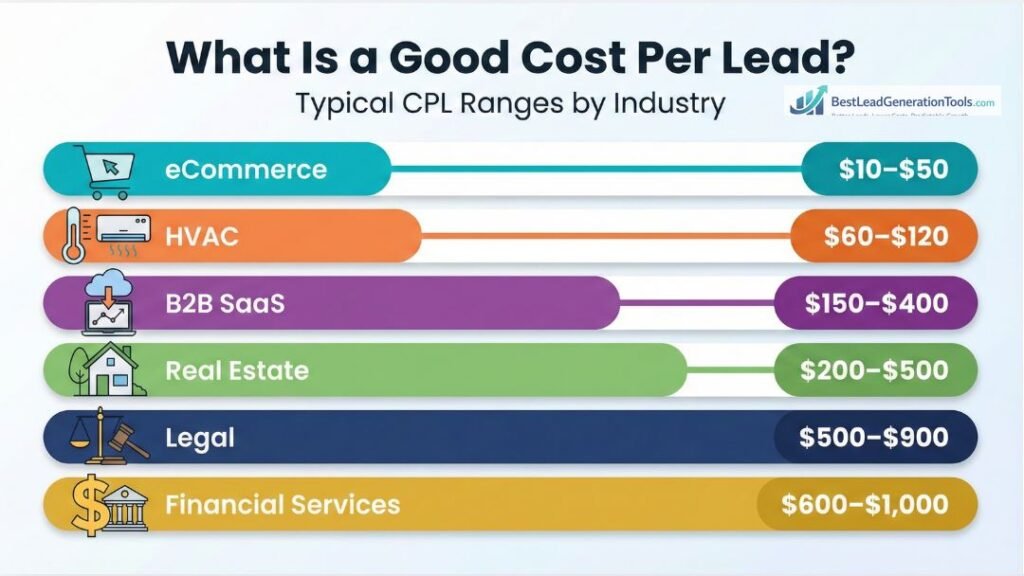
Average Cost Per Lead by Industry
Understanding the average cost per lead (CPL) helps you set realistic marketing budgets and measure efficiency across channels. The price you pay depends heavily on your business model, target audience, and sales cycle. Some industries, such as higher education and financial services, face steep lead costs, while others like eCommerce or HVAC stay much lower.
B2B SaaS and Software
In the B2B SaaS and technology sectors, you often spend more per lead than companies in consumer markets. Generating high-quality leads requires professional outreach, niche content, and demos that attract decision-makers. According to First Page Sage, the average CPL for B2B SaaS is about $310 for paid campaigns and $164 for organic, resulting in a $237 blended average.
Paid search and LinkedIn ads tend to perform well but come with higher price tags. Organic methods like SEO and thought leadership often provide lower-cost leads that convert better over time. You can lower CPL by aligning marketing and sales teams, improving qualification criteria, and refining your outreach toward industries with shorter buying cycles.
Legal and Professional Services
For legal services and other professional firms, expect to pay considerably more for each lead. The average CPL for legal services stands around $649, while business insurance and consulting services follow similar patterns. These high figures reflect the intense competition among firms and the high lifetime value of clients.
Law practices and accountants rely heavily on trust and reputation, so you often spend heavily on establishing credibility through referrals and digital ads. Paid channels such as Google Ads remain effective yet expensive, especially for competitive keywords like “personal injury lawyer” or “tax attorney.” To manage costs, you can use retargeting campaigns, nurture qualified leads with content marketing, and partner with a lead generation agency to filter poor-quality prospects.
Automotive and HVAC
The automotive and HVAC industries tend to enjoy lower lead costs thanks to strong local demand and repeat sales potential. Based on average CPL by industry, automotive leads cost roughly $283, while HVAC leads average $92.
Both industries benefit from local search visibility and seasonal promotions. Customers often look for quick quotes, so response time directly affects conversion rates. Building a solid online reputation through reviews and consistent local SEO can boost your organic leads and reduce your dependency on paid ads. You can also consider referral programs and simple text-based outreach to keep lead costs predictable during busy periods.
Healthcare, Finance, and Other Sectors
In healthcare and finance, lead costs reflect both regulation and customer value. According to the First Page Sage 2025 report, healthcare averages $361 per lead, while financial services climb to $653. These industries require strict compliance and trust, which increases costs of acquisition.
Paid channels like display ads or PPC work, but many organizations see better ROI from organic strategies such as detailed educational content, email newsletters, and partnerships with professional associations. If you operate in regulated sectors, you should invest in strong data privacy practices and credibility signals to maintain lead quality over time.
Realtors
The real estate industry sits near the middle range for CPL. On average, real estate leads cost about $448, varying by market size and listing quality. Realtors face rising ad competition, especially within social media and property platforms.
You can lower your CPL by leveraging local SEO, maintaining updated profiles on major listing sites, and using automated workflows to respond to inquiries quickly. Organic visibility through neighborhood guides, video tours, and client testimonials helps increase conversions. In competitive regions, combining paid ads for immediate exposure with ongoing organic campaigns can keep your lead generation pipeline strong while maintaining a balanced marketing spend.
Optimizing Your Lead Generation Costs
You can reduce spending and improve performance by focusing on where leads come from, the quality of those leads, and how well your tools manage data. Effective tracking, testing, and refinement make every dollar of your marketing budget work harder.
Assessing Lead Generation Channels
Start by analyzing which lead generation channels bring you the highest conversion rates. Track results from organic lead generation methods like SEO, content marketing, and email marketing, as well as paid methods such as PPC and social media ads. Compare each channel’s cost per lead (CPL) and return on investment (ROI).
Use a simple table like this to guide decisions:
| Channel | Avg. CPL | Conversion Rate | ROI Trend |
|---|---|---|---|
| Organic (SEO/Blog) | Low | Moderate | High |
| PPC/Display Ads | Medium | High | Medium |
| Email Campaigns | Low | High | High |
| Affiliate Programs | High | Variable | Variable |
Review metrics monthly. Shift more budget toward channels that deliver quality prospects efficiently. For example, optimizing landing pages and ad targeting can significantly reduce paid campaign costs.
Improving Lead Quality and Qualification
High-quality leads increase conversion rates and lower acquisition costs over time. Focus on refining lead generation strategies that filter out low-intent contacts early. Apply lead scoring to rank prospects by engagement level, demographic fit, and buying intent.
Use A/B testing to improve forms, calls-to-action, and email campaigns. When you optimize landing page content and test multiple versions, you can cut underperforming elements and reallocate ad spend. Marketing experts suggest refining lead qualification and nurturing processes to make each lead more valuable before passing them to sales.
Lead nurturing through personalized email sequences also boosts ROI. A well-timed follow-up often converts more effectively than increasing ad volume. Always measure results using analytics dashboards connected to your sales data.
Leveraging Data and CRM Tools
Accurate data and strong systems help you maintain control of costs. Integrating a CRM platform allows you to track leads from initial contact to closed deal, ensuring that marketing and sales teams act on consistent information.
Modern CRMs support automation for lead nurturing, data enrichment, and campaign tracking. They also help identify patterns showing which marketing tactics—such as content creation or targeted email marketing—drive the highest-quality leads. Businesses should consider the indirect costs of tools and personnel when comparing pricing models.
Keep records clean by removing duplicates and outdated contacts. Use segmentation to send relevant messages and improve conversion rates. Over time, analyzing CRM insights ensures that your lead generation budget supports channels and strategies that consistently produce measurable results.
Maximizing ROI and Setting a Profitable Lead Budget
You increase profit from lead generation by measuring what drives returns, aligning expenses with performance, and adjusting your marketing spend to favor high-converting channels. Paying attention to cost per lead, conversion rate, and customer lifetime value helps you set a marketing budget that balances growth and efficiency.
Measuring Return on Investment
To understand if your lead campaigns deliver value, calculate ROI using the basic formula:
| Metric | Formula | Purpose |
|---|---|---|
| ROI | (Revenue – Total Marketing Cost) ÷ Total Marketing Cost × 100 | Measures profitability |
| Customer Acquisition Cost (CAC) | Total Marketing Spend ÷ New Customers Gained | Tracks efficiency |
| Cost per Lead (CPL) | Total Spend ÷ Number of Leads | Evaluates lead efficiency |
You can refine your analysis by comparing the cost per acquisition and the average revenue per customer. A good ROI means your leads generate more revenue than your total marketing cost.
Tracking performance by channel—such as email, paid ads, or social—helps identify strong and weak points. Understanding which lead channels bring the best returns allows you to focus your budget on what truly works.
Balancing Lead Volume With Marketing Spend
Getting more leads doesn’t always mean getting better leads. It’s often more profitable to invest in fewer, high-quality leads that convert. Assess how each campaign affects your lead volume and conversion rate.
Use the cost per lead (CPL) and ROI together to find your balance point. For example, 50 high-intent leads from LinkedIn ads may outperform 300 lower-quality leads from generic email lists. Paying attention to different lead generation pricing models helps you align cost with expected performance.
When outsourcing lead generation to an agency, request transparency about how your budget converts into real opportunities. Consistent performance reviews keep your marketing costs in control and your profits predictable.
Strategies for Sustainable Lead Acquisition
You build long-term growth by mixing inbound and outbound efforts that scale efficiently. Inbound channels like content marketing and SEO deliver lower-cost leads over time but may grow slowly. Outbound methods like cold outreach or paid ads provide faster results yet cost more upfront.
To sustain ROI, test both approaches and automate repetitive marketing tasks to reduce total labor cost. As Forbes explains, cost-effective lead generation often relies on creativity and efficient resource use.
If you choose to work with a lead generation agency, set expectations for performance metrics such as qualified appointment rate and conversion rate. Regularly review those benchmarks to ensure your marketing efforts keep delivering profitable returns over time.