
Inbound vs Outbound Lead Generation: Key Differences + Best Strategy
Most businesses don’t struggle with generating leads because of a lack of tools or tactics—they struggle because they choose the wrong approach.
At the center of this decision is a fundamental distinction: inbound vs outbound lead generation.
Inbound focuses on attracting potential customers through value and intent, while outbound focuses on proactively reaching out to prospects. Both can work—but they operate very differently, produce different types of leads, and require different expectations.
In this guide, you’ll learn not just the differences between inbound and outbound lead generation, but how to choose the right approach based on your goals, timeline, and business model.
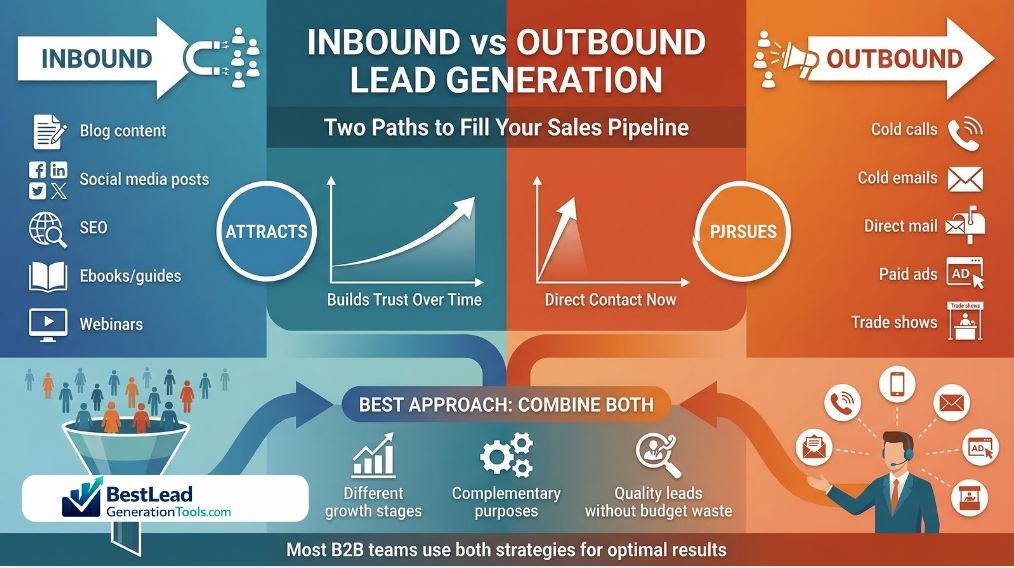
What Is the Difference Between Inbound and Outbound Lead Generation?
The difference between inbound and outbound lead generation comes down to how prospects enter your pipeline.
Inbound lead generation attracts potential customers by creating valuable content and experiences that they actively seek out. Prospects discover your business through channels like search engines, blog content, or social media, and they choose to engage when they are already interested in solving a problem.
Outbound lead generation, on the other hand, involves proactively reaching out to potential customers who may not yet be looking for your solution. This includes methods like cold email, cold calling, paid ads, and direct outreach, where you initiate the conversation rather than waiting for interest.
Key Differences at a Glance
- Inbound = Pull strategy (customers come to you)
- Outbound = Push strategy (you go to the customer)
- Inbound = Intent-driven (higher initial interest)
- Outbound = Interruption-based (creates awareness)
- Inbound = Long-term growth (compounding results)
- Outbound = Short-term results (immediate pipeline)
In simple terms, inbound captures existing demand, while outbound helps create it. Most effective lead generation systems use both approaches together to balance long-term growth with immediate results.
What Is Inbound Lead Generation?
Inbound lead generation attracts potential customers to your business through valuable content and organic channels rather than interrupting them with direct outreach. This approach focuses on creating resources people are already searching for and capturing their information when they engage with your brand.
Definition and Core Concept
Inbound lead generation is the process of attracting leads to you through content marketing, search engine optimization, and other organic methods. You create educational materials that answer your prospects’ questions and solve their problems. When someone finds your content helpful, they provide their contact information in exchange for more value.
This strategy works because you’re meeting potential customers where they already are in their buying journey. Instead of cold calling or sending unsolicited emails, you build trust by providing useful information first. The prospect initiates contact with your business, which typically leads to higher-quality leads who are more interested in what you offer.
Common Inbound Channels
Your inbound efforts can take many forms across different platforms. SEO and content marketing involve creating blog posts, guides, and videos that rank on search engines for terms your buyers use. Social media marketing on platforms like LinkedIn helps you share thought leadership content and engage with your target audience organically.
Webinars and virtual events allow you to demonstrate expertise while capturing attendee information. Email newsletters keep prospects engaged over time with valuable insights. Lead magnets like templates, calculators, and industry reports give people a reason to share their contact details.
You can also leverage customer reviews and case studies as social proof that attracts new leads. Referral programs turn your existing customers into inbound lead sources.
Key Characteristics
Inbound lead generation typically takes 3 to 6 months to gain meaningful traction, but results compound over time. Once your content ranks or gains visibility, it continues generating leads without additional spending per lead. Your cost per lead decreases as your content library grows.
The quality of inbound leads tends to be higher because they’ve already shown interest by finding and engaging with your content. These prospects are often further along in their research process. However, you have limited control over who finds you and when they discover your business.
This approach requires consistency. If you stop creating content, your lead flow will eventually decline. Competition for attention and search rankings can be intense in crowded markets.
What Is Outbound Lead Generation?
Outbound lead generation involves directly reaching out to potential customers who may not be actively searching for your product or service. You take the initiative to start conversations and create demand rather than waiting for prospects to find you.
Definition and Core Concept
Outbound lead generation is a proactive sales approach where you identify and contact potential customers directly. Your team initiates the conversation through various channels to introduce your business and spark interest.
This strategy is often called push marketing because you’re pushing your message to a targeted audience. You don’t wait for buyers to discover you. Instead, you research companies that fit your ideal customer profile and reach out with personalized messages.
The core concept centers on control and speed. You decide which accounts to target, when to contact them, and how often to follow up. This gives you predictable lead flow but requires more hands-on effort from your sales team.
Common Outbound Channels
You can reach prospects through multiple outbound channels. Cold email campaigns remain one of the most popular methods, allowing you to send personalized messages at scale to decision-makers.
Cold calling lets you have direct conversations with prospects by phone. While many consider it challenging, it can open doors quickly when done with a consultative approach.
LinkedIn outreach has become essential for B2B companies. You can use tools like Sales Navigator to find prospects, engage with their content, and send connection requests with personalized messages.
Targeted advertising on platforms like LinkedIn or Google puts your message in front of specific job titles or companies. Account-based marketing (ABM) takes targeting further by treating high-value accounts as individual markets with highly customized campaigns.
Key Characteristics
Outbound leads typically cost more per contact than inbound methods. You’re paying for your team’s time, tools, and advertising spend with each outreach attempt. The cost structure remains fairly consistent as you scale.
You get faster initial results with outbound compared to content-based strategies. Your team can start generating conversations within days or weeks rather than waiting months for SEO results.
Your prospects often have lower initial intent since they weren’t actively searching for solutions. You’re creating demand and awareness rather than responding to existing interest. This means you need stronger qualification processes to identify which contacts are worth pursuing.
The success of your outbound efforts depends heavily on execution quality. Poorly written emails or generic scripts will get ignored, while personalized, value-focused outreach can generate meaningful conversations.
Inbound vs Outbound Lead Generation: Key Differences Explained
Both approaches can fill your pipeline, but they work in fundamentally different ways. Understanding how they compare across key business factors helps you decide where to invest your time and budget.
Dimensions to Compare
When you look at inbound versus outbound lead generation, several critical factors separate them. Speed matters most if you need quick results. Inbound takes 3-6 months to gain traction while outbound can book meetings within weeks.
Cost structure differs too. Inbound requires upfront investment in content and SEO but gets cheaper per lead over time. Outbound costs stay consistent since you pay for tools, data, and team effort on each campaign.
Control is another key difference. With outbound, you choose exactly who sees your message and when. Inbound depends on search algorithms and whether prospects find your content.
| Factor | Inbound | Outbound |
|---|---|---|
| Speed | 3-6 months | Days to weeks |
| Cost Over Time | Decreases | Stays consistent |
| Targeting Control | Limited | Full control |
| Scalability | High once established | Requires ongoing effort |
| Lead Intent | Higher (self-selected) | Lower (cold contact) |
Your choice depends on whether you need immediate pipeline or long-term growth assets.
Inbound vs Outbound Lead Generation: Which Produces Better Leads?
Lead quality differs sharply between inbound and outbound approaches. Inbound leads typically close at about 14.6% versus roughly 1.7% for traditional outbound-sourced leads, showing a clear advantage in conversion rates.
Over 80% of B2B marketers report that inbound leads are higher quality. This happens because inbound prospects arrive with existing intent—they’re already researching solutions and have chosen to engage with your content.
Outbound methods can yield quicker results through direct outreach, but they require careful execution to avoid attracting lower-quality leads. When you reach out cold, prospects haven’t signaled interest yet.
Key quality differences:
| Factor | Inbound | Outbound |
|---|---|---|
| Buyer Intent | High—actively searching | Low to medium—unaware or not ready |
| Close Rate | ~14.6% | ~1.7% |
| Sales Cycle | Often shorter | Can be longer |
| Lead Education | Self-educated through content | Requires more nurturing |
The gap in quality comes down to timing and context. Inbound prospects have already consumed content and understand your value proposition before they contact you. Outbound leads need more education and relationship building.
However, quality also depends on your execution. Poor inbound content attracts unqualified visitors, while highly targeted outbound can reach decision-makers who simply weren’t searching yet. Your targeting strategy, messaging relevance, and follow-up speed all impact the final quality of leads from either channel.
Inbound vs Outbound Lead Generation Cost: Which Has Better ROI?
The cost structure of inbound and outbound lead generation differs significantly. Outbound campaigns require higher upfront spending on ads, cold outreach tools, and contact databases. These costs continue as long as you run campaigns.
Inbound marketing involves lower initial costs but requires time and resources to build assets. You’ll invest in content creation, SEO tools, and website optimization. These assets continue generating leads without ongoing ad spend.
Short-Term Economics:
- Outbound: Delivers faster results but stops when budget ends
- Inbound: Takes 3-7 months to gain traction
- Outbound: Higher cost per lead initially
- Inbound: Lower immediate lead volume
Long-Term Economics:
- Inbound: Creates compounding returns over time
- Outbound: Requires consistent spending to maintain results
- Inbound: Builds evergreen content that attracts leads for years
- Outbound: Produces temporary visibility with each campaign
Research shows that inbound marketing delivers higher ROI over time due to lower costs and better-qualified leads. Nearly 50% of companies using inbound see sales increases within seven months.
Outbound lead campaigns tend to be more expensive in the short term due to contact methods and shorter campaign durations. However, they provide immediate pipeline fill when you need quick results.
The best approach combines both strategies. Use outbound to fill short-term pipeline gaps while building inbound assets for sustainable long-term growth.
When Should You Use Inbound Lead Generation?
Inbound lead generation works best when your buyers actively research solutions online before making a purchase decision. This approach makes sense when you can invest 3-6 months before seeing significant results.
You should choose inbound when your sales cycles are longer and prospects need time to educate themselves. B2B buyers typically want to read content and compare options before talking to sales reps. In fact, 80% of business decision-makers prefer reading articles over receiving ads.
Inbound is the right choice when:
- Your product has a lower price point (under $5,000 annually)
- You can wait several months to build pipeline momentum
- Your target audience searches for solutions on Google
- You have budget for content creation and SEO
- You want to reduce your cost per lead over time
The economics favor inbound for products with lower contract values. Companies with inbound strategies see leads that cost 62% less than outbound methods. If your average deal is $200 per month, spending $188 per outbound lead doesn’t make financial sense.
You should also lean into inbound when you need to build long-term brand awareness. SEO-optimized content compounds in value over time. Businesses that publish regular blog content report 55% more website visitors compared to those that don’t.
The compounding effect becomes visible around month four. Your organic traffic can grow 18-25% month-over-month once you maintain a consistent publishing schedule. This makes inbound ideal when you’re playing the long game rather than filling immediate pipeline gaps.
When Should You Use Outbound Lead Generation?
Outbound lead generation works best when you need to fill your pipeline quickly. If your sales team needs meetings this month, not six months from now, outbound gives you that speed.
You should use outbound when you know exactly who your ideal customer is. This approach lets you target specific companies, job titles, and industries. You control who sees your message and when they see it.
Outbound is particularly effective for:
- New product launches that need market validation
- Breaking into new industries or markets
- Targeting enterprise accounts with long sales cycles
- Companies that need predictable revenue growth
- Businesses selling high-ticket B2B products or services
Startups often benefit from outbound because they can’t wait months for organic traffic to build. You need customers now to prove your concept and generate revenue.
Outbound also makes sense when your ideal customers aren’t actively searching for solutions. Sometimes decision-makers don’t realize they have a problem until you show them. This is especially true for innovative products or services that solve problems in new ways.
Use outbound when you’re selling to a narrow market. If your total addressable market is only a few hundred companies, targeted outbound campaigns deliver better results than waiting for them to find you.
The key is having a clear ideal customer profile. Without it, your outbound efforts waste time and money reaching the wrong people.
Inbound vs Outbound Lead Generation: Should You Use Both?
You don’t have to choose between inbound and outbound lead generation. The most successful companies use both strategies together.
A hybrid approach that merges both strategies often produces the best outcomes. This combined method lets you leverage the strengths of each approach while covering their weaknesses.
Here’s why you need both:
- Inbound builds long-term trust through valuable content and SEO while outbound generates immediate pipeline through direct outreach
- Inbound attracts interested prospects who are already searching for solutions while outbound targets specific accounts you want to reach
- Inbound costs less over time as content continues working while outbound gives you control over who you contact and when
Companies that use both strategies see real results. B2B teams that do both achieve 2x higher revenue compared to those relying on just one method.
Think of it this way: inbound creates awareness and attracts leads organically. Outbound fills gaps by reaching prospects who haven’t found you yet. Together, they create a complete lead generation system.
You can start by using outbound to get quick wins and immediate meetings. At the same time, build your inbound foundation with content and SEO for sustainable growth. Your outbound efforts can amplify your inbound content by sharing valuable resources during cold outreach.
The key is balancing both based on your goals, resources, and timeline. You’ll build a stronger pipeline when you stop debating which approach is better and start using them together.
Inbound vs Outbound Lead Generation Mistakes to Avoid
Many B2B teams fall into the trap of thinking they must choose one approach over the other. This either-or mentality limits your pipeline potential and leaves money on the table.
Treating All Leads the Same
You can’t use identical sales processes for both lead types. Inbound leads typically arrive further along in their buyer journey with existing interest in your solution. Outbound leads need more education and nurturing since they’re just learning about their problem.
Ignoring Speed for Inbound Responses
Responding within 5 minutes can increase your conversion chances significantly. Yet 41% of companies struggle with quick follow-up. When prospects raise their hand through inbound channels, delayed responses send them straight to competitors.
Choosing Based on Cost Alone
Inbound leads often cost 60% less than outbound leads. But outbound frequently generates larger deals and gives you control over targeting high-value accounts. The cheapest option isn’t always the most profitable.
Running Single-Channel Campaigns
Multi-channel outreach combining email, LinkedIn, and calls drives over 40% higher responses than email alone. Relying on just one channel severely limits your reach and effectiveness.
Skipping the Hybrid Approach
Companies using both inbound and outbound strategies see 2× faster revenue growth compared to single-strategy firms. Your market contains both active searchers and passive prospects who aren’t looking yet. You need different tactics to capture each group effectively.
Inbound vs Outbound Lead Generation: How to Choose the Right Strategy
Your business stage, sales cycle length, and immediate revenue needs determine whether inbound or outbound lead generation fits your situation. Budget constraints and target market characteristics also play major roles in this decision.
Factors
Start by evaluating your timeline for results. If you need leads within the next 30 days, outbound methods like cold email and paid ads deliver faster. Inbound approaches require 6-12 months before generating consistent lead flow.
Consider your available budget and how you want to allocate it. Outbound typically costs $50-$500 per lead with consistent expenses each month. Inbound lead generation starts at $200-$500 per lead in year one but drops to $30-$100 per lead by year three as content compounds.
Look at your target audience size and how defined it is. When you can identify specific companies or decision-makers, outbound lets you reach them directly. Broader markets where buyers research extensively before purchasing favor inbound content strategies.
Your sales cycle length matters too. Complex B2B sales with long research phases benefit from inbound content that educates prospects over time. Shorter sales cycles with immediate needs work well with outbound outreach that creates quick conversations.
How Inbound and Outbound Lead Generation Work Together in a System
Inbound and outbound don’t compete with each other. They work together as parts of a complete lead generation system.
Think of inbound as your long-term foundation. It builds trust and brings prospects to you through content, SEO, and organic channels. These leads come in warmer because they found you while searching for solutions.
Outbound fills immediate gaps in your pipeline. You reach out directly to prospects through cold email, LinkedIn messages, and calls. This gives you control over who you contact and when.
Here’s how they complement each other:
- Inbound creates awareness and credibility in your market
- Outbound turns that awareness into active conversations
- Inbound nurtures prospects who aren’t ready to buy yet
- Outbound accelerates deals with prospects who match your ideal customer profile
The best B2B lead generation strategies combine both approaches to create predictable revenue. Your content marketing attracts visitors to your website. Your outbound team reaches out to those who engaged but didn’t convert.
Your system should include:
| Inbound Activities | Outbound Activities |
|---|---|
| Blog posts and SEO | Cold email campaigns |
| Social media content | LinkedIn outreach |
| Lead magnets | Phone calls |
| Email nurture sequences | Direct mail |
You can use inbound to warm up your outbound prospects. When someone sees your content before receiving your outreach, response rates improve. Combining both creates a multiplier effect that fills your pipeline faster than either method alone.
Conclusion
You don’t have to choose between inbound and outbound lead generation. The most successful B2B companies use both methods together.
Outbound lead generation gives you speed and control. You can start conversations with your ideal customers right away. This approach lets you target specific accounts and decision-makers who match your buyer profile.
Inbound lead generation builds trust over time. It attracts prospects who are already looking for solutions like yours. These leads often convert better because they come to you with genuine interest.
The hybrid approach works best because:
- Outbound fills your pipeline quickly when you need immediate results
- Inbound creates a steady flow of qualified leads over time
- Together they balance short-term revenue goals with long-term growth
- Each method strengthens the other
Your choice depends on where your business is right now. Startups often need outbound to get their first customers fast. Established companies can invest more in inbound for sustainable growth.
The key is understanding the strengths and weaknesses of both approaches. Then you can build a strategy that fits your budget, timeline, and goals.
Start by testing both methods on a small scale. Track which approach brings you better quality leads and higher conversion rates. Use that data to adjust your mix over time. Your lead generation strategy should grow and change with your business.
Frequently Asked Questions
What is the main difference between inbound and outbound lead generation?
The main difference is how leads are acquired. Inbound lead generation attracts prospects through content and organic channels when they are actively searching for solutions, while outbound lead generation involves proactively reaching out to potential customers through methods like cold email, calls, or ads.
Which is better: inbound or outbound lead generation?
Neither is universally better – it depends on your goals. Inbound is better for long-term growth and higher-quality leads, while outbound is better for generating quick results and targeting specific prospects. Most businesses benefit from using a combination of both.
Is inbound lead generation cheaper than outbound?
Inbound lead generation typically becomes cheaper over time because content continues generating leads without additional cost per click. Outbound lead generation often has higher ongoing costs since it requires continuous spending on ads, tools, or outreach efforts.
Why are inbound leads considered higher quality?
Inbound leads are often higher quality because they come from prospects who are actively searching for solutions and have already shown interest in your content. This means they are usually more informed and closer to making a purchasing decision.
When should a business use outbound lead generation?
A business should use outbound lead generation when it needs leads quickly, wants to target specific companies or decision-makers, or is launching a new product and needs immediate market feedback.
Can inbound and outbound lead generation work together?
Yes, inbound and outbound lead generation work best when combined. Inbound builds trust and attracts interested prospects, while outbound helps reach new audiences and accelerate pipeline growth. Together, they create a balanced and scalable lead generation system.