
B2B vs B2C Lead Generation: Key Differences Explained Simply
Most businesses struggle with lead generation for one simple reason: they are using the wrong model.
What works in B2C can completely fail in B2B. And what works in B2B can feel slow, expensive, and ineffective in a B2C environment. The strategies, funnels, and even the way leads are nurtured are fundamentally different.
If you do not understand these structural differences, you can waste time, budget, and effort on approaches that were never designed for your type of business.
In this guide, you will see exactly how B2B vs B2C lead generation works, where they differ, and how to choose the right approach.
B2B vs B2C Lead Generation in One Sentence:
B2B focuses on fewer, higher-value leads with longer sales cycles, while B2C focuses on high-volume, faster conversions driven by emotion and convenience.
Once you understand whether you are operating in a B2B or B2C model, choosing the right tools becomes much easier.
You can explore the best B2B lead generation tools or the best lead generation tools for small business depending on your approach.
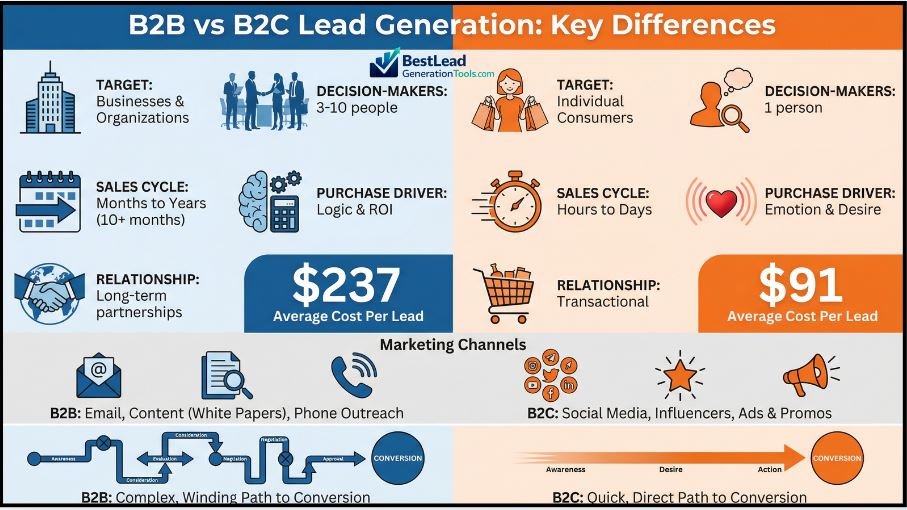
What Is The Difference Between B2B And B2C Lead Generation
B2B and B2C lead generation differ primarily in how buying decisions are made and how long those decisions take.
In B2B lead generation, you are targeting businesses rather than individuals. These decisions often involve multiple stakeholders, require more information, and take longer to finalize. As a result, the process is built around educating prospects, building trust over time, and guiding leads through a structured funnel.
In B2C lead generation, you are targeting individual consumers. Decisions are typically faster, more emotional, and involve fewer steps. Instead of long nurturing sequences, the focus is on capturing attention quickly, reducing friction, and converting leads as efficiently as possible.
Because of these differences, the entire structure of lead generation changes, from the channels you use to the way your funnel is designed.
Understanding this distinction makes every other part of lead generation easier to get right.
Why The Structure Of Lead Generation Changes Between B2B And B2C
The structure of lead generation changes because the way people make buying decisions changes.
At a surface level, B2B and B2C may look similar. In both cases, you are attracting attention, generating interest, and converting that interest into a lead. But the process behind those actions is fundamentally different.
The key difference comes down to three factors: risk, complexity, and decision ownership.
In B2B, purchases typically involve higher costs, greater perceived risk, and multiple stakeholders. Because of this, buyers need more information, more reassurance, and more time before they commit to a decision.
This naturally leads to a more structured approach to lead generation, where the goal is to guide prospects through a series of steps. Each interaction is designed to build trust, reduce uncertainty, and move the buyer closer to a confident decision.
In B2C, the decision process is much simpler. The buyer is usually an individual, the financial risk is lower, and the decision is often influenced by emotion as much as logic.
Because of this, lead generation shifts toward speed and simplicity. Instead of guiding the buyer through multiple stages, the focus is on capturing attention, presenting a clear offer, and converting quickly while interest is high.
These differences in decision-making shape everything else, including:
- How your funnel is structured
- Which channels you use
- How you measure success
- The tools required to support your strategy
Once you understand how decision-making changes between B2B and B2C, the rest of the lead generation process becomes much easier to design and optimize.
In short, B2B lead generation is built for careful, multi-step decisions, while B2C lead generation is built for fast, individual decisions.
B2B vs B2C Lead Generation: Side By Side Comparison
B2B and B2C lead generation follow completely different structures because buying behavior is fundamentally different.
| Factor | B2B Lead Generation | B2C Lead Generation |
|---|---|---|
| Sales Cycle | Long and multi-step | Short and fast |
| Decision Makers | Multiple stakeholders | Individual or small group |
| Lead Value | High | Lower |
| Lead Volume | Lower volume, higher quality | High volume |
| Buying Motivation | Logic, ROI, long-term value | Emotion, desire, convenience |
| Content Type | In-depth, educational | Short, engaging, visual |
| Funnel Complexity | Multi-step, structured | Simple, direct |
| Channels | LinkedIn, email, SEO | Social media, ads, influencers |
| Nurturing | Extensive follow-up required | Minimal to moderate |
At a high level, B2B lead generation is designed to build trust over time, while B2C lead generation is designed to convert quickly.
Key Structural Differences In B2B Lead Generation
B2B lead generation is built around one core reality: decisions take time and involve multiple people.
Because of this, the entire system is designed to educate, build trust, and guide prospects through a structured process rather than push for immediate conversion.
Longer Sales Cycles Require Lead Nurturing Systems
B2B buyers rarely convert after a single interaction.
They need time to evaluate options, compare solutions, and justify decisions internally. This makes lead nurturing essential.
Effective B2B systems rely on:
- Email sequences
- Retargeting
- Ongoing content
The goal is to stay visible and build trust until the prospect is ready to move forward.
Multiple Decision Makers Change Targeting Strategy
In B2B, you are not selling to one person. You are selling to a group of people who each play a different role in the decision.
A typical buying decision may involve:
- A decision maker who approves the purchase
- A financial stakeholder who evaluates cost
- End users who care about usability and outcomes
Each of these people has different priorities and concerns.
This changes how lead generation works.
Instead of focusing on a single message, your strategy needs to address multiple perspectives. One piece of content may need to demonstrate ROI, while another builds trust or explains how the product solves a specific problem.
Because of this, B2B lead generation often requires:
- Multiple touchpoints
- Different types of content
- Messaging that evolves over time
The goal is not just to convince one person. It is to align an entire group around the same decision.
Higher Lead Value Justifies More Complex Funnels
B2B leads are typically more valuable, which allows for a more structured and involved funnel.
When a single conversion can represent a significant amount of revenue, it makes sense to invest more time and effort into each lead.
This changes how the funnel is designed.
Instead of optimizing for speed, the focus shifts to:
- Qualification, to ensure the lead is a good fit
- Education, to help the buyer understand the solution
- Relationship building, to build confidence over time
As a result, B2B funnels often include:
- Multiple content interactions
- Email follow-up sequences
- Retargeting campaigns
Each step is designed to move the lead closer to a confident decision.
Content Plays a Central Role in Trust Building
In B2B, content is not optional. It is a core part of the lead generation system.
Buyers are looking for:
- Clear explanations
- Proof of results
- Confidence in the decision
This is why B2B strategies often rely on:
- Case studies
- Detailed guides
- Webinars
Content builds the trust needed to move prospects through a longer decision process.
Key Structural Differences In B2C Lead Generation
B2C lead generation is built around one core reality: decisions happen quickly and are often driven by emotion.
Because of this, the entire system is designed to capture attention, reduce friction, and convert as fast as possible.
Shorter Sales Cycles Emphasize Speed And Convenience
B2C buyers rarely go through a long evaluation process.
In many cases, the decision happens within minutes or even seconds. If the offer is clear and compelling, the conversion can happen immediately.
This makes speed critical.
Effective B2C systems focus on:
- Fast-loading pages
- Clear offers
- Minimal steps to convert
Any delay or confusion can cause the lead to drop off.
Emotional Triggers Drive Conversions
Unlike B2B, where decisions are primarily logic-driven, B2C decisions are heavily influenced by emotion.
Buyers respond to:
- Desire
- Urgency
- Fear of missing out
This is why messaging often focuses on outcomes, benefits, and immediate value rather than detailed explanations.
High Volume Requires Scalable Traffic Sources
B2C lead generation typically relies on volume.
Because individual lead value is lower, success comes from reaching a large audience and converting a percentage of that traffic.
This requires scalable channels such as:
- Paid advertising
- Social media
- Influencer partnerships
The focus is on consistent traffic flow rather than highly targeted outreach.
Simpler Funnels Convert Better
In B2C, complexity reduces conversions.
The most effective funnels are short and direct:
- Landing page
- Offer
- Conversion
Each additional step creates friction and increases the chance of drop-off.
The goal is to make the path to conversion as simple and obvious as possible.
In short, B2C lead generation is built to convert in the moment, not over time.
Lead Generation Channels: B2B vs B2C
The channels you use for lead generation are shaped by how your audience makes decisions.
B2B and B2C require different approaches because they rely on different types of attention, trust, and timing.
Best Channels For B2B Lead Generation
B2B lead generation works best in environments where you can target specific professionals and build trust over time.
The most effective channels include:
- LinkedIn for direct outreach and relationship building
- Email for consistent follow-up and nurturing
- SEO content for attracting high-intent prospects
- Webinars for education and deeper engagement
These channels support a longer sales cycle by allowing multiple touchpoints with the same prospect.
Because of this, B2B strategies often rely on tools that help you:
- Manage contacts
- Automate follow-up
- Track engagement over time
If you want to scale B2B lead generation effectively, having the right tools in place becomes essential.
See our guide to the top B2B lead generation tools to find the right platforms for your strategy.
Best Channels For B2C Lead Generation
B2C lead generation performs best on platforms where attention is immediate and decisions happen quickly.
The most effective channels include:
- Paid advertising for fast, scalable traffic
- Social media platforms for discovery and engagement
- Influencer marketing for trust and reach
- Search ads for high-intent conversions
These channels are built around speed and volume, allowing you to reach large audiences and convert a percentage of them quickly.
Because of this, B2C strategies often depend on tools that help you:
- Build high-converting landing pages
- Optimize conversions
- Track performance across campaigns
Choosing the right tools can significantly impact how efficiently you turn traffic into leads.
Explore the top lead generation tools for small business to find options that fit your budget and goals.
The difference in channels is exactly why the tools used in B2B and B2C lead generation are often completely different.
Funnel Structure Differences: B2B vs B2C
The biggest difference between B2B and B2C lead generation is not just how long the funnel is. It is how the funnel actually works.
In B2B, the funnel is designed to guide a prospect through a series of steps before a decision is made. In B2C, the funnel is designed to remove steps and convert as quickly as possible.
B2B Funnel Structure
A typical B2B funnel follows a multi-step process:
- Awareness
- Education
- Evaluation
- Decision
At each stage, the goal is to build trust and reduce uncertainty.
Prospects move slowly through the funnel, often interacting with multiple pieces of content, emails, or touchpoints before taking action.
This is why B2B funnels are built around:
- Lead nurturing
- Content depth
- Ongoing communication
The funnel is not just about conversion. It is about progression.
B2C Funnel Structure
A typical B2C funnel is much more compressed:
- Awareness
- Decision
In many cases, these steps happen almost at the same time.
The focus is on:
- Capturing attention quickly
- Presenting a clear offer
- Making it easy to convert immediately
Instead of guiding the user through multiple stages, the goal is to remove friction and shorten the path to conversion.
B2B funnels are designed to guide decisions over time, while B2C funnels are designed to capture decisions in the moment.
These funnel differences are exactly why the tools used in B2B and B2C lead generation are rarely the same.
Metrics That Matter: B2B vs B2C
The metrics that matter in lead generation are shaped by how the funnel works.
Because B2B and B2C follow different structures, they require completely different ways of measuring success.
B2B Metrics
In B2B, success is not about how many leads you generate. It is about the quality of those leads and how they move through the pipeline over time.
Key metrics include:
- Cost per lead (CPL)
Higher is acceptable because each lead has greater potential value. - Lead quality
How well the lead fits your target audience and likelihood to convert. - Pipeline value
The total potential revenue from leads currently in your funnel. - Conversion rate over time
How leads progress from initial contact to final decision across multiple touchpoints.
In B2B, the goal is not speed. It is consistency and long-term conversion.
B2C Metrics
In B2C, success is driven by efficiency, volume, and immediate results.
Key metrics include:
- Cost per acquisition (CPA)
How much it costs to generate a paying customer. - Conversion rate
The percentage of visitors who take action. - Traffic volume
The number of people entering your funnel. - Return on ad spend (ROAS)
How much revenue you generate compared to what you spend on ads.
In B2C, the goal is to convert quickly and scale what works.
These differences in metrics are why the tools used to track and optimize B2B and B2C lead generation are often completely different.
Which Lead Generation Model Is Right For Your Business
Choosing between B2B and B2C lead generation is not about preference. It is about how your audience makes decisions.
The right model depends on three key factors.
Your Customer Type
If you are selling to businesses, you are operating in a B2B environment.
If you are selling directly to individuals, you are operating in a B2C environment.
This may seem obvious, but it is where many mistakes begin. Some businesses try to apply B2C tactics in a B2B setting, or vice versa, and struggle as a result.
Your Product or Service Value
Higher-value offers tend to follow a B2B-style lead generation process.
When the cost is significant, buyers take more time, involve more people, and require more information before making a decision.
Lower-cost offers tend to behave more like B2C.
The lower the financial risk, the more likely the buyer is to make a quick decision without a long evaluation process.
Your Sales Cycle
If your typical sale takes weeks or months, you need a B2B-style approach.
This means:
- Lead nurturing
- Multiple touchpoints
- Ongoing communication
If your sale can happen quickly, often within a single session or interaction, a B2C-style approach is more effective.
This means:
- Clear offers
- Fast conversion paths
- Minimal friction
If your audience needs time, information, and internal approval, you are operating in a B2B model. If your audience makes quick, individual decisions, you are operating in a B2C model.
Once you know which model applies to your business, the next step is choosing the right tools and channels to support it.
For B2B, see the B2B lead generation tools.
For small business and B2C-focused setups, explore the lead generation tools for small business.
Common Mistakes When Applying B2B Strategies To B2C And Vice Versa
Even when businesses understand the difference between B2B and B2C lead generation, they often apply the wrong strategies.
This usually leads to poor results, wasted budget, and unnecessary complexity.
Overcomplicating B2C Funnels
One of the most common mistakes is applying B2B-style funnels to B2C audiences.
Adding too many steps, emails, or decision points creates friction and reduces conversions.
In B2C, simplicity wins.
Expecting Instant Results in B2B
Another mistake is treating B2B like B2C.
Trying to generate immediate conversions without building trust often leads to low-quality leads or no results at all.
In B2B, patience and consistency are essential.
Using the Wrong Messaging Style
B2B messaging is typically logic-driven and detail-focused.
B2C messaging relies more on emotion, speed, and clear outcomes.
Using the wrong style can make your offer feel unconvincing or out of place.
Choosing the Wrong Channels
Some businesses try to use high-volume B2C channels for B2B lead generation, or highly targeted B2B channels for B2C offers.
This mismatch reduces efficiency and makes it harder to reach the right audience.
Best Tools For B2B Lead Generation
B2B lead generation relies on systems, not single actions.
Because the process is longer and more complex, you need tools that help you manage relationships, automate follow-up, and track progress over time.
To see the top platforms for managing outreach, automation, and pipeline tracking, explore the leading B2B lead generation tools.
CRM Tools for Managing Leads and Relationships
In B2B, every lead matters.
A CRM helps you track interactions, organize contacts, and manage your pipeline across multiple touchpoints. Without a structured system in place, it becomes difficult to maintain consistency over a longer sales cycle.
If you want to see which platforms are best suited for managing and scaling your pipeline, explore our guide to the best CRM tools for lead generation.
Email Outreach and Automation Tools
Follow-up is a core part of B2B lead generation.
Email tools allow you to send sequences, stay consistent, and nurture leads over time. This becomes essential when decisions take weeks or even months.
To find the most effective platforms for building and automating your outreach, take a look at our breakdown of the best email marketing software for lead generation.
LinkedIn and Prospecting Tools
B2B lead generation often starts with identifying and reaching the right people.
Prospecting tools help you find decision makers, automate outreach, and build highly targeted lists. These tools make it possible to scale what would otherwise be a slow, manual process.
If you are looking to improve your targeting and outreach efficiency, see our guide to the best B2B prospecting tools.
Analytics and Tracking Tools
Because B2B funnels are longer, you need clear visibility into what is working at each stage.
Analytics tools help you track engagement, measure pipeline performance, and identify bottlenecks so you can improve results over time.
Choosing the right analytics tools can make a significant difference in how effectively you optimize your lead generation process.
B2B lead generation tools are designed to support long-term relationships, not quick conversions.
Best Tools For B2C Lead Generation
B2C lead generation is built around speed, volume, and conversion efficiency.
Because decisions happen quickly, the tools you use must help you capture attention, reduce friction, and convert visitors in as few steps as possible.
If you want tools that help you capture leads quickly and convert traffic efficiently, check out the best tools for small business lead generation.
Landing Page Builders and Funnel Tools
In B2C, the landing page is often where the conversion happens.
These tools help you:
- Create high-converting pages
- Present clear offers
- Guide users toward a single action
Even small improvements in page design can have a significant impact on conversion rates.
If you want to see which platforms are best for building fast, high-converting funnels, explore the best landing page builders for lead generation.
Paid Advertising Platforms and Tools
B2C lead generation relies heavily on paid traffic.
Advertising tools help you:
- Reach large audiences quickly
- Target specific demographics
- Scale campaigns that are performing well
Because volume is key, the ability to test and optimize campaigns efficiently is critical.
To understand which platforms deliver the best results, take a closer look at the best paid traffic sources for lead generation.
Conversion Optimization Tools
In B2C, small changes can lead to large gains.
Conversion optimization tools help you:
- Test variations of your pages
- Improve user experience
- Increase the percentage of visitors who convert
This is especially important when you are driving large amounts of traffic.
If you want to improve your conversion rates, explore the best conversion rate optimization tools.
Analytics and Tracking Tools
When you are working at scale, data becomes essential.
Analytics tools help you:
- Track performance across campaigns
- Identify what is working
- Adjust quickly based on results
Without clear tracking, it becomes difficult to optimize or scale effectively.
Choosing the right analytics setup can make a major difference in your overall results.
B2C lead generation tools are designed to capture attention and convert quickly at scale.
Frequently Asked Questions About B2B vs B2C Lead Generation
What is the main difference between B2B and B2C lead generation
The main difference between B2B and B2C lead generation is how buying decisions are made.
B2B focuses on longer sales cycles, multiple decision makers, and higher-value leads. B2C focuses on faster decisions, individual buyers, and high-volume conversions.
Is B2B lead generation harder than B2C
B2B lead generation is not necessarily harder, but it is more complex.
It requires more time, consistent follow-up, and stronger trust-building. B2C lead generation is simpler in structure but requires higher volume and efficient conversion systems to succeed.
Which is more profitable, B2B or B2C lead generation
Both can be profitable, but they scale differently.
B2B typically generates fewer leads with higher value per deal, while B2C relies on a larger number of lower-value conversions. The best approach depends on your business model and pricing.
Can the same lead generation tools be used for B2B and B2C
Some tools can be used for both, but most are optimized for one model.
B2B tools focus on relationship management, outreach, and lead nurturing, while B2C tools focus on traffic generation, conversion optimization, and speed. Choosing the right tools depends on how your funnel is structured.
If you are comparing platforms, it helps to understand the differences between CRM tools, email marketing software, and landing page builders before making a decision.
How long does B2B lead generation take
B2B lead generation can take weeks or months depending on the complexity of the sale.
Because decisions involve multiple stakeholders and higher risk, leads typically move through several stages before converting. This is why lead nurturing and consistent follow-up are essential.
How quickly can B2C lead generation produce results
B2C lead generation can produce results quickly, sometimes within minutes or hours.
If the offer is clear and the funnel is optimized, users can move from initial contact to conversion in a single session. This makes speed and simplicity critical for success.
What are the best channels for B2B vs B2C lead generation
B2B lead generation works best with channels like LinkedIn, email outreach, and SEO content.
B2C lead generation performs better with paid ads, social media, and influencer marketing. The effectiveness of each channel depends on how your audience prefers to discover and evaluate offers.
How do I know if my business is B2B or B2C
If you are selling to businesses, you are operating in a B2B model. If you are selling directly to individuals, you are operating in a B2C model.
You can learn more about how to choose the right approach in the section above on selecting the best lead generation model for your business.