
Most websites don’t have a traffic problem.
They have a conversion problem.
Visitors arrive, browse for a few seconds, and leave without taking action. No email signup, no inquiry, no sale.
The reason is often simple. There’s no structured system guiding them from curiosity to commitment.
A lead generation funnel solves this. It turns scattered traffic into a more predictable flow of qualified prospects and gives your marketing a clear, repeatable path from attracting attention to generating customers.
Once you understand how a lead generation funnel works, you can begin to see where your current strategy is breaking down and what you can do to improve it.
Quick Answer: What Is a Lead Generation Funnel?
A lead generation funnel is a structured process that attracts potential customers, captures their interest, nurtures and qualifies them, and moves the strongest prospects toward taking action.
At the top of the funnel, you attract people who are becoming aware of a problem or need. In the middle, interested prospects engage more deeply as they evaluate possible solutions. At the bottom, qualified prospects decide whether to take the next step, such as requesting a demo, starting a trial, scheduling a consultation, or making a purchase.
The goal is not simply to generate more leads. It is to create a repeatable system for generating the right leads and moving them toward conversion.
What Is a Lead Generation Funnel?
If your website is getting traffic but not producing leads, the problem may not be visibility. It may be structure.
A lead generation funnel is the system that guides visitors from their first interaction with your business to the point where they become qualified prospects and, ultimately, customers.
Instead of leaving that process to chance, the funnel creates logical next steps based on what prospects know, what they need, and how much interest they have demonstrated.
At the top, your goal is to attract relevant prospects and build awareness.
As prospects move into the middle, your goal shifts toward capturing interest, building trust, nurturing the relationship, and helping them evaluate possible solutions.
At the bottom, the focus turns to qualified prospects who are close to making a decision. Your job is to remove uncertainty and make the next step clear.
When these stages work together, your marketing becomes a process rather than a collection of disconnected tactics.
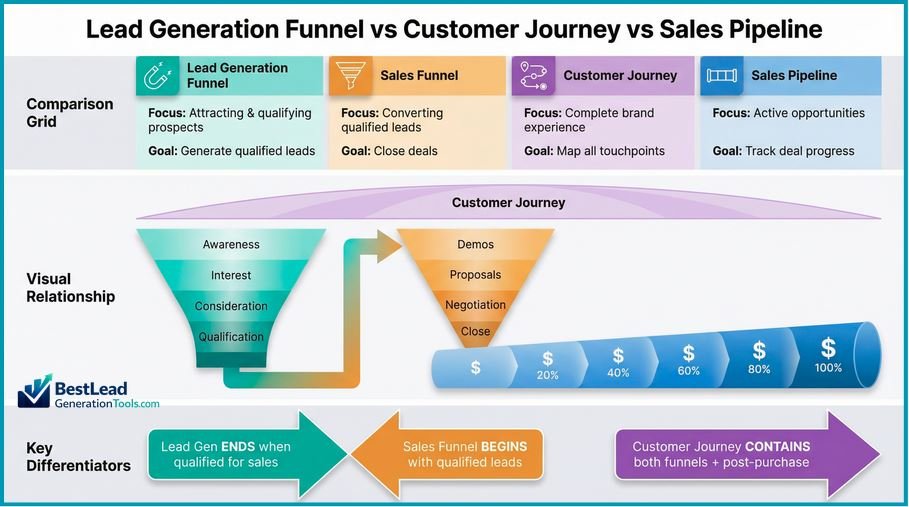
Lead Generation Funnel vs Customer Journey vs Sales Pipeline
These terms are often used interchangeably, but they represent different parts of the overall customer acquisition process.
The lead generation funnel focuses on attracting prospects and moving them toward becoming qualified opportunities.
The sales funnel focuses more directly on converting qualified prospects into customers through activities such as demos, proposals, consultations, and sales conversations.
The customer journey is broader than either funnel. It includes every interaction someone has with your business, from first discovering your brand through purchasing and the post-purchase experience.
The sales pipeline is typically used by the sales team to track active opportunities. It shows where individual deals stand and how close they may be to closing.
Understanding these distinctions helps you see how the pieces fit together. Your lead generation funnel creates and develops opportunities, your sales process converts them, and both operate within the larger customer journey.
| Term | Primary Focus | Key Goal |
|---|---|---|
| Lead Generation Funnel | Attracting, nurturing, and qualifying prospects | Generate qualified opportunities |
| Sales Funnel | Converting qualified prospects | Close deals |
| Customer Journey | Complete customer experience | Understand all touchpoints |
| Sales Pipeline | Active sales opportunities | Track deal progress |
A funnel also works best when it is connected to the rest of your marketing rather than treated as an isolated tactic. Our guide to building a lead generation system explains how the different processes and tools can work together.
Why Lead Generation Funnels Matter for Business Growth
Without a clear funnel, marketing can feel unpredictable.
You may get traffic, but it does not turn into leads. You may generate leads, but they do not become customers. Results come and go, and it becomes difficult to understand what is working and what is not.
This is where many businesses get stuck. They are putting in effort but are not seeing consistent outcomes.
A lead generation funnel gives your marketing structure, visibility, and direction. Instead of relying on chance, you create a system that guides people from first contact toward meaningful action.
When that system is working, growth becomes easier to understand and easier to improve.
How Funnels Create Predictable Lead Flow
A funnel shows you how people move through your marketing.
You can see where they enter, what they engage with, which actions they take, and where they drop off.
This visibility allows you to connect marketing activity to actual results. You are no longer simply guessing which campaigns are working or which prospects are worth pursuing.
Over time, patterns begin to emerge.
You may discover that certain topics consistently attract engaged visitors. One lead magnet may convert far better than another. Prospects from one traffic source may become customers at a higher rate than prospects from another.
With enough data, you can begin to forecast outcomes. If a certain amount of qualified traffic consistently produces a certain number of leads and customers, you can plan your marketing with greater confidence.
Instead of relying on occasional spikes, you begin building a more predictable flow of qualified prospects.
The Role of Funnels in Scalable Marketing Systems
As your funnel improves, your marketing becomes more efficient.
You are not simply generating more leads. You are becoming better at identifying and developing the leads that matter.
Segmentation allows you to group people based on characteristics, behavior, and interests. This makes your messaging more relevant.
Automation can handle repetitive activities such as follow-up, nurturing, and lead scoring. Leads receive information based on what they have done without requiring every interaction to be handled manually.
This combination of structure, data, and automation allows a funnel to scale without creating unnecessary complexity.
It also makes bottlenecks easier to identify. When something stops working, the data can point you toward the stage that needs attention.
That turns your funnel into a system you can continually refine rather than something you repeatedly rebuild from scratch.
Overview of the Lead Generation Funnel Stages
Most lead generation funnels can be understood through three broad stages:
Top of Funnel (TOFU): Awareness
You attract people who are beginning to understand a problem, need, or opportunity.
Middle of Funnel (MOFU): Consideration
Prospects become more engaged, explore possible solutions, and provide signals that help you nurture and qualify their interest.
Bottom of Funnel (BOFU): Decision
Qualified prospects evaluate their final options and decide whether to take action.
These stages are useful because the prospect’s needs change as buying intent develops. Someone learning about a problem needs different information from someone comparing products or reviewing pricing.
For a detailed explanation of the buyer mindset, content, and marketing approach associated with each stage, see TOFU, MOFU, BOFU Explained: What Each Funnel Stage Means.
For this article, the more important question is different:
What does your lead generation funnel need to accomplish at each stage to keep the right prospects moving forward?
Top of Funnel: Attracting the Right Audience
If the wrong people enter your funnel, nothing else works.
You can have excellent landing pages, emails, and offers, but none of them matter if your traffic is not aligned with your ideal customer.
This stage is therefore not simply about getting more traffic.
It is about getting the right traffic.
Best Traffic Sources for TOFU Lead Generation
Not all traffic sources produce the same quality of visitors.
Organic search can be particularly valuable because it captures people actively searching for information related to a problem.
Social media allows you to reach audiences based on interests, behaviors, professional characteristics, and existing communities. It can be effective for building awareness, although the quality of traffic varies considerably depending on targeting and platform.
Paid advertising gives you more control over targeting and speed. You can reach specific audiences and test messages quickly, but poor targeting can also produce expensive clicks that never move further into the funnel.
Video, podcasts, partnerships, referrals, and other channels can also generate valuable traffic when they align with your audience.
The key is not to be everywhere.
It is to identify which channels consistently bring people who fit your target audience and show meaningful interest in the problems you solve.
Traffic volume alone can therefore be misleading. Understanding the difference between high-intent and low-intent traffic can help you evaluate visitors based on what their behavior suggests, not simply how many sessions appear in your analytics.
Content That Moves TOFU Visitors Forward
At the top of the funnel, content needs to be useful first and persuasive second.
Blog posts can capture search traffic by answering questions potential customers are already asking.
Long-form guides can establish expertise and help visitors understand complex subjects.
Videos and infographics can make information easier to consume, while quizzes and interactive tools can provide more personalized experiences.
The important funnel question is:
What should an interested visitor do next?
That does not always mean filling out a form.
The next step might be reading a related article, downloading a useful resource, joining an email list, completing an assessment, or exploring a more specific topic.
Every piece of TOFU content should offer a logical path forward without forcing visitors into a commitment they are not ready to make.
Key Metrics to Track at the Top of the Funnel
The purpose of TOFU is not simply visibility. It is qualified visibility.
Traffic volume shows how many people are finding your content, but it does not tell you whether they are the right people.
Engagement metrics such as time on page, pages per session, and content interactions help reveal whether visitors find the material relevant.
Click-through rate can show whether people take another step after consuming the content.
Lead capture rate helps you determine how effectively your TOFU traffic eventually moves into a deeper relationship.
Look for patterns rather than isolated numbers.
Which topics attract engaged visitors? Which channels produce leads instead of just clicks? Which entry pages send visitors deeper into your site?
When you focus on quality rather than volume alone, everything downstream becomes easier.
Middle of Funnel: Turning Interest Into Qualified Leads
Traffic alone does not build a business.
The middle of the funnel is where interest becomes more meaningful.
Prospects are engaging more deeply, and your job is to give them appropriate reasons to continue while learning enough about their needs and behavior to determine whether they are a good fit.
How Lead Magnets Help Capture Interest
Most visitors are not ready to speak with sales the first time they encounter your business.
A relevant lead magnet can bridge that gap.
It offers something useful in exchange for contact information. Depending on your audience, that might be:
- A guide
- A checklist
- A template
- A webinar
- A calculator
- An assessment
- A case study
- A toolkit
The key is relevance.
If someone is researching solutions, offer something that helps them evaluate their options. If they are trying to solve a specific problem, give them something practical they can use.
When the value is clear and closely connected to the visitor’s intent, people have a stronger reason to identify themselves and continue the relationship.
Landing Pages and Lead Capture Forms
Your landing page has one primary job: turn interest into action.
Anything that distracts from that goal can reduce your chances of capturing the lead.
Start with a clear headline that explains the benefit of the offer. Follow it with concise information showing what the visitor will receive and why it matters.
Keep forms proportional to the value being offered. Name and email may be enough for an early-stage resource. Higher-value offers may justify requesting more information.
Every additional field creates friction, so there should be a reason for asking for it.
The call to action should also make the next step obvious. Visitors should know what will happen when they click.
Small improvements in clarity and simplicity can produce meaningful improvements in conversion rates.
Nurturing and Qualifying Leads
Capturing an email address is not the end of MOFU. It is the beginning of a more informed relationship.
Prospects can now be nurtured based on what they have shown interest in.
Someone who downloaded a comparison guide should not necessarily receive the same follow-up as someone who attended a technical webinar. Their behavior is giving you information about what matters to them.
At the same time, not every captured lead deserves equal sales attention.
Lead qualification helps determine whether a prospect is a good fit based on factors such as need, authority, budget, timing, and other criteria important to your business.
Lead scoring can complement that process by assigning values to characteristics and behaviors that suggest stronger fit or buying intent.
Together, nurturing, qualification, and scoring help prevent your sales team from treating every contact as though it has the same potential.
Key Metrics to Track at the Middle of the Funnel
This is where funnel performance becomes increasingly measurable.
Conversion rate shows how many visitors take the desired action and become identifiable leads.
Cost per lead helps you understand how efficiently those leads are being generated.
Form abandonment rate can reveal unnecessary friction.
Email engagement and repeat visits can indicate whether captured leads continue interacting with your business.
But do not stop at volume.
A funnel generating hundreds of poor-fit contacts may be less valuable than one generating a smaller number of prospects who consistently progress toward sales.
Lead quality matters.
Bottom of Funnel: Converting Qualified Prospects
Leads do not become customers automatically.
By the time someone reaches the bottom of the funnel, that person has demonstrated meaningful interest and is evaluating whether to move forward.
Your job is to remove unnecessary doubt and make the decision process clear.
Common BOFU Conversion Actions
At this stage, prospects often need more than educational information. They need proof, specifics, and sometimes firsthand experience.
Depending on the business, common BOFU actions include:
- Booking a product demo
- Starting a free trial
- Scheduling a consultation
- Requesting a proposal
- Reviewing pricing
- Comparing specific products
- Speaking with sales
- Making a purchase
Case studies and testimonials can provide reassurance by showing how similar customers achieved results.
Transparent pricing can reduce uncertainty.
Trials and demonstrations allow prospects to experience the solution before fully committing.
The right conversion action depends on your business model, but the principle is consistent: make the next step easy to understand and easy to take.
The Role of Follow-Up and CRM Systems
Follow-up is where many funnels break down.
A prospect may be interested, but that interest can fade if nobody responds at the right time or the communication feels disconnected from what the prospect has already done.
Email and direct sales follow-up should reflect the person’s previous interactions whenever possible.
A CRM supports this process by organizing contact information and interaction history. Sales and marketing teams can see what a prospect has engaged with, which actions have been taken, and what may be appropriate next.
Relevant and timely follow-up builds confidence.
Generic or delayed follow-up creates distance.
Key Metrics to Track at the Bottom of the Funnel
At the bottom of the funnel, the results become much clearer.
Track actions such as:
- Demo bookings
- Trial signups
- Consultation requests
- Proposals sent
- Lead-to-customer conversion rate
- Time to conversion
- Customer acquisition cost
- Revenue generated
These metrics tell you how effectively your funnel turns qualified interest into business results.
Common Lead Generation Funnel Leaks and Bottlenecks
Most lead generation funnels do not fail all at once.
They leak.
Small breakdowns at individual stages quietly drain leads, reduce conversions, and limit growth.
If your funnel is not producing the results you expect, the problem is often a specific point where prospects lose interest, encounter friction, or fail to see a reason to continue.
The challenge is identifying where that breakdown occurs.
Top-of-Funnel Traffic and Targeting Issues
If the wrong people enter your funnel, everything that follows becomes harder.
The most common TOFU problem is not necessarily a lack of traffic. It is a lack of relevant traffic.
Broad targeting, poorly aligned keywords, and content that attracts curiosity without meaningful relevance can produce impressive visitor numbers but very few leads.
Typical warning signs include:
- High traffic with low engagement
- Visitors leaving quickly
- Few clicks to deeper content
- Very low lead capture rates
- Traffic sources that rarely produce qualified leads
If traffic is strong but meaningful engagement is weak, targeting and search intent are good places to investigate first.
Middle-of-Funnel Conversion Problems
This is where interest should become action.
Visitors may be reading your content and spending time on the site but never filling out forms, downloading resources, joining your list, or taking another meaningful step.
Common causes include:
- Weak or unclear offers
- Poorly matched lead magnets
- Long forms
- Confusing calls to action
- Distracting landing pages
- Slow page load times
- Generic messaging
- Poor follow-up after conversion
If people engage with your content but rarely become leads, your problem is probably somewhere in this part of the funnel.
Simplifying the experience and aligning the offer with visitor intent can make a substantial difference.
Bottom-of-Funnel Sales and Follow-Up Gaps
This is where strong opportunities are either converted or lost.
By BOFU, prospects have already demonstrated interest. If they do not move forward, something may be creating uncertainty or friction.
Slow follow-up is a common problem.
Poor personalization is another. If sales outreach ignores everything the prospect has already done, the interaction can feel disconnected.
Poor handoffs between marketing and sales can have the same effect. When important context is lost, prospects may have to repeat information or receive messages that do not match their situation.
Other possible problems include:
- Unclear pricing
- Weak proof
- Complicated scheduling
- Confusing purchase processes
- Unanswered objections
- Poor trial or demo experiences
If qualified leads reach the bottom of the funnel but rarely become customers, investigate these points before assuming you need more traffic.
How to Identify Where Your Funnel Is Breaking Down
You do not need to guess.
Look at how performance changes from one stage to the next.
If you have high traffic but low engagement, investigate the top of the funnel.
If you have strong engagement but poor lead capture, investigate the middle.
If you have qualified leads but few conversions, investigate the bottom.
Each stage builds on what came before it.
Once you identify where prospects are dropping out, you can focus your effort on that particular problem instead of trying to change everything at once.
How to Optimize Each Stage of the Lead Generation Funnel
Optimization becomes much easier once you know where the funnel is underperforming.
Instead of making random changes, improve the stage limiting your results.
Optimizing Traffic and Targeting at TOFU
If TOFU is weak, your priority is usually not simply more traffic.
It is better traffic.
Refine your targeting around audiences that are genuinely connected to your offer.
Make sure your content matches what those people are searching for and expecting when they arrive.
Test topics, headlines, search terms, channels, and content formats. Then compare not only traffic volume but what visitors do afterward.
A traffic source that produces thousands of visits but almost no engagement or leads may be less valuable than a smaller source that consistently produces qualified prospects.
Improving Conversion Rates at MOFU
At MOFU, small reductions in friction can produce large gains.
Start with your offer.
Is its value immediately clear? Does it logically follow from the content or campaign that brought the visitor there?
Then evaluate the conversion experience.
Simplify forms. Remove distractions. Use clear headlines and direct calls to action.
Segment prospects based on their behavior and interests so follow-up reflects what they have already shown you.
Testing different offers, forms, page layouts, and messaging can help reveal what prevents interested visitors from moving forward.
Increasing Close Rates at BOFU
At BOFU, the focus shifts toward confidence and action.
Personalization becomes increasingly important.
Tailor communication to the prospect’s situation whenever possible. Make pricing, scheduling, and next steps easy to understand.
Use proof where it matters. Relevant case studies, testimonials, reviews, and results can reduce uncertainty.
Pay attention to where deals slow down.
If prospects disappear after demos, investigate the demo experience.
If they stop responding after receiving pricing, examine how value and cost are being communicated.
If trials generate activity but few paid conversions, look at onboarding and the transition from trial to purchase.
Faster, more relevant follow-up can also preserve momentum while interest is high.
B2B vs B2C Lead Generation Funnel Differences
The structure of a funnel may be similar across businesses, but the way prospects move through it can differ significantly.
B2B Lead Generation Funnels
B2B decisions often take more time.
Multiple stakeholders may be involved, each with different concerns. One person may focus on price, another on implementation, and another on long-term return.
As a result, B2B funnels often require:
- More educational touchpoints
- More detailed comparisons
- Longer nurturing sequences
- Case studies and proof
- Lead qualification
- Sales involvement
- Demos or consultations
- Multiple decision-makers
This makes coordination between marketing and sales especially important.
Our guide to B2B vs B2C lead generation examines these differences in greater detail.
B2C Lead Generation Funnels
B2C decisions are often faster and may involve only one person.
Clarity, convenience, price, emotion, and perceived value can therefore have greater immediate influence.
A B2C funnel may need fewer touchpoints and a shorter path between discovery and conversion.
At TOFU, content needs to attract attention and establish relevance.
At MOFU, offers should be easy to understand and act upon.
At BOFU, reducing friction becomes especially important. Clear pricing, simple checkout, social proof, and strong calls to action can help prospects make decisions quickly.
The goal in either case is the same: design the funnel around how your actual customers make decisions rather than forcing every audience through the same process.
Key Metrics to Track Across the Entire Funnel
If you cannot measure your funnel, you cannot improve it.
Metrics reveal where people enter, how they engage, where they take action, and where momentum disappears.
The goal is not to track every available number.
It is to track the numbers that tell you whether prospects are progressing.
Traffic and Engagement Metrics
At the top of the funnel, useful metrics include:
- Qualified traffic
- New visitors
- Traffic source
- Time on page
- Pages per session
- Click-through rate
- Engagement with content
Traffic tells you how many people are entering.
Engagement begins telling you whether they are the right people.
Lead Conversion Metrics
In the middle, useful metrics include:
- Visitor-to-lead conversion rate
- Cost per lead
- Form completion rate
- Form abandonment rate
- Lead magnet conversion rate
- Email engagement
- Return visits
- Qualified lead rate
If engagement is strong but conversions are weak, investigate your offer, landing pages, forms, and messaging.
Revenue and Customer Conversion Metrics
At the bottom, useful metrics include:
- Lead-to-customer conversion rate
- Demo-to-customer conversion
- Trial-to-paid conversion
- Time to conversion
- Customer acquisition cost
- Revenue generated
- Customer lifetime value
If you generate plenty of qualified leads but few customers, focus on sales follow-up, personalization, pricing, proof, and the conversion experience.
Using Metrics to Identify Funnel Leaks
Individual metrics become more useful when you look at how they connect.
High traffic + low engagement = possible TOFU problem
Strong engagement + low lead capture = possible MOFU problem
Qualified leads + low sales = possible BOFU problem
Those patterns give you a starting point.
You can then investigate the specific pages, offers, traffic sources, forms, emails, or sales activities involved.
Quick Funnel Health Checklist
Top of Funnel
- Are you attracting visitors from the right sources?
- Are those visitors engaging with your content?
- Are they moving to other relevant pages?
Middle of Funnel
- Are engaged visitors becoming leads?
- Are forms being completed?
- Are your offers relevant and valuable?
- Are the leads you capture actually qualified?
Bottom of Funnel
- Are qualified leads taking high-intent actions?
- Are you following up quickly?
- Are prospects completing demos, trials, or consultations?
- Are leads becoming customers?
Across the Funnel
- Do you know where prospects are dropping off?
- Are you tracking the metrics that reveal movement between stages?
- Are marketing and sales working from the same information?
- Are you fixing identifiable bottlenecks rather than guessing?
A healthy funnel does not mean every visitor converts.
It means you understand how prospects move through the system and where improvements can have the greatest impact.
Example of a Lead Generation Funnel in Action
Consider a potential customer who searches for a question related to a business problem and discovers one of your articles.
The article answers the question clearly and introduces related information. Because the content matches the person’s intent, the visitor continues exploring.
That is the beginning of the funnel.
Eventually, the visitor encounters a relevant resource offering deeper help, perhaps a template, guide, calculator, or case study.
The visitor decides the resource is valuable enough to provide an email address.
You now have a lead.
Follow-up content builds on the topic that originally attracted the prospect. Instead of sending unrelated promotional messages, you provide information that helps the person understand potential solutions and evaluate the available options.
The prospect’s behavior also gives you additional information.
Which emails are opened?
Which pages are revisited?
Has the prospect viewed pricing?
Downloaded a comparison?
Attended a webinar?
Those signals can help determine whether the lead is becoming more qualified.
Eventually, the prospect takes a higher-intent action such as requesting a demo, starting a trial, or scheduling a consultation.
At this point, the funnel needs to make the transition toward purchase as smooth as possible.
Relevant follow-up, clear pricing, useful proof, and straightforward next steps help the prospect make a decision.
This is what a lead generation funnel looks like in practice:
Attract → Engage → Capture → Nurture → Qualify → Convert
Each step creates the conditions for the next.
If the traffic is wrong, engagement suffers.
If the offer is weak, visitors do not become leads.
If nurturing is irrelevant, leads lose interest.
If qualification is poor, sales wastes time.
If BOFU creates friction, strong prospects fail to convert.
The funnel works when those parts operate as a connected process.
How Lead Generation Funnels Fit Into a Larger System
A lead generation funnel should not operate in isolation.
It is one part of a broader system that includes your traffic sources, content, landing pages, lead capture, email marketing, automation, qualification, CRM, sales process, analytics, and follow-up.
Connecting Your Funnel to Marketing and Sales
At the top, traffic sources and content bring prospects into the system.
Those efforts need to align with your target audience and messaging.
In the middle, lead capture and nurturing should reflect what prospects have already engaged with.
At the bottom, the sales process should continue the experience created earlier rather than suddenly changing the message or forcing prospects into an unfamiliar process.
Good handoffs matter.
Marketing should not simply send sales a name and email address. Whenever possible, sales should understand what the prospect has done, what content has been consumed, what needs have been expressed, and why the lead may be ready for a conversation.
Why Systems Thinking Improves Funnel Performance
Looking at the funnel as part of a larger system helps you see patterns instead of isolated problems.
If leads are not converting, the issue may not originate at BOFU.
Perhaps TOFU attracted the wrong audience.
Perhaps the lead magnet created expectations that your offer cannot meet.
Perhaps qualification allowed poor-fit prospects to progress too far.
Similarly, weak engagement may reflect a traffic-source problem rather than a content problem.
Systems thinking encourages you to look upstream and downstream before making changes.
Creating a More Reliable and Scalable Funnel
As your funnel grows, technology can help manage complexity.
Marketing automation can support segmentation, nurturing, and timely follow-up.
Lead scoring can help prioritize contacts.
A CRM can organize interactions and give marketing and sales a shared view of prospect activity.
Analytics can show where people enter, where they progress, and where they leave.
But software does not fix a poorly designed funnel.
Before adding more technology, understand what process you are trying to improve and what role the tool needs to perform. Our guide to how to build a B2B lead generation stack explains how different tools can work together without creating unnecessary complexity.
When the underlying process is clear, technology can make the funnel more consistent, measurable, and scalable.
Final Thoughts: What Makes a High-Converting Lead Generation Funnel?
A high-converting lead generation funnel is not built by adding more traffic, more forms, more emails, or more software.
It is built by making each stage perform a clear job.
At the top, attract the right audience.
In the middle, turn meaningful interest into identifiable and increasingly qualified leads.
At the bottom, give qualified prospects the clarity and confidence they need to take action.
Then measure how people move between those stages.
When the funnel is working, the pattern becomes visible. The right people arrive. They engage with useful content. Some identify themselves as leads. The strongest prospects continue demonstrating interest. Qualified opportunities receive appropriate follow-up, and a portion become customers.
When the funnel is not working, the breakdown is also visible.
Traffic does not engage.
Visitors do not become leads.
Leads do not become qualified opportunities.
Qualified prospects do not convert.
Do not try to fix everything at once.
Find the point where momentum is being lost and improve that part of the process first.
Over time, those targeted improvements turn a collection of marketing tactics into something much more valuable: a repeatable system for attracting, qualifying, and converting the right prospects.