
You generated 500 leads last month.
Your sales team followed up.
A handful became customers.
What happened to the other 495?
For many businesses, the problem isn’t lead generation. It’s lead quality.
Not every lead who downloads a guide, fills out a form, or requests information is actually ready to buy. Some don’t have the budget. Some don’t have the authority to make decisions. Others were never a good fit in the first place.
That’s why successful businesses don’t treat every lead the same. They use a process called lead qualification to identify which prospects are worth pursuing and which ones are unlikely to become customers.
In this guide, you’ll learn what lead qualification is, how it works, the most common qualification frameworks, and how businesses use lead qualification to improve conversion rates, shorten sales cycles, and focus their efforts on the opportunities most likely to close.
Quick Answer: What Lead Qualification Means
Lead qualification is the process of determining whether a prospect is likely to become a customer.
Instead of treating every lead the same, businesses evaluate factors such as need, budget, decision-making authority, company fit, and purchase timeline to identify which prospects are worth pursuing.
Effective lead qualification helps sales teams focus on the opportunities most likely to close while avoiding time spent on leads that are unlikely to buy. This leads to higher conversion rates, shorter sales cycles, and more efficient use of sales and marketing resources.
In simple terms, lead qualification helps businesses spend less time chasing the wrong prospects and more time closing the right customers.
What You’ll Learn in This Guide
In this guide, you’ll learn:
- What lead qualification is and why it matters
- How marketing and sales teams qualify leads
- The most common criteria used to evaluate prospects
- Popular qualification frameworks such as BANT, CHAMP, and MEDDIC
- The difference between lead qualification and lead scoring
- Tools that help businesses identify sales-ready leads
- Signs that your current qualification process needs improvement
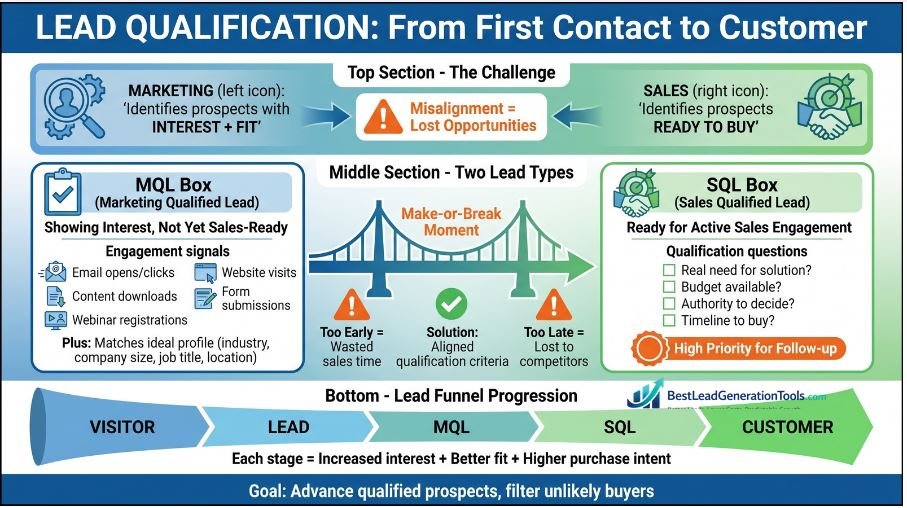
What Does Lead Qualification Mean in Marketing and Sales?
One of the biggest lead generation challenges businesses face is that marketing and sales often have different ideas about what makes a lead “qualified.”
Marketing teams focus on identifying prospects who show interest and match the company’s target audience. Sales teams focus on identifying prospects who are ready and able to buy. When these definitions are not aligned, marketing may pass leads that sales does not want to pursue, while sales may overlook opportunities that simply need more nurturing.
Understanding how lead qualification works at each stage helps create a smoother path from first contact to customer.
What Is a Marketing Qualified Lead (MQL)?
A marketing qualified lead (MQL) is a prospect who has shown enough interest in your business to deserve further attention but is not yet ready for a direct sales conversation.
Marketing teams often evaluate engagement signals such as:
- Email opens and clicks
- Content downloads
- Webinar registrations
- Website visits
- Form submissions
Marketing also looks at whether the prospect fits the company’s ideal customer profile based on factors such as industry, company size, job title, or location.
An MQL has demonstrated interest and appears to be a good fit, but additional qualification is usually needed before involving the sales team.
What Is a Sales Qualified Lead (SQL)?
A sales qualified lead (SQL) is a prospect who has moved beyond general interest and appears ready for active sales engagement.
At this stage, sales teams focus on questions such as:
- Does the prospect have a real need for the solution?
- Is there a budget available?
- Does the prospect have authority to make purchasing decisions?
- Is there a realistic timeline for buying?
An SQL has already passed basic marketing qualification and has shown stronger signs of purchase intent. These leads are typically the highest priority for sales follow-up.
Why the Marketing-to-Sales Handoff Matters
The transition from marketing to sales is one of the most important points in the lead generation process.
If marketing passes leads too early, sales teams may waste time on prospects who are not ready to buy. If marketing waits too long, interested prospects may lose momentum or choose a competitor before sales has a chance to engage them.
The most successful businesses establish clear qualification criteria that both teams understand and follow. This creates better communication, more efficient follow-up, and higher conversion rates.
How Qualified Leads Move Through the Funnel
Lead qualification is not a single event. It happens throughout the buyer’s journey as businesses gather more information about a prospect.
A typical progression looks like this:
Visitor -> Lead -> Marketing Qualified Lead (MQL) -> Sales Qualified Lead (SQL) -> Customer
At each stage, the prospect demonstrates greater interest, stronger fit, and higher likelihood of making a purchase. The goal of lead qualification is to move the right prospects through this process while filtering out leads that are unlikely to become customers.
Why Lead Qualification Is Important
Generating leads is only half of the challenge. The real question is whether those leads are worth pursuing.
Many businesses assume that more leads will automatically produce more sales. In reality, poor-quality leads often create more work, longer sales cycles, and lower conversion rates. Sales teams spend valuable time chasing prospects who were never likely to buy, while promising opportunities may not receive the attention they deserve.
Lead qualification helps solve this problem by identifying which prospects are most likely to become customers. The result is a more efficient sales process, better use of resources, and stronger business results.
Helps Teams Focus on the Right Prospects
Sales teams have limited time and resources. Every hour spent pursuing an unqualified lead is an hour that cannot be spent with a serious buyer.
Lead qualification helps teams identify which prospects deserve immediate attention and which ones may need further nurturing. By evaluating factors such as fit, need, budget, and purchase intent, businesses can prioritize the opportunities with the highest likelihood of success.
This focused approach helps sales teams spend more time having productive conversations and less time pursuing leads that are unlikely to move forward.
Improves Conversion Rates
Not all leads have the same potential to become customers. Some prospects are actively searching for a solution, while others are simply gathering information or exploring their options.
Lead qualification helps businesses identify prospects who have a genuine need, the ability to buy, and a realistic timeline for making a decision. This allows sales teams to tailor their conversations around the prospect’s specific goals and challenges.
When sales efforts are concentrated on qualified prospects, conversion rates often improve because the team is speaking with people who are already a strong fit for the solution being offered.
Reduces Wasted Time and Lowers Acquisition Costs
Poor lead qualification can be expensive.
Without a qualification process, businesses may spend days or even weeks pursuing prospects who lack the budget, authority, or need to become customers. These efforts consume valuable sales and marketing resources while producing little return.
A strong qualification process helps identify poor-fit leads earlier in the buyer journey. This allows teams to focus their efforts where they are most likely to generate revenue while reducing the cost of acquiring new customers.
Over time, this creates a more efficient sales process and a better return on your lead generation investment.
Aligns Sales and Marketing Teams
Lead qualification creates a shared understanding of what a qualified prospect looks like.
When marketing and sales agree on qualification criteria, marketing can focus on attracting the right types of leads while sales can focus on converting them into customers. This reduces friction between departments and creates a smoother handoff process.
Clear qualification standards also make it easier to measure performance, improve lead quality, and identify opportunities for optimization across the entire funnel.
Improves Sales Forecasting
Accurate sales forecasting depends on understanding the quality of your pipeline.
If your pipeline is filled with unqualified leads, revenue projections become unreliable. Deals may appear promising on paper but never move forward because the underlying prospects were never good candidates to begin with.
Lead qualification helps businesses build healthier pipelines by focusing on opportunities with a realistic chance of closing. This leads to more accurate forecasting, better planning, and greater confidence in future revenue projections.
In simple terms, lead generation fills the pipeline. Lead qualification determines whether that pipeline contains real opportunities or costly distractions.
How the Lead Qualification Process Works
Many businesses understand the importance of lead qualification but are less certain about what the process actually looks like in practice.
While qualification methods vary from one company to another, most businesses follow the same basic process. They gather information, evaluate whether the prospect is a good fit, assess how ready the prospect is to buy, and then decide what action to take next.
A simple lead qualification process looks like this:
- Gather Information
- Evaluate Fit
- Assess Buying Readiness
- Take Action
Let’s look at each step in more detail.
Step 1: Gather Information About the Lead
The first step is collecting enough information to determine whether a prospect deserves further attention.
Some of this information may come from website forms, CRM records, email interactions, or previous conversations. Additional details can often be found through company websites, LinkedIn profiles, and publicly available business information.
At this stage, businesses typically gather information such as:
- Company size
- Industry
- Location
- Job title
- Business challenges
- Current solutions being used
The goal is not to conduct an exhaustive investigation. The goal is to gather enough information to make an informed decision about whether the prospect is worth pursuing.
Step 2: Evaluate Whether the Prospect Is a Good Fit
Once basic information has been collected, the next step is determining whether the prospect fits your ideal customer profile.
A prospect may show interest in your solution, but that does not automatically make them a qualified lead. You need to determine whether your product or service can realistically solve their problem and whether they have the resources to become a successful customer.
Questions at this stage often include:
- Does the prospect have a problem we can solve?
- Is our solution a good fit for their situation?
- Can they afford the product or service?
- Do they match our target market?
Some prospects may have a legitimate need but still lack the resources, budget, or organizational fit required for success. Identifying those situations early helps prevent wasted effort later in the sales process.
Step 3: Assess Buying Readiness
A prospect may be a strong fit for your solution but still not be ready to buy.
This stage focuses on determining whether the opportunity deserves immediate sales attention or should remain in a nurturing process.
Businesses often evaluate factors such as:
- Purchase timeline
- Level of urgency
- Decision-making authority
- Internal approval requirements
- Current buying intent
For example, a prospect who is actively evaluating vendors and needs a solution within the next 30 days is typically a higher priority than a prospect who is simply researching options for next year.
The goal is to understand not only whether the prospect can buy, but whether they are likely to buy in the foreseeable future.
Step 4: Take Action Based on Qualification Results
Lead qualification is not simply about deciding whether a lead is good or bad. It is about determining the most appropriate next step.
After qualification, most leads fall into one of three categories:
Sales-Ready Leads
These prospects meet your qualification criteria and show strong purchase intent. They should move directly into the sales process for active follow-up.
Nurture-Worthy Leads
These prospects appear to be a good fit but are not yet ready to buy. They may need additional education, follow-up, or time before becoming sales opportunities.
Disqualified Leads
These prospects do not match your target customer profile or are unlikely to become customers. Rather than investing additional resources, businesses typically remove them from active sales pursuit.
Making the right decision at this stage is critical. Pursuing poor-fit leads wastes valuable time, while nurturing the right prospects can create future sales opportunities.
Ultimately, the purpose of lead qualification is not just to identify good prospects. It is to ensure that every lead receives the right level of attention based on its likelihood of becoming a customer.
Common Criteria Used to Qualify Leads
While every business has its own qualification process, most lead qualification criteria are designed to answer two important questions:
- Is this prospect a good fit for our product or service?
- How likely is this prospect to become a customer?
The first question focuses on fit. The second focuses on intent.
By evaluating both, businesses can identify which prospects deserve immediate attention, which need additional nurturing, and which are unlikely to become customers.
The most common qualification criteria include the following.
| Qualification Factor | What It Helps Determine |
|---|---|
| Need | Whether the prospect has a problem you can solve |
| Budget | Whether they can afford your solution |
| Authority | Whether they can approve a purchase |
| Company Fit | Whether they match your ideal customer profile |
| Timeline | How soon they may buy |
| Engagement | How interested they appear to be |
Need: Does the Prospect Have a Problem You Can Solve?
Need is often the most important qualification criterion.
A prospect may have budget, authority, and strong interest, but if they do not have a problem that your product or service solves, they are unlikely to become a customer.
During qualification, businesses seek to understand:
- What challenges the prospect is facing
- How serious those challenges are
- Whether the prospect is actively looking for a solution
- Whether the solution being offered is a good fit
The stronger and more urgent the need, the more likely the prospect is to move forward.
Budget: Can the Prospect Afford the Solution?
A qualified lead must have the financial resources necessary to purchase your product or service.
This does not always require discussing an exact budget immediately. Sometimes businesses evaluate purchasing ability based on company size, revenue, previous spending patterns, or available resources.
Questions often include:
- Does the prospect have funding available?
- Is there an approved budget for this type of purchase?
- Can the prospect realistically invest in the solution?
Even highly interested prospects may not be qualified if they lack the resources to move forward.
Authority: Can the Prospect Make the Buying Decision?
Many sales opportunities stall because the salesperson is speaking with someone who cannot approve a purchase.
Authority refers to whether the prospect has the power to make buying decisions or significantly influence them.
Businesses often seek to identify:
- Decision-makers
- Budget owners
- Department leaders
- Members of the buying committee
Understanding who is involved in the purchasing process helps prevent delays and improves the likelihood of a successful sale.
Company Fit: Does the Prospect Match Your Ideal Customer Profile?
Not every prospect is the right fit for every business.
Company fit evaluates whether a prospect matches the characteristics of your most successful customers.
Factors may include:
- Company size
- Industry
- Geographic location
- Revenue
- Technology requirements
- Organizational structure
A prospect may have interest and budget, but if they fall far outside your target market, they may not be an ideal customer.
Strong company fit often leads to smoother implementations, higher satisfaction, and better long-term customer relationships.
Timeline and Urgency: How Soon Is the Prospect Likely to Buy?
A prospect may be a perfect fit for your solution but still not be ready to purchase.
Timeline helps businesses understand when a buying decision is likely to occur.
Important questions include:
- Is the prospect actively evaluating solutions?
- Do they have an upcoming deadline?
- Are they comparing vendors right now?
- Is the problem becoming urgent?
Prospects with immediate needs typically receive higher priority than those who are simply gathering information for future projects.
Engagement Signals: How Interested Is the Prospect?
Engagement signals help businesses evaluate a prospect’s level of interest and buying intent.
These signals often include:
- Pricing page visits
- Demo requests
- Webinar registrations
- Content downloads
- Email engagement
- Multiple website visits
Not all engagement signals carry the same weight. For example, a prospect requesting a product demonstration generally shows stronger intent than someone reading a single blog post.
The goal is to identify behaviors that indicate a prospect is actively researching solutions and moving closer to a purchase decision.
No single qualification criterion tells the entire story. The strongest lead qualification processes evaluate multiple factors together to determine both fit and intent.
When a prospect has a genuine need, sufficient budget, decision-making authority, strong company fit, reasonable urgency, and clear engagement signals, they are far more likely to become a customer than a prospect who only meets one or two of those criteria.
Popular Lead Qualification Frameworks
Once businesses understand the criteria used to qualify leads, the next challenge is applying those criteria consistently.
This is where lead qualification frameworks become useful.
A qualification framework provides a repeatable structure that helps sales and marketing teams evaluate prospects using the same standards. Rather than relying on guesswork, teams can use a framework to determine whether a lead deserves further attention and how likely that lead is to become a customer.
Several frameworks are commonly used in sales and lead generation. While they differ in approach, all are designed to answer the same basic question: Is this prospect worth pursuing?
BANT Framework
BANT is one of the oldest and most widely used lead qualification frameworks. It focuses on four key factors:
| BANT Element | Question It Answers |
|---|---|
| Budget | Can the prospect afford the solution? |
| Authority | Can the prospect approve the purchase? |
| Need | Does the prospect have a problem you can solve? |
| Timeline | When is the prospect likely to buy? |
BANT works well because it is simple and easy to apply. Many small and mid-sized businesses use it as a starting point for qualifying leads.
While BANT may not capture every detail of a complex buying process, it provides a practical framework for determining whether an opportunity deserves further sales attention.
CHAMP Framework
CHAMP stands for Challenges, Authority, Money, and Prioritization.
Unlike BANT, which starts with budget, CHAMP begins by identifying the prospect’s challenges and pain points. The idea is that understanding the problem should come before discussing the financial details.
CHAMP is often used in consultative sales environments where uncovering customer needs is a critical part of the sales process.
The framework focuses on:
- The challenges the prospect is facing
- Whether they have decision-making authority
- Available financial resources
- How important solving the problem is to the organization
MEDDIC Framework
MEDDIC is a more advanced qualification framework commonly used in complex B2B and enterprise sales.
The acronym stands for:
- Metrics
- Economic Buyer
- Decision Criteria
- Decision Process
- Identify Pain
- Champion
MEDDIC goes beyond basic qualification and helps sales teams understand how buying decisions are made inside larger organizations.
Because enterprise purchases often involve multiple stakeholders, lengthy approval processes, and significant financial investments, MEDDIC provides a deeper framework for evaluating opportunities and managing complex sales cycles.
GPCT Framework
GPCT stands for Goals, Plans, Challenges, and Timeline.
This framework focuses on understanding what the prospect wants to achieve and what obstacles stand in their way.
Sales teams using GPCT seek to answer questions such as:
- What goals is the prospect trying to achieve?
- What plans are currently in place?
- What challenges are preventing success?
- What timeline exists for reaching those goals?
GPCT is particularly useful for understanding the broader business context behind a buying decision rather than focusing solely on budget and authority.
ANUM Framework
ANUM stands for Authority, Need, Urgency, and Money.
This framework places authority first because many sales teams believe there is little value in pursuing opportunities if the person being contacted cannot influence or approve the purchase.
ANUM helps sales teams quickly determine:
- Whether they are speaking with the right person
- Whether a genuine need exists
- How urgent the problem is
- Whether sufficient budget is available
The framework is often used when sales teams need to qualify opportunities quickly and prioritize their outreach efforts.
Which Lead Qualification Framework Is Best?
There is no single best lead qualification framework.
The right choice depends on your sales process, target audience, deal size, and buying complexity.
For many businesses, BANT provides a simple starting point. Organizations with more complex sales cycles may prefer frameworks such as CHAMP, GPCT, or MEDDIC because they provide deeper insight into buyer motivations and decision-making processes.
The most important factor is consistency. A framework is valuable because it helps your team evaluate leads using the same criteria and make better decisions about where to invest time and resources.
Lead Qualification vs Lead Scoring: What Is the Difference?
Lead qualification and lead scoring are often discussed together, but they are not the same thing.
Lead qualification helps determine whether a prospect is a good sales opportunity. Lead scoring helps determine which opportunities deserve attention first.
Most businesses use both because they answer different questions. Qualification evaluates whether a lead is worth pursuing, while scoring helps prioritize follow-up efforts.
The easiest way to understand the difference is to compare them side by side.
| Question | Lead Qualification | Lead Scoring |
|---|---|---|
| What does it evaluate? | Fit and buying potential | Interest and engagement |
| Primary goal | Determine whether a lead is worth pursuing | Prioritize leads for follow-up |
| Typical output | Qualified or unqualified | Numerical score or ranking |
| Focus | Need, budget, authority, timeline, and fit | Behavior, activity, and engagement |
| Common users | Sales and marketing teams | Marketing automation and sales teams |
What Lead Qualification Measures
Lead qualification focuses on whether a prospect has the characteristics necessary to become a customer.
Businesses evaluate factors such as:
- Need
- Budget
- Authority
- Timeline
- Company fit
The goal is to determine whether the prospect is a realistic sales opportunity.
For example, a prospect may be interested in your product, but if they lack the budget to purchase it or do not have authority to make buying decisions, they may not qualify as a viable opportunity.
Lead qualification helps businesses focus their sales efforts on prospects who are most likely to become customers.
What Lead Scoring Measures
Lead scoring focuses on how interested a prospect appears to be based on their actions and characteristics.
Businesses assign values to different behaviors and attributes, allowing leads to be ranked according to their level of engagement.
Common scoring factors include:
- Website visits
- Content downloads
- Webinar attendance
- Email engagement
- Demo requests
- Job title
- Company size
- Industry
As prospects interact with your business, their scores may increase or decrease. Leads with higher scores typically receive greater attention because they appear more engaged and more likely to move forward.
The purpose of lead scoring is not to determine whether a prospect can buy. The purpose is to identify which prospects deserve immediate attention.
Why Businesses Use Both Together
Lead qualification and lead scoring work best when used together.
A prospect may visit your website frequently, download multiple resources, attend webinars, and engage with every marketing campaign you send. Their lead score may be extremely high.
However, if they lack budget, authority, or a genuine need for your solution, they may still fail qualification.
The opposite can also be true. A prospect may perfectly match your ideal customer profile but have very little engagement with your content. They may qualify as a strong opportunity but need additional nurturing before they are ready for a sales conversation.
Think of lead qualification as determining whether a lead belongs in your pipeline.
Think of lead scoring as determining where that lead should sit within the pipeline.
When used together, qualification and scoring help businesses focus on the right prospects at the right time, leading to more efficient sales processes and better conversion rates.
Can Lead Qualification Be Manual or Automated?
Lead qualification does not have to follow a single approach.
Some businesses qualify leads manually through direct conversations and research. Others rely heavily on software and automation. Most use a combination of both.
The right approach depends on factors such as lead volume, sales complexity, available resources, and the nature of the buying process.
Manual Lead Qualification
Manual lead qualification relies on people rather than software to evaluate prospects.
Sales representatives gather information through phone calls, emails, meetings, research, and discovery conversations. They use their experience and judgment to determine whether a prospect is a good fit and how likely that prospect is to become a customer.
Manual qualification allows businesses to uncover details that may not appear in forms, reports, or analytics. It also helps sales teams build relationships and better understand a prospect’s goals, challenges, and decision-making process.
Manual qualification is often a good fit for:
- Small businesses
- High-ticket products and services
- Complex B2B sales
- Relationship-driven sales environments
The primary drawback is that manual qualification requires time and effort. As lead volume grows, it becomes more difficult to evaluate every prospect individually.
Automated Lead Qualification
Automated lead qualification uses software to collect, analyze, and evaluate lead data.
CRM platforms, marketing automation tools, and lead scoring systems can track behaviors such as website visits, content downloads, email engagement, and demo requests. Based on predefined criteria, these systems can automatically identify prospects who appear to be strong opportunities.
Automated qualification offers several advantages:
- Faster lead evaluation
- Consistent qualification standards
- Better scalability
- Reduced manual workload
This approach is especially useful for businesses that generate a large number of leads and need a way to prioritize follow-up efforts efficiently.
However, automation cannot always capture the full context behind a prospect’s situation. Software can identify patterns and signals, but it may not fully understand motivations, objections, or organizational dynamics that emerge during direct conversations.
Most Businesses Use Both
For many organizations, the most effective approach combines manual and automated qualification.
Automation helps identify promising leads and prioritize opportunities at scale. Sales teams then use conversations and discovery processes to verify fit, uncover needs, and determine buying readiness.
For example, a marketing automation platform may identify a prospect who has visited multiple product pages, downloaded several resources, and requested a demo. Those actions suggest strong interest.
A salesperson can then confirm whether the prospect has a genuine need, available budget, decision-making authority, and a realistic timeline for purchasing.
In this way, automation helps businesses work more efficiently while human judgment helps ensure better qualification decisions.
| Manual Qualification | Automated Qualification |
|---|---|
| Human-driven | Software-driven |
| More personalized | More scalable |
| Better for complex sales | Better for high-volume lead generation |
| Provides deeper context | Processes data faster |
| Relationship-focused | Efficiency-focused |
The goal is not to choose one approach over the other. The goal is to use the strengths of each approach to identify qualified leads more accurately and move promising prospects through the sales process more efficiently.
Tools That Help Businesses Qualify Leads
As lead volume grows, manually evaluating every prospect becomes increasingly difficult.
This is why many businesses use software to support their lead qualification process. Rather than replacing human judgment, these tools help teams collect information, evaluate fit, measure engagement, and prioritize follow-up efforts more efficiently.
Different tools serve different purposes, but all help businesses make better qualification decisions.
| Tool Type | Primary Purpose |
|---|---|
| CRM Platforms | Organize and manage lead information |
| Lead Scoring Tools | Measure engagement and buying intent |
| Data Enrichment Tools | Improve lead data quality |
| AI Qualification Tools | Prioritize opportunities at scale |
CRM Platforms
CRM platforms help businesses organize lead information and maintain a complete record of prospect interactions.
A CRM can track details such as:
- Contact information
- Company information
- Communication history
- Sales activity
- Qualification status
Having this information in one place helps sales and marketing teams evaluate leads more consistently and avoid making decisions based on incomplete data.
For many businesses, the CRM serves as the foundation of the entire lead qualification process.
Lead Scoring Tools
Lead scoring tools help businesses identify which prospects appear most interested in buying.
These tools evaluate behaviors such as:
- Website visits
- Content downloads
- Webinar registrations
- Email engagement
- Demo requests
As prospects interact with your business, their scores change based on their activity. This allows sales teams to focus on leads that show stronger buying intent rather than treating every lead equally.
Lead scoring helps answer an important qualification question:
“Which prospects deserve attention first?”
Data Enrichment Tools
Lead qualification depends on having accurate information.
Data enrichment tools help businesses fill gaps in their lead records by adding information such as:
- Job titles
- Company size
- Industry
- Revenue estimates
- Geographic location
This additional information makes it easier to evaluate company fit, identify decision-makers, and determine whether a prospect matches the ideal customer profile.
Without accurate data, even the best qualification process can produce poor results.
AI-Powered Qualification Tools
AI-powered qualification tools help businesses analyze large numbers of leads and identify promising opportunities more efficiently.
These tools can evaluate behavioral signals, engagement patterns, and historical sales data to help determine which prospects are most likely to become customers.
Rather than replacing sales teams, AI helps prioritize where sales teams should focus their efforts.
This can be particularly valuable for organizations that generate large numbers of leads and need a scalable way to identify their best opportunities.
The Goal Is Better Qualification, Not More Software
The purpose of qualification tools is not to automate every decision.
The purpose is to help businesses qualify leads more consistently, efficiently, and accurately.
CRM systems help organize information. Lead scoring tools help identify engagement. Data enrichment tools improve lead quality. AI tools help prioritize opportunities.
Together, these tools support the lead qualification process by helping businesses focus their time and resources on the prospects most likely to become customers.
Signs Your Lead Qualification Process Needs Improvement
Many businesses assume their lead generation strategy is the problem when sales results fall short.
In reality, the issue is often lead qualification.
If your team is generating leads but struggling to convert them into customers, your qualification process may need attention. Poor qualification can create longer sales cycles, lower conversion rates, wasted resources, and frustration across both sales and marketing teams.
Here are some common warning signs that your lead qualification process may need improvement.
High Lead Volume but Poor Conversion Rates
Generating a large number of leads can feel like progress, but lead volume alone does not drive revenue.
If your business consistently generates leads but only a small percentage become customers, the problem may be that too many unqualified prospects are entering the sales pipeline.
Common signs include:
- High lead volume with few closed deals
- Long sales cycles with low conversion rates
- Frequent follow-up with prospects who never move forward
- Sales teams struggling to identify promising opportunities
Strong lead qualification helps ensure that sales teams spend their time on prospects who are more likely to become customers rather than pursuing opportunities that were never a good fit.
Sales Teams Frequently Complain About Lead Quality
One of the clearest warning signs is when sales teams consistently question the quality of the leads they receive.
Sales representatives often know quickly whether prospects are serious buyers, good fits, or unlikely to convert. If they regularly report that leads lack budget, authority, need, or buying intent, your qualification criteria may need refinement.
Watch for signs such as:
- Low response rates from prospects
- Frequent lead rejection by sales teams
- Sales representatives creating their own prospect lists
- Complaints that leads are not sales-ready
When sales teams lose confidence in lead quality, follow-up efforts often decline and valuable opportunities can be missed.
Marketing and Sales Definitions Do Not Match
Lead qualification works best when marketing and sales agree on what makes a qualified lead.
Problems arise when marketing and sales use different standards.
For example, marketing may view a lead as qualified because the prospect downloaded content or attended a webinar. Sales may believe qualification requires a demonstrated need, available budget, or active buying intent.
When these definitions do not align, businesses often experience:
- Frustration between departments
- Poor lead handoffs
- Missed opportunities
- Lower conversion rates
Establishing shared qualification criteria helps create a smoother transition from marketing engagement to sales conversations.
Too Much Time Is Spent on Low-Quality Leads
Sales teams have limited time.
If representatives spend a large portion of their day researching, contacting, and following up with prospects who never become customers, qualification standards may not be strict enough.
Common warning signs include:
- Excessive time spent on unresponsive prospects
- Repeated follow-up with low-intent leads
- Large pipelines with little revenue growth
- Sales resources spread across too many opportunities
A strong qualification process helps teams focus their efforts on the prospects most likely to generate revenue while reducing time spent on poor-fit opportunities.
Long Sales Cycles With Frequent Stalled Deals
Not every long sales cycle indicates a qualification problem, but consistently stalled deals often do.
When unqualified prospects enter the pipeline, sales teams may spend weeks or months pursuing opportunities that never had a realistic chance of closing.
Warning signs include:
- Deals that remain inactive for extended periods
- Prospects who repeatedly delay decisions
- Opportunities that frequently disappear late in the sales process
- High numbers of stalled or abandoned deals
Improving qualification criteria can help identify these situations earlier and prevent sales teams from investing excessive time in opportunities that are unlikely to move forward.
The Bottom Line
If several of these warning signs sound familiar, the problem may not be lead generation at all.
Generating more leads rarely solves issues caused by poor qualification. In many cases, businesses achieve better results by improving how they evaluate, prioritize, and manage existing leads.
A strong lead qualification process helps sales and marketing teams focus on the right prospects, improve conversion rates, and make better use of their time and resources.
I would rewrite the section as follows:
Frequently Asked Questions About Lead Qualification
What is lead qualification?
Lead qualification is the process of determining whether a prospect is likely to become a customer. Businesses evaluate factors such as need, budget, authority, company fit, and purchase timeline to decide which leads deserve sales attention.
What makes a lead qualified?
A qualified lead is a prospect who matches your ideal customer profile and shows a realistic likelihood of purchasing your product or service. While qualification criteria vary by business, most organizations evaluate factors such as need, budget, decision-making authority, and buying intent.
What is the difference between lead qualification and lead generation?
Lead generation focuses on attracting potential customers and bringing them into the sales pipeline. Lead qualification focuses on evaluating those prospects to determine which ones are most likely to become customers. Lead generation creates opportunities, while lead qualification helps prioritize them.
What is the difference between lead qualification and lead scoring?
Lead qualification determines whether a prospect is worth pursuing based on factors such as fit and buying potential. Lead scoring ranks prospects based on their level of engagement and interest. Many businesses use both together to identify and prioritize sales opportunities.
What is a marketing qualified lead (MQL)?
A marketing qualified lead (MQL) is a prospect who has shown interest in a business through actions such as downloading content, attending webinars, completing forms, or engaging with marketing campaigns. MQLs typically require additional evaluation before being passed to sales.
What is a sales qualified lead (SQL)?
A sales qualified lead (SQL) is a prospect who has demonstrated both interest and buying potential. SQLs generally meet key qualification criteria and are considered ready for active sales engagement.
What is the BANT lead qualification framework?
BANT is a lead qualification framework that evaluates prospects based on Budget, Authority, Need, and Timeline. It is one of the most widely used frameworks because it provides a simple structure for determining whether a lead is a viable sales opportunity.
Can lead qualification be automated?
Yes. Many businesses use CRM platforms, lead scoring systems, marketing automation tools, and AI-powered software to support lead qualification. However, human judgment is still important, especially in complex sales environments where context and relationship-building play a significant role.
Who is responsible for lead qualification?
Lead qualification is typically a shared responsibility between marketing and sales teams. Marketing often performs initial qualification based on engagement and fit, while sales conducts deeper qualification to confirm buying readiness and sales potential.
Why is lead qualification important?
Lead qualification helps businesses focus their time and resources on the prospects most likely to become customers. Effective qualification can improve conversion rates, reduce wasted effort, shorten sales cycles, and create better alignment between marketing and sales teams.
Final Thoughts: Why Better Lead Qualification Creates Better Results
Lead generation and lead qualification are closely connected, but they are not the same thing.
Lead generation brings prospects into your pipeline. Lead qualification helps determine which of those prospects are most likely to become customers.
Many businesses assume that generating more leads will automatically increase sales. In reality, more leads often create more work if those leads are not properly qualified. Sales teams can spend valuable time pursuing prospects who are unlikely to buy while high-potential opportunities receive less attention than they deserve.
Effective lead qualification helps solve this problem.
By evaluating factors such as need, budget, authority, company fit, and buying intent, businesses can focus their resources on the prospects most likely to move forward. This leads to more productive sales conversations, stronger conversion rates, shorter sales cycles, and better use of marketing and sales resources.
The most successful organizations do not treat lead qualification as a one-time task. They continuously refine their qualification criteria, improve collaboration between marketing and sales, and adjust their processes as customer needs and market conditions evolve.
Whether you use frameworks such as BANT or CHAMP, rely on manual qualification, implement automated systems, or combine multiple approaches, the goal remains the same: identify the right prospects and give them the right level of attention at the right time.
The key takeaway is simple:
More leads do not automatically create more sales. Better-qualified leads do.
If your business is generating plenty of leads but struggling to convert them into customers, improving your lead qualification process may have a greater impact than generating additional leads.
Understanding lead qualification is the first step. The next step is building a repeatable process that helps your team identify, prioritize, and manage high-quality opportunities consistently.