
Why Lead Generation Doesn’t Work (And the System That Actually Does)
I’ve been in the lead generation world for over a decade, and there’s an uncomfortable truth most “experts” avoid saying out loud:
Lead generation doesn’t work the way it’s usually taught.
Run some ads. Build a funnel. Create a landing page. Watch the leads roll in.
That’s the promise.
The reality looks more like this:
You spend months building a sophisticated lead generation setup, invest thousands in ads, launch with confidence… and end up with a handful of leads. Half of them are unqualified. A few never respond. One is a competitor. And the only person who’s interested has no budget and won’t for another year.
If that sounds familiar, you’re not alone.
The problem isn’t that lead generation doesn’t work. It absolutely does. Companies with systematic approaches generate significantly more revenue than those without.
The real problem is that most businesses approach lead generation completely backwards.
They obsess over getting more leads instead of building a lead generation system that attracts the right people, qualifies them correctly, nurtures them intelligently, and hands them to sales at exactly the right moment.
That’s what this article is about.
This isn’t beginner-level content. If you’re looking for “what is a lead” definitions or surface-level tactics, this isn’t for you.
This is for people who already understand the basics and want to build something that generates predictable, scalable revenue instead of constant frustration.
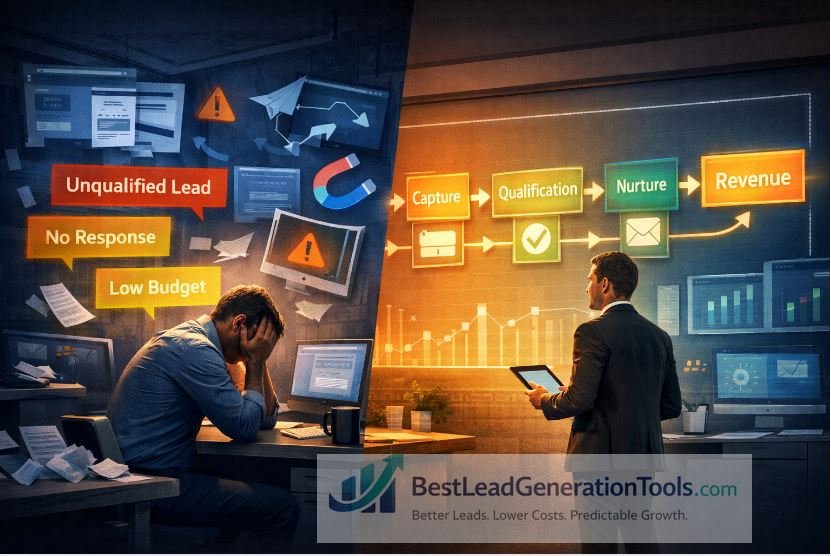
Why Most Lead Generation Efforts Don’t Work
Most lead generation efforts fail for a simple reason: they’re built as disconnected tactics instead of a system.
- Businesses launch ads without thinking about qualification.
- They capture leads without a clear nurture path.
- They hand unvetted contacts to sales and call it “marketing.”
The result is predictable: low-quality leads, wasted follow-up, frustrated sales teams, and the belief that “lead generation just doesn’t work in our industry.”
In reality, what doesn’t work is treating lead generation as a linear process instead of an interconnected system.
Until you understand how attraction, capture, qualification, and nurture work together—and how each one influences the others—your results will always feel inconsistent, no matter how much traffic you generate.
Understanding the Lead Generation System Architecture (What Actually Works)
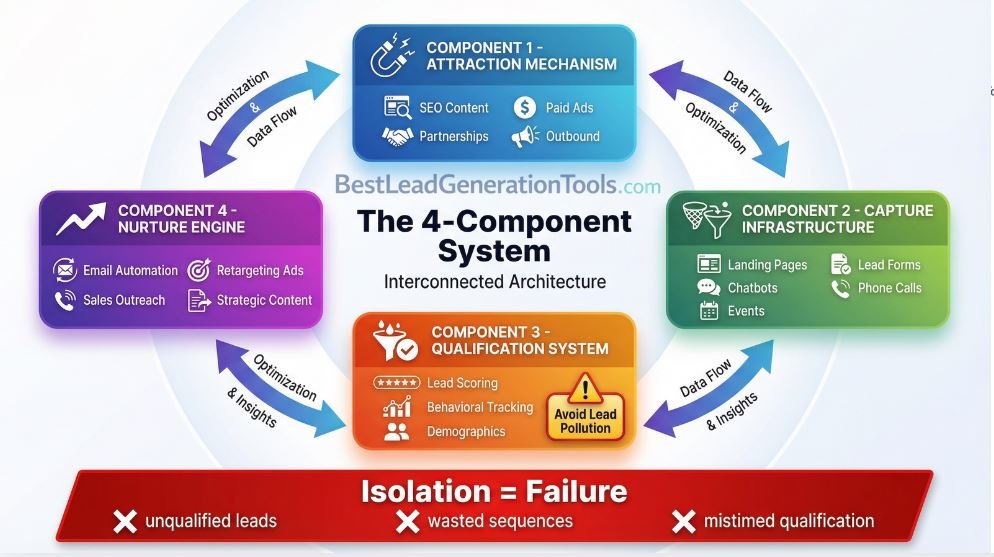
Most people think of lead generation as a linear process: create content, drive traffic, capture leads, done. That’s like thinking cooking is just “apply heat to ingredients.” Technically true but practically useless.
Real lead generation functions as an interconnected system with multiple feedback loops, and understanding this architecture is crucial before you build anything.
The system has four core components that need to work in harmony. First is your attraction mechanism, the specific way you earn attention from your target audience.
This could be content that ranks in search engines, paid advertisements on specific platforms, strategic partnerships that give you access to established audiences, or outbound prospecting that creates awareness where none existed.
Second is your capture infrastructure, the actual mechanisms that convert attention into contact information. This includes landing pages, lead forms, chatbots, phone calls, or even physical events.
The key insight here is that your capture infrastructure must match the awareness level and intent of the traffic source.
Someone clicking a targeted ad about a specific problem is in a completely different mental state than someone discovering your blog post through organic search.
Third is your qualification system, the process for determining which leads are worth your team’s limited time and energy. This involves lead scoring models, behavioral tracking, demographic data, and often direct qualification questions embedded in your capture forms.
Without effective qualification, you end up with what I call “lead pollution”, a database full of contacts that will never buy but need resources to manage.
Fourth is your nurture engine, the systematic follow-up that moves qualified leads toward a buying decision. This typically involves email automation, retargeting ads, direct sales outreach, and strategic content that addresses specific objections or concerns at different stages of the buyer process.
Here’s what most people miss: these four components aren’t independent. Your attraction mechanism decides what kinds of leads you can realistically capture.
Your capture infrastructure decides how effectively you can qualify.
Your qualification system decides what nurture sequences are suitable. And your nurture engine feeds data back to your attraction efforts, showing you which sources produce leads that actually convert.
When you build these components in isolation without considering how they interconnect, you get systems that technically function but practically fail. You generate lots of leads that don’t convert.
You create sophisticated nurture sequences that go to unqualified prospects.
You invest in qualification processes that happen too late in the funnel to be useful.
The businesses that dominate their markets understand this systemic view. They don’t just “do lead generation”, they architect lead generation systems where each component amplifies the others.
Building Your Attraction Mechanism: Strategic Traffic Generation
There are really only four basic ways to generate awareness: you can earn it through content and SEO, you can buy it through paid advertising, you can borrow it through partnerships and affiliations, or you can steal it through aggressive outbound prospecting. Each approach has specific economics, timelines, and ideal use cases.
Earned attention through organic content is the long game. You’re creating valuable content, blog posts, videos, podcasts, research reports, tools, that ranks in search engines or gets shared organically.
The economics here are fascinating and counter-intuitive.
A typical high-quality blog post might cost $500-1,000 to create (either your time or outsourced). That same post, if it ranks for valuable keywords, might generate 50-500 leads per year for 3-5 years with zero incremental cost.
Do the math: 200 leads per year over 3 years is 600 leads at $1,000 investment, or $1.67 per lead.
Compare that to Facebook ads at $12-20 per lead or LinkedIn at $45-350 per lead. The compound economics of organic content are unbeatable.
But here’s the catch, it takes 6-12 months to see meaningful results, and most businesses don’t have that kind of patience or runway. This is why organic content works best for established businesses with existing revenue or well-funded startups with long time horizons.
Paid advertising gives you speed and control. You can turn budget into leads within days if you know what you’re doing.
The key variables are cost per click, conversion rate, and lead quality.
The biggest mistake people make with paid advertising is optimizing for the wrong metric. They obsess over cost per lead without considering lead quality or conversion rate to customer.
I’ve seen campaigns with $200 cost per lead dramatically outperform campaigns with $30 cost per lead because the expensive leads actually converted to customers at 10x the rate.
The real metric that matters is cost per customer acquisition relative to customer lifetime value. If your average customer is worth $10,000 and you’re spending $500 to acquire them, you can afford dramatically higher per-lead costs than someone whose average customer is worth $800.
Borrowed attention through partnerships is the most underutilized approach. This means getting access to someone else’s established audience through webinars, podcast interviews, guest content, co-marketing campaigns, or formal referral relationships.
The economics are usually lower cost but need more relationship-building effort.
A single appearance on a podcast with 5,000 targeted listeners might generate 20-50 leads at essentially zero cash cost, though it needs time investment for the interview and relationship development. Strategic partnerships with complementary (not competitive) businesses can create consistent referral flows that dramatically reduce acquisition costs.
Outbound prospecting means directly reaching out to people who haven’t expressed interest yet. This includes cold email, LinkedIn outreach, cold calling, and direct mail.
It’s controversial because it’s often done poorly and experienced as spam, but when done with proper targeting and personalization, it can be extremely effective for high-value B2B offers.
The key to outbound success is extreme specificity. Instead of emailing 10,000 generic prospects with a template message, you email 100 highly-specific prospects with deeply personalized messages referencing their specific situation.
Response rates go from 0.5% to 15-30% with this approach.
Most businesses should use a portfolio approach, a mix of these attraction mechanisms that balance speed (paid), compounding returns (organic), relationship leverage (partnerships), and direct control (outbound). The specific mix depends on your business model, time horizon, and resource constraints.
Designing Capture Infrastructure That Actually Converts
Once you’ve earned, bought, borrowed, or stolen someone’s attention, you need to convert that attention into contact information. This is where most lead generation efforts leak potential.
The basic challenge is that people are increasingly protective of their email addresses and contact information. They’ve been burned by spam, aggressive sales tactics, and irrelevant follow-up too many times.
Your capture mechanism needs to overcome this resistance by offering clear, compelling value.
Landing pages are the workhorse of lead capture for digital campaigns. The anatomy of a high-converting landing page includes a clear headline that matches the promise from wherever they clicked, a subheadline that expands on the value proposition, some form of social proof or credibility indicators, a clear explanation of what they’ll get and why it matters, a simple form requesting only essential information, and a compelling call-to-action button.
Here’s what actually decides conversion rates: message match and friction balance. Message match means the landing page delivers on whatever promise brought them there.
If your ad says “Free Real Estate Market Analysis for Phoenix Luxury Homes,” your landing page better be specifically about Phoenix luxury home market analysis, not generic real estate information.
Friction balance is about asking for the right amount of information. Too few fields and you get high volume but low-quality leads.
Too many fields and conversion rates plummet.
The optimal balance depends on your offer value and where the lead is in their process.
For high-value offers targeting people ready to buy (free consultation, custom quote, demo), you can ask for more information, name, email, phone, company, title, specific needs. Conversion rates might be 5-15%, but lead quality is high.
For educational content targeting people early in their research (ebook, webinar, research report), asking for more than email and maybe company name kills conversion. You might see 40-60% conversion rates with minimal friction, but lead quality and immediate sales-readiness is lower.
Most businesses make one of two mistakes: they either treat all traffic the same and use one landing page template for everything, or they create dozens of slightly different landing pages without a clear strategic reason for the variations.
The smarter approach is segmented capture based on traffic source and intent. Someone clicking an ad for “Real estate CRM for teams over 50 agents” should hit a landing page specifically about solutions for large teams, with form fields that qualify team size.
Someone discovering your blog post about “How to manage leads during busy season” might see an email-only capture for a relevant guide.
Beyond landing pages, consider choice capture mechanisms. Chatbots can qualify visitors in real-time and capture information conversationally.
Phone calls work exceptionally well for high-ticket services where immediate consultation is valuable.
In-person events create relationship-based capture where the “form fill” happens through business card exchange or event registration.
The key principle is matching capture friction to offer value and traffic temperature. High-intent, high-value scenarios can sustain higher friction.
Low-intent, educational scenarios need minimal friction.
Implementing Lead Scoring and Qualification Systems
This is where sophisticated lead generation separates from amateur hour. You can generate thousands of leads, but if you can’t identify which ones are worth your team’s time, you’ve just created an expensive mess.
Lead qualification happens through two lenses: demographic fit and behavioral signals. Demographic fit is about whether this person matches your ideal customer profile.
Behavioral signals show their level of interest and where they are in the buying timeline.
For demographic qualification, you need a clear ideal customer profile. If you sell B2B software for mid-market companies, your demographic criteria might include company size (50-500 employees), industry (SaaS, professional services, financial services), role (VP or Director level), and geography (North America, English-speaking markets).
You can collect this information explicitly through form fields, or derive it through enrichment tools that append data based on email address or company domain. Services like Clearbit, ZoomInfo, or LinkedIn Sales Navigator can automatically add firmographic data to leads.
Behavioral signals are more nuanced. They include actions like which pages someone visited, which content they downloaded, whether they attended a webinar, how many emails they opened, whether they visited your pricing page, and how much time they spent on your site.
The art of lead scoring is assigning point values to these signals that accurately forecast buying intent. A visit to your pricing page might be worth 20 points.
Downloading a case study might be 15 points.
Opening three consecutive emails might be 10 points. Attending a webinar might be 30 points.
You set a threshold, let’s say 75 points, where leads become “sales-qualified” and warrant direct sales outreach. Below that threshold, they stay in marketing nurture sequences.
Here’s the tricky part: these point values are not universal. They need to be calibrated based on your actual conversion data.
You might think pricing page visits show high intent, but your data might show that leads who visit pricing pages early actually convert at lower rates because they’re price-shopping as opposed to value-comparing.
The only way to build an accurate scoring model is to track leads through your entire funnel and backtest which signals actually predicted conversion. This needs 3-6 months of data and rigorous analysis.
Many businesses skip this work and use generic scoring models from their marketing automation platform. This is better than nothing but dramatically less effective than a custom model built on your specific conversion patterns.
Beyond points-based scoring, apply explicit qualification questions in your capture forms. For a high-value offer, you might ask “What’s your timeline for implementing a solution?” with options like “Immediate need (within 30 days),” “Exploring options (1-3 months),” “Planning ahead (3-6 months),” or “Just researching (no timeline).”
Leads selecting “Immediate need” get routed directly to sales. Leads selecting “Just researching” go into a 6-month educational nurture sequence.
This explicit qualification is often more reliable than behavioral inference.
The output of your qualification system should be clear routing rules: hot leads to sales immediately, warm leads to accelerated nurture, cool leads to educational nurture, unqualified leads to disqualification or long-term brand awareness.
Building Nurture Sequences That Actually Move People Forward
Most nurture sequences suck.
They’re either aggressively salesy (“Have you had a chance to review our proposal??” repeated five times) or generically educational with no clear next step.
Effective nurture works because it matches content to the specific stage of the buying process and addresses the actual objections or questions people have at each stage.
A useful framework is problem-aware → solution-aware → product-aware → decision-ready.
Problem-aware leads know they have a problem but don’t yet know the category of solutions. A real estate agent might be frustrated with inconsistent lead flow but doesn’t yet know that “lead generation systems” are the solution category.
Content for this stage is educational and diagnostic, “7 Reasons Your Real Estate Leads Dry Up Every Summer” or “The Hidden Costs of Referral-Dependent Growth.”
Solution-aware leads know the category of solutions but haven’t evaluated specific options. They know they need lead generation but don’t know whether to focus on organic content, paid ads, partnerships, or a mix.
Content for this stage is comparative and strategic, “Paid vs Organic Lead Generation: Which Makes Sense for Your Real Estate Business” or “How Top-Producing Agents Structure Their Lead Generation Mix.”
Product-aware leads are evaluating specific vendors or approaches. They’re comparing your solution to choices.
Content for this stage is differentiating and proof-heavy, case studies, customer testimonials, comparison guides, demo videos, pricing transparency.
Decision-ready leads have essentially decided but need final confirmation or approval. Content for this stage is risk-reduction, implementation guides, onboarding previews, ROI calculators, executive summaries for decision-makers.
Your nurture sequences should systematically move people through these stages with suitable content at each step. A typical sequence might look like:
- Day 1: Deliver the promised lead magnet.
- Day 3: Problem-aware educational content.
- Day 7: Solution-aware strategic content.
- Day 12: Product-aware case study.
- Day 18: Decision-stage risk-reduction content.
- Day 25: Direct sales outreach if behavioral signals show readiness.
The timing and content should be adjusted based on your sales cycle length. A $500 product might compress this into 7-10 days.
A $50,000 B2B solution might stretch it over 90-180 days.
The biggest mistake is making every email a sales pitch. The second biggest mistake is sending purely educational content with no call-to-action.
The optimal balance is 70% value-providing education with 30% strategic calls-to-action that progress the relationship.
Calls-to-action don’t always mean “buy now” or “schedule a demo.” Early-stage CTAs might be “Read this related article” or “Take this assessment” or “Watch this case study video.” Each CTA should be designed to reveal behavioral signals about readiness and interest level.
Personalization based on qualification data matters tremendously. Someone who identified themselves as having an “immediate need” should get a compressed sequence with earlier sales outreach.
Someone who selected “just researching” gets a longer, more educational sequence.
Common Problems and How to Avoid Them
Let me walk you through the lead generation failures I see over and over again, because recognizing these patterns will save you months of wasted effort.
Optimizing for vanity metrics instead of revenue metrics. Businesses celebrate “We generated 500 leads this month!” without asking how many became customers and what the actual ROI was. You can generate infinite low-quality leads with low enough qualification standards.
The metric that matters is cost per customer acquisition relative to customer lifetime value.
If you’re spending $1,000 to acquire customers worth $800, generating more leads faster just accelerates your path to bankruptcy.
No systematic follow-up process. Forty-eight percent of sales teams never make a single follow-up try after the first contact. This is insane.
Research consistently shows that 80% of conversions happen after 5+ touchpoints.
If you’re generating leads but have no disciplined follow-up system, you’re lighting money on fire. The fix is creating explicit follow-up sequences with defined touchpoints, timelines, and responsibilities.
Marketing and sales misalignment on lead definitions. Marketing thinks they’re generating qualified leads. Sales thinks marketing is sending garbage.
This happens because there’s no agreed-upon definition of what makes a lead qualified. The fix is a formal service-level agreement between marketing and sales that defines MQL criteria, SQL criteria, expected response times, and feedback loops.
Over-reliance on a single traffic source. I’ve seen businesses build their entire lead generation around Facebook ads, then see costs triple when algorithm changes hit or ad accounts get randomly suspended. Diversification isn’t optional, it’s risk management. You should have at least three active lead sources so that problems with one don’t kill your entire pipeline.
Capturing leads without a clear next step. You offer a lead magnet, people download it, then… nothing. No sequence, no follow-up, no path forward.
Every lead capture should trigger an automated welcome sequence that delivers the promised value and provides a clear next step within 24 hours.
Frequently Asked Questions
What is lead generation in digital marketing?
Lead generation is the systematic process of attracting potential customers and converting their interest into contact information that allows for follow-up. This typically involves creating valuable content or offers that people exchange their email address or phone number to access.
How much does lead generation cost per lead?
Lead costs vary dramatically by industry and method. B2B lead costs average around $198, while eCommerce averages $83 and real estate around $116.
Organic content can generate leads for under $5 each over time, while LinkedIn ads might cost $45-350 per lead depending on targeting.
What is the difference between MQL and SQL?
Marketing Qualified Leads (MQLs) have shown interest through engagement with marketing materials but haven’t been vetted by sales yet. Sales Qualified Leads (SQLs) have been evaluated by sales teams and determined to have genuine buying intent and budget, making them worth direct sales effort.
How long should lead nurture sequences be?
Nurture sequence length should match your sales cycle. Products under $1,000 might need 7-14 day sequences.
B2B services from $10,000-50,000 typically need 90-180 day nurture sequences.
The key is providing value at each stage as opposed to rushing people to purchase decisions.
Does cold email still work for lead generation?
Cold email stays highly effective when done with proper personalization and targeting. The key is extreme specificity, highly personalized emails to narrowly targeted prospects generate 15-30% response rates compared to 0.5% for generic mass emails.
Compliance with CAN-SPAM and GDPR regulations is essential.
How can I improve my landing page conversion rate?
Focus on message match between your traffic source and landing page headline, minimize form friction by only asking for essential information, add credible social proof, confirm fast page loading, optimize for mobile devices, and create clear value propositions. A/B test one element at a time to identify what moves the needle.
What lead scoring model should I use?
Your lead scoring model should be built on your actual conversion data as opposed to generic templates. Track which behavioral signals (pricing page visits, content downloads, email opens) and demographic factors (company size, role, industry) actually forecast customer conversion in your business, then assign point values accordingly.
Key Takeaways
Lead generation functions as an interconnected system with four components: attraction mechanisms, capture infrastructure, qualification systems, and nurture engines. Each component must work together as opposed to operating in isolation.
Cost per lead means nothing without considering lead quality and conversion to customer. The metric that actually matters is cost per customer acquisition relative to customer lifetime value.
Organic content provides superior long-term economics through compounding returns but needs 6-12 months to see results. Paid advertising provides immediate control but stops generating leads when spending stops.
Most businesses need both.
Lead scoring and qualification prevent wasted sales effort on unqualified prospects. Even basic scoring dramatically improves efficiency by routing hot leads to sales immediately while nurturing cooler leads until they’re ready.
Nurture sequences must match content to buying stage, problem-aware, solution-aware, product-aware, decision-ready, rather than sending generic content to everyone. Stage-appropriate personalization significantly improves conversion rates.
Common failures include optimizing for volume over quality, no systematic follow-up, marketing-sales misalignment, over-reliance on single traffic sources, and treating all leads identically. Building explicit processes prevents these problems.
Implementation must adapt to your specific business model, sales cycle, average deal size, and buying process. Generic best practices fail without proper contextualization to your situation.