
The best traffic source for lead generation is not necessarily the one that sends the most visitors. It is the one that consistently brings people who fit your target audience, show genuine interest, and have a realistic chance of becoming customers.
That means the best source will vary from one business to another. Organic search may work well when customers actively research solutions online. Paid advertising can make more sense when you need leads quickly. LinkedIn may be a strong choice for B2B companies, while referrals can produce highly qualified prospects because trust already exists.
The key is understanding what each traffic source does well and matching it to your audience, budget, sales cycle, and goals.
In this guide, we’ll compare the major traffic sources for lead generation, explain their advantages and limitations, and help you determine which channels are most likely to produce quality leads for your business.
Quick Answer: What Are the Best Traffic Sources for Lead Generation?
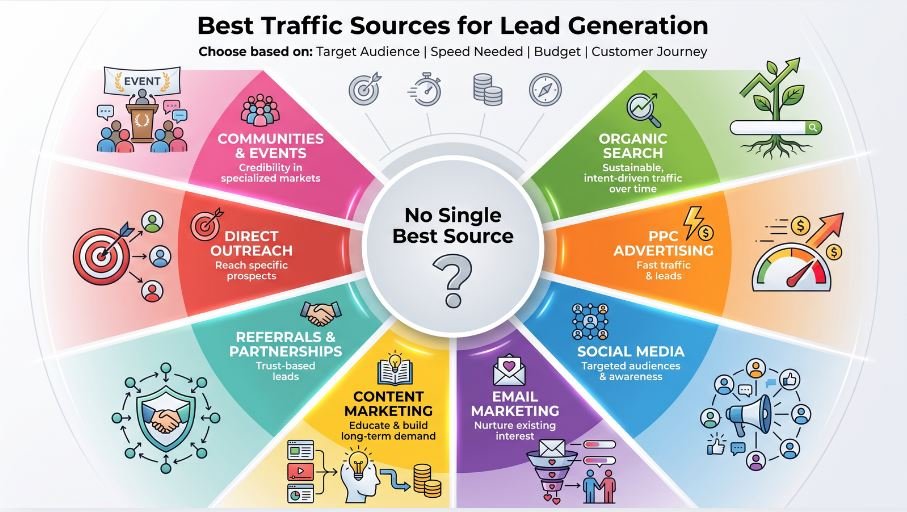
There is no single best traffic source for every business. The right choice depends on who you want to reach, how quickly you need leads, how much you can spend, and how your customers typically make buying decisions.
As a general guide:
- Organic search is best for building sustainable, intent-driven traffic over time.
- PPC advertising is best when you need traffic and leads quickly.
- Social media is best for reaching targeted audiences and building awareness.
- Email marketing is best for nurturing people who have already shown interest in your business.
- Content marketing is best for educating prospects and building long-term demand.
- Referrals and partnerships are best for generating trust-based leads and introductions.
- Direct outreach is best when you can identify specific prospects you want to reach.
- Communities and events are best for building credibility and relationships within specialized markets.
For most businesses, the best strategy is not choosing one traffic source. It is combining two or three complementary channels, measuring the quality of leads each produces, and investing more heavily in the sources that consistently lead to qualified prospects and customers.
What Is a Traffic Source in Lead Generation?
A traffic source is the channel through which a potential customer discovers or reaches your business.
Common traffic sources include:
- Organic search
- Paid search
- Social media
- Referral websites
- Online communities
- Direct outreach
- Events and offline marketing
Understanding where prospects come from allows you to determine which marketing activities are actually contributing to your pipeline.
Traffic Sources vs. Lead Generation Tools
Traffic sources and lead generation tools perform different jobs.
Traffic sources bring potential customers to your business.
Lead generation tools help you capture, qualify, nurture, or manage those prospects.
For example, someone might discover your company through Google search. Organic search is the traffic source.
After reaching your website, that person might complete a form created with landing page software and then enter your CRM. The form software and CRM are lead generation tools.
You need both sides of the process to work together.
If you’re still building the technology side of your strategy, our guide to how to build a B2B lead generation stack explains how different lead generation tools can work together.
Why Traffic Quality Matters More Than Traffic Volume
Traffic numbers can be misleading.
Suppose one channel sends 10,000 visitors to your website but generates only a handful of qualified prospects. Another sends 1,000 visitors but produces dozens of genuine sales opportunities.
The smaller source is probably more valuable.
High-quality traffic tends to come from people who:
- Match your target customer profile
- Have a problem your business can solve
- Show meaningful interest in your offer
- Are at an appropriate stage of the buying process
This is why businesses should evaluate traffic sources based on conversions and customers rather than visitors alone.
Our guide to high-intent vs. low-intent traffic explains this distinction in more detail.
Organic Search Traffic
Organic search traffic comes from unpaid search engine results.
Someone searches Google or another search engine for information, finds one of your pages, and visits your website.
For lead generation, the major advantage of organic search is intent.
A person searching for “accounting software for construction companies” or “best CRM for small law firms” is actively looking for information related to a specific problem or solution.
That makes search traffic potentially valuable even when overall visitor numbers are relatively modest.
When Organic Search Works Best
SEO is particularly useful when:
- Customers research solutions before buying
- Your products or services solve problems people search for online
- You have expertise that can be turned into useful content
- You want a sustainable source of traffic
- You can wait for results to develop
SEO is not an instant lead generation strategy. Creating useful content, earning visibility, and building search authority can take time.
The benefit is that successful content can continue attracting prospects long after it is published.
Advantages of Organic Search
- Reaches people actively searching for information
- Can generate traffic over long periods
- Does not require paying for every visitor
- Supports authority and brand visibility
- Can target prospects throughout the buying journey
Disadvantages of Organic Search
- Usually takes time to produce meaningful results
- Requires ongoing content and SEO work
- Competitive keywords can be difficult to rank for
- Search rankings can change
- Traffic does not automatically translate into qualified leads
Pay-Per-Click Advertising
Pay-per-click advertising, or PPC, allows businesses to purchase traffic rather than waiting to earn organic visibility.
Google Ads and Microsoft Advertising are common examples.
Search advertising can be especially useful for lead generation because ads can appear when someone searches for a specific product, service, or solution.
Search Advertising
Search ads target people according to the terms they enter into a search engine.
That makes keyword selection extremely important.
A broad informational search may indicate curiosity, while searches containing terms such as “pricing,” “service,” “software,” “demo,” or “best” may suggest that the searcher is closer to taking action.
Advertisers can also control factors such as:
- Location
- Device
- Schedule
- Keyword targeting
- Daily budget
This makes paid search easier to test and adjust than many long-term marketing channels.
Display and Retargeting Advertising
Display advertising places visual ads across websites, apps, and other digital properties.
Unlike search ads, display ads often reach people who are not actively searching for your solution at that moment.
That makes display advertising more useful for awareness and retargeting than for capturing immediate search intent.
Retargeting allows you to advertise to people who previously interacted with your website. For example, someone who visited a product or pricing page without converting could later see an ad reminding them about your business.
Advantages of PPC
- Can begin generating traffic quickly
- Offers precise targeting options
- Provides strong budget control
- Makes testing different offers easier
- Produces detailed performance data
Disadvantages of PPC
- Requires ongoing advertising spend
- Competitive keywords can be expensive
- Poor targeting can waste money quickly
- Campaigns require regular optimization
- Traffic usually declines when advertising stops
Social Media Traffic
Social media can generate traffic through both organic content and paid advertising.
The right platform depends heavily on the audience you want to reach.
LinkedIn is generally more relevant for B2B audiences, while platforms such as Facebook, Instagram, TikTok, and YouTube can be valuable for different consumer audiences and industries.
Organic Social Media
Organic social traffic comes from unpaid posts, videos, conversations, shares, and other activity.
Businesses can use social content to:
- Share useful information
- Demonstrate expertise
- Participate in industry conversations
- Promote educational content
- Build an audience over time
The challenge is that organic reach can be unpredictable. Building a meaningful audience usually requires consistent participation rather than occasional promotional posts.
Paid Social Media
Paid social advertising allows businesses to reach audiences beyond their existing followers.
Depending on the platform, advertisers may be able to target users according to factors such as:
- Demographics
- Interests
- Job titles
- Industry
- Company characteristics
- Previous interactions
Paid social can therefore be useful when you know who your ideal customer is but cannot easily reach that person through search.
Email Marketing
Email is different from most traffic sources because the audience usually has an existing relationship with your business.
Subscribers may have:
- Downloaded a resource
- Signed up for a newsletter
- Registered for a webinar
- Requested information
- Previously purchased from you
That makes email particularly valuable for lead nurturing.
Instead of continually paying to reacquire the same prospect through advertising, you can communicate directly with people who have agreed to hear from you.
How Email Supports Lead Generation
Email can help businesses:
- Deliver educational content
- Follow up with new leads
- Promote webinars or resources
- Re-engage inactive prospects
- Move leads toward the next stage of the buying process
The key is relevance.
Someone who downloaded an introductory guide should not necessarily receive the same message as a prospect who has already requested pricing.
Segmenting your audience according to interests, behavior, or buying stage can make email considerably more useful.
Content Marketing
Content marketing attracts prospects by providing information that helps them understand a problem, evaluate options, or make a decision.
Common formats include:
- Blog articles
- Videos
- Webinars
- Guides
- Checklists
- Templates
- Case studies
- Research reports
Content marketing and organic search often work together, but they are not the same thing.
SEO helps people discover content through search engines. Content can also reach prospects through email, social media, referrals, communities, and other channels.
Lead Magnets
Some content is designed specifically to capture contact information.
A lead magnet offers something useful in exchange for information such as an email address.
Examples include:
- Templates
- Checklists
- Calculators
- Guides
- Webinars
- Toolkits
A good lead magnet solves a specific problem rather than simply offering more content.
If you’re deciding whether gated resources belong in your strategy, see our guide to whether lead magnets are worth it.
Referral Traffic and Partnerships
Referral traffic comes from people or organizations that direct prospects to your business.
This can include:
- Existing customers
- Business partners
- Affiliates
- Industry websites
- Professional networks
Referral leads can be especially valuable because the prospect often arrives with some degree of trust already established.
Customer Referrals
Satisfied customers can introduce your business to people with similar needs.
Businesses can encourage this through formal referral programs or simply by making it easy for customers to recommend them.
The important point is not the incentive itself. It is the relevance and trust behind the recommendation.
Strategic Partnerships
Businesses serving similar audiences without directly competing can also exchange referrals or collaborate on marketing.
For example, an accountant and a business attorney may serve many of the same companies while offering different services.
A strong partnership gives both businesses access to a relevant audience while providing genuine value to the customer.
Affiliate Partnerships
Affiliate programs allow third parties to promote a product or service in return for compensation when a defined action occurs.
Because payment can be tied to sales or qualified leads, affiliate marketing can create a performance-based source of traffic.
The effectiveness of an affiliate program depends heavily on partner quality, audience relevance, tracking, and the economics of the offer.
Direct Outreach
Not every lead generation strategy waits for prospects to come to you.
Direct outreach involves identifying potential customers and contacting them proactively.
Common channels include:
- Cold email
- LinkedIn outreach
- Phone outreach
- Direct messaging
This approach is particularly common in B2B markets where businesses can identify specific companies, industries, or decision-makers they want to reach.
Cold Email
Cold email can work when outreach is carefully targeted and relevant to the recipient.
Effective campaigns typically require:
- A clearly defined target audience
- Accurate contact information
- Relevant messaging
- A clear reason for contacting the prospect
- A simple next step
Sending large volumes of generic email is very different from targeted prospecting.
Businesses also need to consider email deliverability and applicable marketing and privacy rules when conducting outreach.
LinkedIn Outreach
LinkedIn gives B2B marketers another way to identify and communicate with professional prospects.
The platform can be particularly useful when job title, company, industry, or professional role helps define your ideal customer.
As with cold email, personalization matters. Generic connection requests and sales pitches are easy to ignore.
Direct outreach is one form of outbound marketing. For a broader comparison of approaches, see inbound vs. outbound lead generation.
Communities and Industry Forums
Online communities can be useful traffic sources when businesses participate as genuine members rather than treating every conversation as a promotional opportunity.
Potential sources include:
- Reddit communities
- Facebook Groups
- Industry forums
- Professional communities
- Slack or Discord groups
- Question-and-answer platforms
These channels work differently from paid advertising.
People join communities to exchange information, ask questions, and learn from peers. Businesses that repeatedly promote themselves may quickly lose credibility or violate community rules.
A better strategy is to contribute useful answers and establish expertise. Relevant traffic can follow naturally when people want additional information.
Community marketing is generally a long-term relationship strategy rather than a quick traffic tactic.
Events and Offline Lead Sources
Not every useful lead source is digital.
For some businesses, particularly B2B companies and local service providers, offline channels can produce highly relevant prospects.
Examples include:
- Industry conferences
- Trade shows
- Networking events
- Professional associations
- Local business organizations
- Educational workshops
- Direct mail
- Community sponsorships
Events provide something digital channels often cannot: direct conversation.
A salesperson can learn about a prospect’s needs, answer questions, and determine whether there is a potential fit in real time.
The downside is cost and scalability. Conferences, sponsorships, travel, booths, and staff time can make event-generated leads expensive.
Businesses should therefore measure the opportunities and revenue generated rather than judging an event by attendance or the number of contacts collected.
How the Major Lead Generation Traffic Sources Compare
Different channels solve different problems.
| Traffic Source | Speed | Typical Cost Structure | Best For |
|---|---|---|---|
| Organic search | Slow to build | Time and content investment | Sustainable, intent-driven traffic |
| PPC | Fast | Pay per click | Immediate demand capture |
| Organic social | Slow to moderate | Time and content | Audience and brand building |
| Paid social | Fast to moderate | Advertising spend | Targeted audience reach |
| Fast with an existing list | Software and content | Lead nurturing | |
| Content marketing | Slow to build | Content production | Education and long-term demand |
| Referrals | Variable | Usually low direct cost | Trust-based leads |
| Direct outreach | Fast to moderate | Data, tools, and labor | Targeted B2B prospecting |
| Communities | Slow | Time and participation | Niche audiences and credibility |
| Events | Event dependent | Often relatively high | Relationships and complex sales |
These are general characteristics rather than guarantees. Performance varies considerably by industry, audience, offer, competition, and execution.
How to Choose the Right Traffic Sources
Choosing a traffic source should begin with your customer, not the channel.
Ask where your ideal customers look for information and how they typically discover solutions like yours.
Then consider four factors.
Your Audience
Where does your target customer spend time?
A B2B company selling enterprise software may prioritize search, LinkedIn, industry publications, and conferences.
A consumer brand may find more opportunity through Instagram, TikTok, YouTube, influencers, and paid search.
The best channel is the one that gives you meaningful access to the people you actually want to reach.
Your Budget
Paid advertising can produce results quickly, but it requires continuous spending.
SEO, content, and organic social may require less direct media spending, but they still require time, expertise, and content production.
There is no truly free traffic source. The cost simply appears in different forms.
Your Sales Cycle
Short buying cycles can work well with channels that capture immediate demand.
Longer sales cycles often require multiple interactions before someone becomes a customer.
In those situations, search, content, email, webinars, retargeting, and other nurturing channels may work together rather than independently.
Understanding where prospects are in the lead generation funnel can help you match channels and content to different stages of the buying process.
Your Timeline
If you need leads immediately, relying entirely on SEO probably does not make sense.
If your goal is to build a durable source of leads over several years, depending entirely on paid advertising may not be ideal either.
Many businesses combine faster channels with slower compounding channels.
For example, PPC can capture demand today while SEO and content build organic visibility for the future.
Common Traffic Source Mistakes
Choosing the right channels matters, but avoiding a few common mistakes is equally important.
Chasing Traffic Instead of Qualified Leads
Large visitor numbers can look impressive without contributing much to revenue.
Measure what happens after the click.
Do visitors become leads? Are those leads qualified? Do they become customers?
Our guide to high-quality leads explains the characteristics that separate useful prospects from leads that simply increase database size.
Trying Too Many Channels at Once
Businesses sometimes assume that being everywhere will generate more leads.
In practice, spreading a limited budget and team across too many channels can make it difficult to execute any of them well.
Starting with two or three promising sources usually makes measurement easier.
Once you know what works, you can expand.
Depending Too Heavily on One Source
The opposite problem can also be risky.
If nearly all your leads depend on one advertising platform, search engine, partner, or social network, a change outside your control can disrupt your pipeline.
Diversification reduces that risk.
The goal is not to use every channel. It is to avoid becoming unnecessarily dependent on one.
Ignoring Conversion Tracking
Traffic source data becomes much more useful when it connects to actual business results.
At minimum, track:
- Visitors by source
- Leads generated
- Conversion rate
- Cost per lead
- Qualified leads
- Customers
- Customer acquisition cost
For businesses with longer sales cycles, connecting marketing analytics with CRM data can help identify which sources produce revenue rather than simply form submissions.
Tools for Tracking Lead Generation Traffic
You do not need dozens of platforms to understand where your leads come from.
A basic tracking system may include several types of tools.
Web Analytics
Analytics platforms show where website visitors originate and what they do after arriving.
This can help you compare organic search, paid traffic, social media, referrals, email, and direct visits.
Search Performance Tools
Search tools can show which queries and pages generate organic visibility and clicks.
This information helps determine whether SEO is attracting the type of audience you intended to reach.
CRM and Attribution Tools
A CRM can connect individual leads and customers with their acquisition sources.
More advanced attribution systems can track multiple interactions across a longer buying journey.
This is particularly important for B2B companies where a prospect may discover a business through search, return through social media, attend a webinar, receive several emails, and finally request a sales call.
Lead Capture Tools
Forms, landing pages, chat tools, and other lead capture software turn traffic into identifiable prospects.
Traffic acquisition and lead capture should therefore be evaluated together.
A channel that sends qualified visitors can still perform poorly if the landing page, form, or offer creates unnecessary friction.
Frequently Asked Questions
Which traffic source generates the highest-quality leads?
There is no universal winner.
Referrals can produce excellent leads because they arrive with established trust. Organic search can produce high-quality leads when people search for specific solutions. LinkedIn and industry events may work particularly well for some B2B companies.
The most reliable way to determine lead quality is to track qualified leads and customers by source.
What traffic source works fastest?
Paid search and paid social can begin sending traffic as soon as campaigns are active.
Direct outreach can also generate conversations relatively quickly when you already know which prospects you want to target.
Organic search, content marketing, communities, and organic social generally take longer to build.
Is SEO better than paid advertising for lead generation?
Neither is inherently better.
SEO is generally better suited to building long-term organic visibility, while paid advertising provides faster traffic and greater control over targeting.
Many businesses use both.
Paid advertising can capture immediate demand while SEO builds a source of traffic that does not require paying for every click.
How many traffic sources should a business use?
Start with a small number of channels you can execute and measure properly.
For many businesses, two or three primary sources are enough initially.
Once you understand which channels generate qualified leads, you can expand into additional sources without spreading your resources too thin.
Final Thoughts: Build Around Lead Quality
The best traffic source is not necessarily the one that sends the most visitors.
It is the one that consistently brings people who are a good fit for your business and have a realistic chance of becoming customers.
That means traffic should never be evaluated in isolation.
Look beyond clicks and sessions. Track which channels generate qualified leads, how much those leads cost, and how often they eventually become customers.
Then invest more heavily in what works.
A balanced lead generation strategy often combines channels that serve different purposes. Paid advertising and outreach can create opportunities quickly. SEO and content can build sustainable demand. Email can nurture prospects. Referrals, communities, and events can add trust and relationships.
The right mix is the one that produces qualified opportunities at a cost your business can sustain.