
Most lead scoring models look impressive inside a CRM, but many have little connection to actual sales outcomes. A prospect can open a few emails, download a guide, and accumulate enough points to appear “sales ready” even though they have no intention of buying. Meanwhile, genuinely interested buyers sometimes slip through the cracks because they don’t match the assumptions built into the model.
The problem is not lead scoring itself. The problem is that many scoring systems are built on opinions rather than evidence. Teams assign point values based on what feels important instead of analyzing which attributes and behaviors actually correlate with closed deals. Over time, the scores become little more than educated guesses.
A lead scoring model should do one thing exceptionally well: predict which leads are most likely to become customers. In this guide, you’ll learn how to build a scoring model using real sales data, identify the signals that matter most, create meaningful thresholds, and measure whether your model is actually improving conversion rates. By the end, you’ll have a practical framework that helps sales focus on the opportunities most likely to generate revenue.
Quick Answer
A lead scoring model predicts which prospects are most likely to become customers by assigning points to the characteristics and behaviors that correlate with successful sales. The most effective models are built using real conversion data rather than assumptions about what might indicate buying intent.
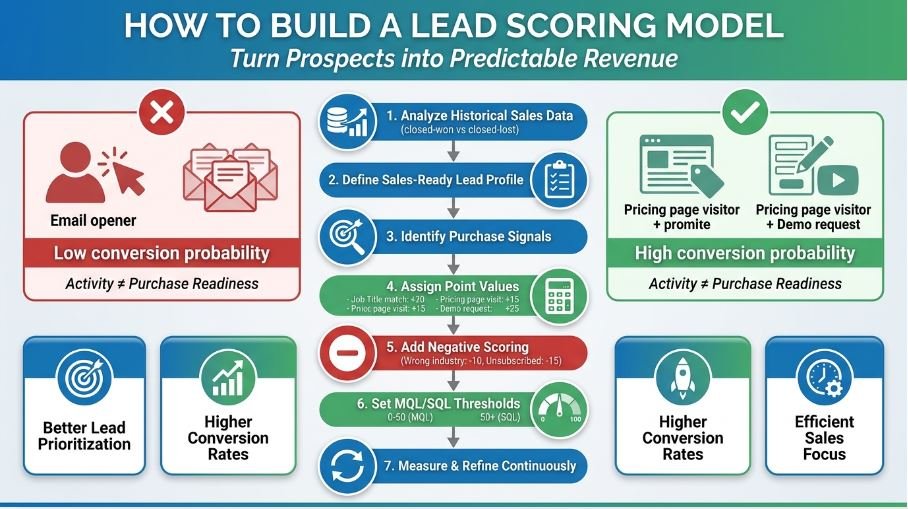
Many lead scoring systems fail because they reward activity instead of purchase readiness. A prospect who opens multiple emails may never buy, while someone who visits your pricing page and requests a demo could become a customer within days. The goal of lead scoring is to identify those differences and help sales focus on the opportunities most likely to close.
To build a lead scoring model, analyze your closed-won and closed-lost deals, identify the attributes and behaviors that consistently predict sales, assign scores based on those patterns, add negative scoring for poor-fit leads, and establish qualification thresholds that align with your sales process.
Essential Steps:
- Analyze historical sales data
- Define what a sales-ready lead looks like
- Identify the signals that predict purchases
- Assign scores to lead attributes and behaviors
- Add negative scoring for poor-fit leads
- Create MQL and SQL thresholds
- Measure results and refine the model over time
A successful lead scoring model improves lead prioritization, increases conversion rates, and helps sales spend more time with prospects who are genuinely likely to become customers.
What Is a Lead Scoring Model?
A lead scoring model is a system that assigns points to prospect attributes and behaviors to predict which leads are most likely to become customers. Companies use lead scoring to prioritize sales outreach, improve conversion rates, and focus attention on high-value opportunities.
Key Takeaways
- The best lead scoring models are built from actual sales data, not assumptions about what might predict conversion.
- Buying intent matters more than activity. A pricing page visit or demo request often signals more value than multiple email opens or content downloads.
- Effective models combine firmographic fit with behavioral signals. A lead should look like your ideal customer and act like someone preparing to buy.
- Negative scoring is just as important as positive scoring. Removing points for poor-fit leads helps prevent false positives and wasted sales effort.
- Sales and marketing should agree on scoring criteria and qualification thresholds before launching a model.
- Your first scoring model is a starting point, not a finished product. Review conversion data regularly and adjust scores based on actual results.
- A successful lead scoring model improves lead prioritization, conversion rates, and revenue by helping sales focus on the prospects most likely to become customers.
What Is a Lead Scoring Model?
A lead scoring model assigns point values to prospect attributes and behaviors to predict which leads are most likely to become customers. Companies use lead scoring to prioritize sales outreach, improve conversion rates, and focus resources on the opportunities with the highest likelihood of closing.
Lead scoring is often confused with lead qualification, but they serve different purposes. Lead scoring is an automated process that ranks leads based on data such as company size, job title, website activity, and content engagement. Lead qualification is the process of determining whether a prospect is genuinely ready for a sales conversation. In most organizations, lead scoring helps identify which leads should move into the qualification process.
If you’re unclear about where scoring ends and qualification begins, see our guide on What Is Lead Qualification? for a detailed breakdown of how the two processes work together.
The goal of a lead scoring model is not simply to measure engagement. The goal is to predict sales outcomes. A prospect who opens every email may never become a customer, while someone who visits your pricing page twice and requests a demo could be ready to buy. The most effective scoring models focus on identifying the signals that correlate with real purchasing behavior.
Unfortunately, many companies build scoring models that do not accurately predict sales. They assign point values based on assumptions, reward the wrong activities, and fail to update the model as buyer behavior changes. Before building your own scoring system, it’s important to understand the mistakes that cause most lead scoring models to fail.
New to lead scoring? Start with What Is Lead Scoring? for a foundational overview before building your own scoring model.
Why Most Lead Scoring Models Fail
Most lead scoring models fail for a simple reason: they measure activity instead of predicting purchases. Teams assign points based on assumptions, reward the wrong behaviors, and rarely verify whether their scores correlate with actual sales outcomes. The result is a system that generates numbers but provides little guidance on which leads are most likely to become customers.
An effective scoring model should help sales identify buying intent, prioritize the right opportunities, and improve conversion rates. Unfortunately, many organizations make the same mistakes that prevent their models from delivering meaningful results.
Assigning Points Without Real Data
Many companies build lead scoring models based on opinions rather than evidence. Someone decides that an email open should be worth 10 points or a content download should be worth 20 points without ever checking whether those actions actually correlate with closed deals.
The problem is that what feels important is not always what predicts sales. A lead may consume large amounts of content without any intention of purchasing. Another prospect may engage very little before becoming a customer.
Instead of guessing, start with your sales data. Review your closed-won and closed-lost opportunities and identify the factors that appear most often among successful customers. Which job titles convert most frequently? Which industries close at the highest rates? Which actions consistently occur before a purchase?
If you do not have enough historical data, begin with a simple model based on a handful of signals you can validate. Complexity should be earned through evidence, not assumptions.
Focusing on Activity Instead of Buying Intent
One of the most common lead scoring mistakes is treating engagement as if it were purchase intent.
A prospect who opens every email, attends webinars, and downloads multiple resources may appear highly engaged. However, that does not necessarily mean they are preparing to buy. In many cases, they are simply gathering information.
Meanwhile, another prospect may quietly visit your pricing page, compare solutions, and request a demo. Their overall activity level may be lower, but their buying intent is significantly higher.
The strongest scoring models prioritize signals that indicate active evaluation rather than general engagement. Examples include:
- Pricing page visits
- Demo requests
- Trial signups
- Product comparison downloads
- Contact form submissions
- Stated purchasing timelines
Engagement matters, but intent matters more. Your scoring model should reward behaviors that consistently precede sales conversations and closed deals.
Ultimately, lead scoring should help you identify more high-quality leads, not simply generate higher engagement scores. Learn more in What Are High-Quality Leads?
Ignoring Negative Signals
Many lead scoring systems only add points. They never subtract them.
This creates a problem because poor-fit leads can accumulate high scores through activity alone. A student researching a class project, a competitor evaluating your product, or a prospect outside your target market may generate significant engagement without ever becoming a customer.
Negative scoring helps eliminate these false positives.
Common negative signals include:
- Student or academic email addresses
- Competitor domains
- Job titles with no purchasing influence
- Companies outside your target market
- Unsubscribes and disengagement
- Long periods of inactivity
Negative scoring is often just as important as positive scoring. Removing points for poor-fit characteristics helps ensure that high scores reflect genuine sales potential rather than simple activity.
Never Updating the Model
Even a well-designed lead scoring model will become less accurate over time if it is never reviewed.
Markets change. Products evolve. Buyer behavior shifts. A model that worked perfectly a year ago may no longer reflect how customers make purchasing decisions today.
For example, a company that originally sold primarily to small businesses may later move upmarket and focus on enterprise accounts. The attributes that once predicted success may become less relevant as the ideal customer profile changes.
Review your scoring model at least quarterly. Compare lead scores against actual sales outcomes and look for patterns. High-scoring leads should consistently convert at higher rates than low-scoring leads.
If they do not, your scoring criteria, point values, or thresholds need adjustment.
The best lead scoring models are never truly finished. They improve through ongoing testing, measurement, and refinement. The goal is not to build a perfect model. The goal is to build a model that becomes more accurate over time.
Step 1: Define What a Sales-Ready Lead Looks Like
Before you can assign point values, set thresholds, or build scoring rules, you need to know exactly what you’re trying to predict. The goal of a lead scoring model is not to identify every potential customer. The goal is to identify the prospects who are most likely to become customers.
Many companies skip this step and jump directly into assigning scores. As a result, they create models that measure activity rather than sales readiness. The most effective scoring models begin with a clear definition of what a sales-ready lead actually looks like.
Analyze Closed-Won and Closed-Lost Deals
Start by reviewing data from your past 50-100 closed-won and closed-lost opportunities. Looking only at successful customers can be misleading. The real value comes from identifying what separates customers who bought from prospects who did not.
Review factors such as:
- Job title and seniority
- Company size
- Industry
- Geographic location
- Lead source
- Sales cycle length
- Website activity
- Content engagement
Look for meaningful differences between your best customers and leads that never converted. These patterns often reveal the strongest predictors of future sales.
Identify the Characteristics Your Best Customers Share
Once you’ve reviewed your historical data, identify the traits that consistently appear among successful customers.
Focus on both firmographic fit and buying behavior.
Firmographic indicators may include:
- Company size
- Revenue range
- Industry
- Technology stack
- Geographic location
Behavioral indicators may include:
- Pricing page visits
- Demo requests
- Product comparison downloads
- Webinar attendance
- Multiple return visits
Your goal is to identify the combination of characteristics and behaviors that appear most frequently among closed-won opportunities.
Remember that fit alone is not enough. A lead may perfectly match your ideal customer profile but have no intention of buying. The strongest scoring models consider both who the prospect is and what they are doing.
Validate Your Findings With Sales
Your CRM data tells part of the story. Your sales team often knows the rest.
Meet with the sales reps who regularly close deals and ask questions such as:
- What traits do your best customers share?
- Which buying signals typically appear before a sale?
- What characteristics are common among leads that never convert?
- Which prospects move through the pipeline most quickly?
Sales teams often identify patterns that do not appear clearly in reports. Their feedback can help you avoid assigning importance to signals that look promising in the data but rarely influence purchasing decisions.
Create a Sales-Ready Lead Profile
Once you’ve defined your ideal sales-ready lead, the next challenge is creating a consistent qualification process. See How to Build a Lead Qualification Process to turn your scoring criteria into actionable sales workflows.
By the end of this step, you should be able to clearly describe what a sales-ready lead looks like for your business.
For example:
A marketing director at a SaaS company with 50-500 employees who has visited the pricing page, downloaded a comparison guide, and requested a demo within the past 30 days.
This profile becomes the foundation of your lead scoring model. Every point value, scoring rule, and qualification threshold you create should support your ability to identify leads that match this definition.
Once you have a clear picture of your ideal sales-ready lead, the next step is identifying the specific signals that indicate a prospect is moving toward a purchase decision.
Step 2: Identify the Signals That Predict Sales
Once you’ve defined what a sales-ready lead looks like, the next step is determining which signals indicate a prospect is moving toward that outcome.
Not every characteristic or behavior deserves a place in your scoring model. The goal is to identify the factors that consistently appear before a sale. Some signals help you understand whether a prospect matches your ideal customer profile, while others reveal how interested they are and how close they may be to making a purchase.
At this stage, focus on identifying potential predictors. Do not worry about point values yet. Your goal is simply to build a list of signals that may help predict future sales.
Firmographic Signals Tell You Who the Prospect Is
Firmographic signals help you determine whether a lead resembles the types of customers who typically buy from you. These characteristics often come from form submissions, CRM records, enrichment tools, or third-party data providers.
Common firmographic signals include:
- Company size
- Annual revenue
- Industry
- Geographic location
- Technology stack
- Growth rate
- Funding status
Review your closed-won opportunities and look for patterns. Do your best customers tend to come from specific industries? Are they typically mid-market companies or large enterprises? Do certain geographic regions convert more frequently than others?
The goal is to identify the characteristics that consistently appear among successful customers. These signals help determine whether a prospect fits your target market.
Behavioral Signals Show How the Prospect Engages
Behavioral signals reveal how prospects interact with your brand. They help you understand what a lead is doing, how engaged they are, and whether their interest is increasing over time.
Common behavioral signals include:
- Website visits
- Content downloads
- Webinar registrations
- Webinar attendance
- Email engagement
- Product page views
- Return visits
- Form submissions
Pay attention to patterns among customers who eventually purchased. Which actions occurred most often before a lead became an opportunity? Which activities appear frequently among customers but rarely among non-buyers?
Not every behavior is equally meaningful, but identifying these patterns helps you determine which activities deserve further analysis in your scoring model.
Many B2B lead generation platforms can automatically track these signals and feed them into your scoring model. See our guide to the Best B2B Lead Generation Tools to explore popular options.
Intent Signals Reveal How Close They Are to Buying
Intent signals are often the strongest predictors of future sales because they indicate active evaluation rather than general interest.
A prospect can be a perfect fit and highly engaged while still having no immediate plans to purchase. Intent signals help distinguish curious prospects from serious buyers.
Common intent signals include:
- Pricing page visits
- Demo requests
- Free trial signups
- Product comparison downloads
- Contact sales form submissions
- Requests for proposals
- Discussions about implementation
- Stated purchasing timelines
When reviewing your customer data, look for actions that consistently occur shortly before opportunities are created or deals are closed. These signals often reveal that a prospect has moved beyond research and entered an active buying process.
Different signals appear at different stages of the buying journey. Understanding where they fit within your overall lead generation funnel can help improve scoring accuracy.
Build Your Predictive Signal List
By the end of this step, you should have a documented list of the firmographic, behavioral, and intent signals that appear most frequently among successful customers.
This list becomes the raw material for your lead scoring model. In the next step, you’ll determine which of these signals deserve the most weight and begin assigning point values based on their relationship to actual sales outcomes.
Step 3: Assign Point Values to Lead Attributes
Now that you’ve identified the attributes that correlate with successful customers, the next step is determining how much each one should influence a lead’s score.
The purpose of assigning point values is not to reward every attribute equally. The goal is to reflect the relative importance of each factor. Attributes that strongly correlate with sales should receive more weight than attributes that have little impact on conversion rates.
At this stage, focus on the firmographic traits that help determine whether a prospect resembles your ideal customer profile.
Weight Industry Fit
Some industries will naturally convert at higher rates than others. Review your historical sales data and identify which industries consistently produce customers.
Assign the most points to industries where you have the highest win rates and strongest customer success outcomes. Industries that occasionally convert can receive moderate scores, while industries that rarely purchase should receive few or no points.
A simple framework might look like this:
- High-fit industries: Highest point values
- Moderate-fit industries: Medium point values
- Low-fit industries: Minimal or no points
- Poor-fit industries: Negative points if appropriate
The exact values matter less than ensuring the scoring reflects real conversion patterns.
Weight Company Size
Company size often influences purchasing behavior, budget availability, and sales cycle length.
Look at the size ranges that appear most frequently among your successful customers. If most of your customers have between 100 and 500 employees, that range should receive more weight than companies that fall far outside your typical customer profile.
Avoid assuming that larger companies are always better prospects. The most valuable score is the one that reflects your actual customer data, not conventional wisdom.
Weight Decision-Making Authority
Job title helps determine whether a lead has the influence or authority needed to drive a purchase decision.
In many B2B environments, executives, directors, and department leaders play a larger role in purchasing decisions than individual contributors. However, the specific titles that matter most will depend on your product and sales process.
Review your closed deals and identify which roles appear most frequently among decision-makers, evaluators, and champions.
Focus on questions such as:
- Who typically signs the contract?
- Who evaluates solutions?
- Who initiates the buying process?
- Who influences the final decision?
The answers will help determine which roles deserve the most weight in your model.
Weight Geographic Fit
Geographic location may influence conversion rates depending on your business model, support capabilities, compliance requirements, or target market.
For some companies, geography is a major factor. For others, it may have little impact. Review your customer data to determine whether location affects sales outcomes.
If certain regions consistently produce stronger customers, shorter sales cycles, or higher win rates, geography may deserve a place in your scoring model. If not, keep its weight relatively low.
Remember that every attribute does not need to carry equal importance. The strongest predictors of sales should receive the greatest influence on the final score.
Create Your Attribute Scoring Table
By the end of this step, you should have a preliminary scoring table for your most important firmographic attributes.
For example:
| Attribute | Criteria | Example Weight |
|---|---|---|
| Industry | High-fit industry | High |
| Industry | Moderate-fit industry | Medium |
| Company Size | Ideal customer range | High |
| Job Title | Decision-maker | High |
| Geographic Location | Primary market | Medium |
These values do not need to be perfect. They simply provide a starting point based on the patterns you’ve identified in your customer data.
In the next step, you’ll assign point values to behavioral and engagement signals so you can combine customer fit and buyer activity into a complete lead scoring model.
Step 4: Assign Point Values to Lead Behaviors
Once you’ve assigned scores to firmographic attributes, the next step is weighting the behaviors that indicate interest, evaluation, and buying intent.
Not all actions deserve the same score. Some behaviors reflect general curiosity, while others suggest a prospect is actively evaluating solutions and preparing to make a purchase. Your goal is to assign greater weight to behaviors that consistently occur before opportunities are created and deals are closed.
As a general rule, buying intent should carry more weight than engagement alone.
Weight Low-Intent Engagement Signals
Low-intent signals indicate awareness and general interest, but they do not necessarily suggest that a prospect is preparing to buy.
Examples include:
- Reading blog posts
- Opening marketing emails
- Visiting educational content
- Downloading introductory resources
- Following your company on social media
These activities can help identify engaged prospects, but they often occur early in the buyer journey. Many leads will perform these actions without ever becoming customers.
Low-intent behaviors should receive relatively modest scores because they indicate interest rather than purchase readiness.
Weight Mid-Intent Evaluation Signals
Evaluation signals suggest that a prospect has moved beyond awareness and is actively researching potential solutions.
Examples include:
- Downloading case studies
- Viewing product feature pages
- Attending webinars
- Reading customer success stories
- Comparing different solutions
- Returning to your website multiple times
These actions often indicate that a prospect is evaluating whether your solution can address a specific problem.
Pay close attention to patterns that appear among closed-won customers. You may discover that certain content types or website pages consistently appear during the evaluation stage of successful deals.
Evaluation signals should generally receive more weight than simple engagement because they indicate a deeper level of consideration.
Weight High-Intent Buying Signals
High-intent signals are often the strongest behavioral predictors of future sales because they indicate active buying activity rather than passive research.
Examples include:
- Visiting pricing pages
- Requesting a demo
- Starting a free trial
- Requesting a proposal
- Contacting sales
- Downloading product comparison guides
- Discussing implementation requirements
- Sharing purchasing timelines
These actions often occur shortly before opportunities are created or contracts are signed. When reviewing your historical sales data, look for the behaviors that consistently appear near the end of successful buying journeys.
High-intent actions should receive the greatest weight in your scoring model because they are typically the strongest indicators of purchase readiness.
Consider Recency and Frequency
Behavioral signals become more valuable when they occur frequently or recently.
For example, a prospect who visits your pricing page three times this week may be demonstrating stronger buying intent than someone who visited it once six months ago. Likewise, multiple visits to product pages, repeated content consumption, or several interactions within a short period often indicate growing interest.
When evaluating behavioral data, consider:
- How recently the action occurred
- How often the behavior occurred
- Whether engagement is increasing over time
- Whether multiple high-intent signals appear together
These factors can help improve the predictive power of your scoring model.
Create Your Behavioral Scoring Table
By the end of this step, you should have a behavioral scoring framework that ranks actions according to buying intent.
For example:
| Behavior Type | Example Actions | Relative Weight |
|---|---|---|
| Low Intent | Blog visits, email opens | Low |
| Mid Intent | Case studies, webinars, product pages | Medium |
| High Intent | Pricing pages, demos, free trials | High |
The exact point values will vary from one business to another. What matters most is that your scoring reflects the behaviors that actually predict sales within your organization.
At this point, you have assigned scores to both lead attributes and lead behaviors. The next step is incorporating negative scoring so poor-fit leads and disqualifying signals do not artificially inflate your results.
Step 5: Use Negative Scoring to Eliminate Poor-Fit Leads
Positive scoring identifies reasons a lead may buy. Negative scoring identifies reasons they probably will not.
Without negative scoring, poor-fit leads can accumulate points through activity alone and appear more qualified than they actually are. A prospect may open every email, attend webinars, and visit your website repeatedly while having little chance of ever becoming a customer.
An effective lead scoring model does not simply reward engagement. It also recognizes the signals that reduce the likelihood of a sale.
Reduce Scores for Poor-Fit Leads
Some prospects do not align with your ideal customer profile regardless of how engaged they appear.
Common examples include:
- Companies that are too small or too large for your solution
- Industries that rarely convert
- Organizations outside your target market
- Prospects in unsupported geographic regions
- Leads that lack the budget or resources required to purchase
These leads may still interact with your content, but their likelihood of becoming customers is lower than prospects that closely match your ideal customer profile.
If historical sales data consistently shows lower conversion rates for certain segments, your scoring model should reflect that reality.
Reduce Scores for Non-Buying Intent
Not everyone who engages with your company is evaluating a purchase.
Some people are researching the market, gathering information, exploring career opportunities, or conducting academic research. While these individuals may generate significant activity, they are often unlikely to become customers.
Examples may include:
- Students and academic researchers
- Job seekers
- Media inquiries
- Market analysts
- Competitor research
The specific categories will vary by industry, but the principle remains the same. If a lead’s primary objective is something other than purchasing, their score should be reduced accordingly.
Reduce Scores for Disengagement Signals
Interest changes over time. A prospect who appeared highly engaged six months ago may no longer be evaluating solutions today.
Disengagement signals help prevent old activity from inflating current lead scores.
Common examples include:
- Long periods of inactivity
- Unsubscribing from marketing communications
- Declining website engagement
- No response to outreach attempts
- Reduced interaction with key content
Many companies also use score decay, which gradually lowers a lead’s score as engagement becomes less recent.
Recency matters. A pricing page visit yesterday is often more valuable than multiple product page visits from six months ago.
Identify Automatic Disqualifiers
Some signals may indicate that a lead should never reach your sales team regardless of other activity.
Examples include:
- Competitor domains
- Invalid or fake contact information
- Duplicate records
- Regulatory or compliance restrictions
- Prospects outside your service area
These situations often justify substantial score reductions or immediate disqualification from the sales process.
The goal is not to remove every imperfect lead. The goal is to prevent obvious non-buyers from competing with legitimate opportunities for your sales team’s attention.
Create Your Negative Scoring Framework
By the end of this step, you should have a documented list of attributes, behaviors, and conditions that reduce lead quality and should lower a prospect’s score.
For example:
| Negative Signal Type | Example | Relative Impact |
|---|---|---|
| Poor Fit | Outside target industry | Medium |
| Non-Buying Intent | Student researcher | High |
| Disengagement | No activity for 90+ days | Medium |
| Disqualifier | Competitor domain | Very High |
Your negative scoring framework should work alongside your positive scoring model to produce a more accurate view of overall lead quality.
Once both positive and negative scoring are in place, the final step is determining the score thresholds that trigger marketing actions, sales outreach, and qualification handoffs.
Step 6: Establish Lead Score Thresholds
A lead score has no value unless it helps your team make decisions.
Thresholds transform individual scores into actionable categories by defining when a lead should remain in nurture, move to sales, or receive immediate attention. The goal is not to create arbitrary score ranges. The goal is to identify meaningful differences in conversion likelihood and align your sales process accordingly.
Analyze Conversion Rates by Score Range
Start by reviewing historical lead data and grouping leads into score ranges.
For example:
- 0-20
- 21-40
- 41-60
- 61-80
- 81-100
Then compare conversion rates across each group.
Ask questions such as:
- Which score ranges produce the most opportunities?
- Which ranges generate the highest close rates?
- Where do conversion rates begin to increase significantly?
- Which score bands rarely become customers?
The purpose of this analysis is to identify natural breakpoints in your data. If leads scoring 70 and above consistently convert at much higher rates than leads scoring below 50, that may indicate an effective sales threshold.
Let your data guide your decisions rather than relying on industry benchmarks or assumptions.
Define Your MQL and SQL Thresholds
Once you’ve identified meaningful score ranges, you can establish qualification thresholds.
A Marketing Qualified Lead (MQL) has demonstrated enough fit and engagement to justify additional attention from marketing and potentially sales.
A Sales Qualified Lead (SQL) has demonstrated sufficient buying intent and customer fit to warrant direct sales outreach.
The specific thresholds will vary by company, industry, and sales process. What matters most is that higher-scoring leads consistently convert at higher rates than lower-scoring leads.
If your highest-scoring leads perform no better than average leads, your thresholds may need adjustment.
Remember that qualification thresholds are working hypotheses, not permanent rules. As your business evolves and more data becomes available, expect to revisit and refine them.
Not sure where the line between an MQL and SQL should be? Our MQL vs SQL guide explains how leading sales and marketing teams define and manage both stages.
Create Workflow and Routing Rules
Once your thresholds are established, determine what actions should occur when a lead enters each score range.
For example:
| Score Range | Lead Status | Typical Action |
|---|---|---|
| Low Score | Early-Stage Lead | Continue nurturing |
| Mid Score | Marketing Qualified Lead (MQL) | Increase engagement and monitoring |
| High Score | Sales Qualified Lead (SQL) | Assign to sales for outreach |
| Very High Score | High-Priority Opportunity | Immediate follow-up |
Your workflow should ensure that sales receives the most promising opportunities quickly while marketing continues nurturing leads that are not yet ready to buy.
The exact process will vary by organization, but the principle remains the same: higher scores should trigger higher levels of attention.
Create Your Threshold Framework
By the end of this step, you should have a documented threshold framework that defines how lead scores translate into sales and marketing actions.
For example:
| Score Range | Status | Action |
|---|---|---|
| 0-39 | Early-Stage Lead | Continue nurture campaigns |
| 40-69 | MQL | Marketing follow-up and monitoring |
| 70+ | SQL | Direct sales outreach |
These thresholds do not need to be perfect on day one. They simply need to create meaningful differences in conversion rates between score ranges.
Once your thresholds are in place, your lead scoring model is complete. The next step is measuring how well it performs and refining it over time based on actual sales outcomes.
Putting It All Together: Example Lead Evaluation
Now let’s see how a completed lead scoring model might evaluate a real prospect.
Imagine a lead with the following profile:
- Marketing Director at a SaaS company
- 150 employees
- Visited the pricing page twice
- Downloaded a product comparison guide
- Requested a demo
- No negative scoring signals
A scoring model might evaluate this prospect as follows:
| Scoring Category | Example Score |
|---|---|
| Industry Fit | +20 |
| Company Size | +15 |
| Job Title | +15 |
| Pricing Page Visits | +15 |
| Comparison Guide Download | +10 |
| Demo Request | +25 |
| Negative Scoring | 0 |
| Total Score | 100 |
In this example, the lead demonstrates both strong customer fit and strong buying intent. Because the prospect exceeds the established SQL threshold, the lead would be routed directly to sales for immediate follow-up.
Now consider a different prospect:
- Student researcher
- Downloaded multiple resources
- Attended a webinar
- No pricing page visits
- No sales inquiries
Although this lead generated meaningful engagement, negative scoring adjustments would significantly reduce the overall score because the likelihood of a purchase is low.
This illustrates one of the most important principles of effective lead scoring: the goal is not to reward activity. The goal is to predict which prospects are most likely to become customers.
This example illustrates how fit, buying intent, negative scoring, and qualification thresholds work together inside a complete lead scoring model. For additional templates and industry-specific frameworks, see Lead Scoring Examples: Real Models and Templates You Can Adapt.
How to Measure Whether Your Scoring Model Works
The first version of your lead scoring model is not a finished product. It is a hypothesis about which characteristics and behaviors predict sales.
The only way to determine whether that hypothesis is correct is to compare lead scores against actual business outcomes. If higher-scoring leads consistently convert at higher rates than lower-scoring leads, your model is working. If they do not, your scoring criteria, weights, or thresholds likely need adjustment.
The goal is not to build a perfect model on day one. The goal is to create a system that becomes more accurate over time through testing, measurement, and refinement.
Compare Conversion Rates Across Score Ranges
One of the simplest ways to evaluate a lead scoring model is to group leads into score ranges and compare their conversion rates.
For example:
| Score Range | Conversion Rate |
|---|---|
| 0-25 | Low |
| 26-50 | Moderate |
| 51-75 | High |
| 76-100 | Very High |
If your model is working correctly, conversion rates should generally increase as scores rise.
When high-scoring leads perform no better than low-scoring leads, it is often a sign that the model is rewarding the wrong signals or assigning inappropriate weights.
This type of score-band analysis provides one of the clearest indicators of whether your scoring model is accurately predicting sales outcomes.
Look for False Positives
False positives occur when leads receive high scores but never become customers.
For example, a prospect may:
- Download multiple resources
- Attend webinars
- Open every email
- Visit your website repeatedly
Despite all that activity, they never enter a serious buying process.
When you identify false positives, investigate which signals inflated the score. You may discover that certain activities generate engagement but do not reliably predict purchasing intent.
Reducing the weight of those signals can improve the accuracy of the model.
Look for False Negatives
False negatives occur when leads receive low scores but eventually become customers.
These situations are equally important because they often reveal buying signals that your model is overlooking.
Ask questions such as:
- What characteristics did these customers share?
- What actions did they take before purchasing?
- Which signals should have increased their score?
False negatives frequently expose gaps in scoring logic and help identify new predictors of future sales.
Monitor MQL and SQL Performance
Your qualification thresholds should produce meaningful differences in performance.
Review metrics such as:
- MQL-to-SQL conversion rates
- SQL-to-opportunity conversion rates
- Opportunity-to-customer conversion rates
- Sales acceptance rates
If leads above your SQL threshold are not converting significantly better than leads below it, your thresholds may need refinement.
A good lead scoring model creates clear separation between low-quality leads and high-quality opportunities.
Refine the Model Based on Results
Lead scoring is not a one-time project.
As your business evolves, customer behavior changes, markets shift, and new buying patterns emerge. The scoring model that worked a year ago may no longer reflect how prospects make purchasing decisions today.
Review your model regularly and adjust:
- Attribute weights
- Behavioral weights
- Negative scoring rules
- Qualification thresholds
Small adjustments made consistently often produce better results than major overhauls performed infrequently.
The most successful companies treat lead scoring as an ongoing optimization process rather than a static system.
If higher-scoring leads consistently generate more opportunities, convert at higher rates, and produce more revenue than lower-scoring leads, your model is doing exactly what it was designed to do: helping sales focus on the prospects most likely to become customers.
Common Lead Scoring Mistakes
Even a well-designed lead scoring model can produce poor results if it is implemented incorrectly.
Many companies invest significant time building a scoring system, only to discover that sales teams ignore it, conversion rates stagnate, or lead quality fails to improve. In most cases, the problem is not the concept of lead scoring itself. The problem is how the model is applied, maintained, and evaluated over time.
Avoid these common mistakes to maximize the accuracy and effectiveness of your lead scoring program.
Making the Model Too Complex
One of the most common mistakes is trying to build a highly sophisticated scoring system before validating the fundamentals.
Some companies create dozens of scoring rules, hundreds of point values, and complex automation workflows before they have enough data to support those decisions.
In most cases, a simple model built around a handful of proven signals will outperform a complicated model built on assumptions.
Start with the strongest predictors of sales and add complexity only when the data justifies it.
Giving Every Signal Similar Weight
Not all attributes and behaviors have the same relationship to purchasing decisions.
A demo request may be far more predictive of a future sale than an email open. A pricing page visit may carry greater significance than a blog visit. Likewise, some customer characteristics may correlate much more strongly with conversion than others.
Effective scoring models assign greater weight to the signals that consistently appear among successful customers.
The goal is not to reward every action. The goal is to identify the actions that matter most.
Ignoring Sales Team Feedback
CRM data provides valuable insights, but it rarely tells the entire story.
Sales teams interact directly with prospects and often recognize patterns that do not appear clearly in reports. They know which leads tend to convert, which objections occur most frequently, and which signals indicate serious buying intent.
Organizations that build lead scoring models without involving sales often miss important context.
Review scoring results regularly with your sales team and use their feedback to improve the model.
Many of the best lead generation platforms include built-in scoring, automation, and reporting features. See our roundup of the Best Lead Generation Tools to compare popular options.
Treating Lead Scoring as a One-Time Project
Many companies build a scoring model, launch it, and never revisit it.
Unfortunately, customer behavior changes over time. New products are introduced, markets evolve, competitors emerge, and buying processes shift.
A model that worked well a year ago may become less effective if it is never updated.
The best lead scoring programs include regular reviews of scoring criteria, point values, negative scoring rules, and qualification thresholds.
Failing to Measure Actual Results
A lead scoring model should improve business outcomes, not simply generate scores.
If higher-scoring leads do not consistently convert at higher rates than lower-scoring leads, the model is not achieving its purpose.
Track metrics such as:
- Conversion rates by score range
- MQL-to-SQL conversion rates
- Opportunity creation rates
- Sales acceptance rates
- Revenue generated by high-scoring leads
Measurement is what transforms lead scoring from a theoretical framework into a practical revenue tool.
Copying Another Company’s Scoring Model
It can be tempting to copy a scoring model from a case study, software vendor, or industry example.
The problem is that every business has different customers, sales cycles, buying signals, and qualification criteria.
A scoring model that works well for a SaaS company may perform poorly for a marketing agency, consulting firm, or local service business.
Use examples and templates as inspiration, but build your scoring model around your own customer data and sales process.
The most successful lead scoring models are customized to the realities of the business using them.
Final Checklist
Before launching or revising your scoring model, ask yourself:
- Is the model simple enough to understand and maintain?
- Are the highest-weighted signals supported by real sales data?
- Has the sales team reviewed and validated the model?
- Are we regularly measuring scoring performance?
- Are higher-scoring leads actually converting at higher rates?
- Have we customized the model for our business rather than copying someone else’s framework?
If you can answer “yes” to these questions, you’re far more likely to build a lead scoring model that accurately predicts sales and improves lead prioritization.
Do You Need Lead Scoring Software?
Lead scoring software can automate scoring calculations, apply qualification rules, and help sales teams prioritize leads more efficiently. However, software is only useful after you have defined a scoring model based on real customer data.
Many companies make the mistake of purchasing lead scoring software before they understand which characteristics and behaviors actually predict sales. Software can automate a good scoring model, but it cannot fix a flawed one.
In general:
- Small teams with lower lead volumes can often manage lead scoring using spreadsheets or basic CRM workflows.
- Growing organizations typically benefit from CRM-based scoring tools that automatically track lead activity and apply scoring rules.
- Larger organizations may use predictive or AI-powered scoring systems to analyze large volumes of data and identify patterns that are difficult to detect manually.
The right approach depends on your lead volume, sales process, and available data. The most important decision is not which software you choose, but whether your scoring model accurately predicts sales outcomes.
If you’re evaluating CRM-based scoring tools, marketing automation platforms, or AI-powered scoring solutions, see Lead Scoring Software Explained: CRM, Automation, and AI Options for a detailed comparison of your options.
Frequently Asked Questions
How many points should a lead scoring model have?
There is no universal scoring range that works for every business. Some companies use a 0-100 scale, while others use larger or smaller ranges. What matters most is that higher scores consistently indicate a greater likelihood of becoming a customer. Focus on creating meaningful separation between low-quality and high-quality leads rather than achieving a specific maximum score.
How much historical data do you need to build a lead scoring model?
The ideal approach is to analyze at least 50-100 closed-won and closed-lost opportunities. However, companies with limited historical data can still build a simple scoring model using their best available information and refine it as additional data becomes available. The more conversion data you have, the more accurate your scoring model is likely to become.
Can small businesses use lead scoring?
Yes. Lead scoring is not limited to large organizations with sophisticated marketing automation platforms.
Small businesses can often start with a simple spreadsheet or basic CRM workflow that tracks a handful of important signals. As lead volume increases, the scoring model can become more advanced.
What is the difference between an MQL and an SQL?
A Marketing Qualified Lead (MQL) has demonstrated enough engagement and customer fit to justify additional attention from marketing and potentially sales. A Sales Qualified Lead (SQL) has demonstrated stronger buying intent and is typically ready for direct sales outreach.
The exact definitions vary by company, but the purpose of lead scoring is often to help determine when a lead moves from MQL to SQL status.
Should sales and marketing use the same lead scoring model?
Yes. Lead scoring works best when sales and marketing agree on what qualifies a lead for further action.
Marketing teams often provide insights into engagement patterns, while sales teams understand which signals are most predictive of purchasing decisions. Building the scoring model together helps improve lead quality and reduce disagreements about qualification standards.
What is the difference between lead scoring and predictive lead scoring?
Traditional lead scoring uses rules created by your team to assign points based on specific attributes and behaviors. Predictive lead scoring uses statistical models or artificial intelligence to identify patterns that correlate with successful sales outcomes.
Both approaches can be effective, but predictive scoring typically requires larger data sets and specialized software.
Can lead scoring work without CRM software?
Yes. Many organizations begin with spreadsheets or simple manual scoring systems before adopting dedicated software.
The most important factor is not the software itself. It is whether the scoring criteria accurately predict sales outcomes. Once a scoring model proves effective, software can help automate scoring, reporting, and lead routing processes.
For a deeper discussion of CRM-based scoring, marketing automation platforms, and predictive scoring tools, see our guide on Lead Scoring Software Explained: CRM, Automation, and AI Options.
Final Thoughts
Building an effective lead scoring model is not about creating the most sophisticated scoring system. It is about identifying the prospects most likely to become customers and helping your team focus its time and attention where it matters most.
The companies that get the best results from lead scoring do not rely on assumptions or industry templates. They use their own sales data to identify what actually predicts conversions, prioritize buying intent over simple engagement, and continually refine their models as customer behavior evolves.
If you’re building your first lead scoring model, start simple. Focus on the handful of attributes and behaviors that most clearly separate customers from non-customers. You do not need dozens of scoring rules or complex automation to begin improving lead prioritization.
As your business grows and more data becomes available, review your results, test new ideas, and refine your scoring criteria. The goal is not perfection. The goal is continuous improvement.
A lead score is only valuable if it helps your team make better decisions. When higher-scoring leads consistently generate more opportunities, more customers, and more revenue than lower-scoring leads, your model is doing exactly what it was designed to do.
For additional guidance, see our articles on Lead Scoring Examples: Real Models and Templates You Can Adapt and Lead Scoring Software Explained: CRM, Automation, and AI Options.