
Posting regularly on social media does not automatically generate leads.
A business can have an active LinkedIn page, a steady stream of Instagram posts, and thousands of Facebook followers without producing many genuine sales opportunities. The problem is usually not a lack of activity. It is a lack of connection between that activity and a clear lead generation process.
Generating leads from social media requires you to reach the right audience, give them a reason to engage, and provide a logical next step that moves interested prospects closer to your business.
This guide explains how to do that without trying to be everywhere at once.
Quick Answer
To generate leads using social media, choose the platforms where your target customers are most active, create content around their problems and interests, and give interested prospects a clear next step. That might be downloading a useful resource, requesting information, joining a webinar, starting a conversation, or completing a lead form.
The goal is not simply to accumulate followers or engagement. It is to turn the right social media users into identifiable prospects who can eventually become customers.
What Is Social Media Lead Generation?
Social media lead generation is the process of using social platforms to attract potential customers and encourage them to take an action that identifies them as a prospect.
That action could include:
- Completing a lead form
- Downloading a checklist or guide
- Registering for a webinar
- Joining an email list
- Requesting a consultation
- Sending a direct message
- Signing up for a free trial
- Visiting a landing page and submitting contact information
This is what separates social media lead generation from social media marketing in general.
Social media marketing may focus on awareness, followers, engagement, reach, or community building. Lead generation has a more specific objective: moving interested people toward a measurable conversion.
If you are new to the broader process, our guide to what lead generation is and how it works explains how prospects move from initial awareness to becoming potential customers.
Choose the Social Platforms Where Your Customers Spend Time
One of the easiest ways to waste time on social media is trying to maintain an active presence on every major platform.
A better strategy is to identify the one or two platforms most likely to put you in front of potential customers.
The right choice depends on who you sell to, what you sell, and how customers typically research the purchase.
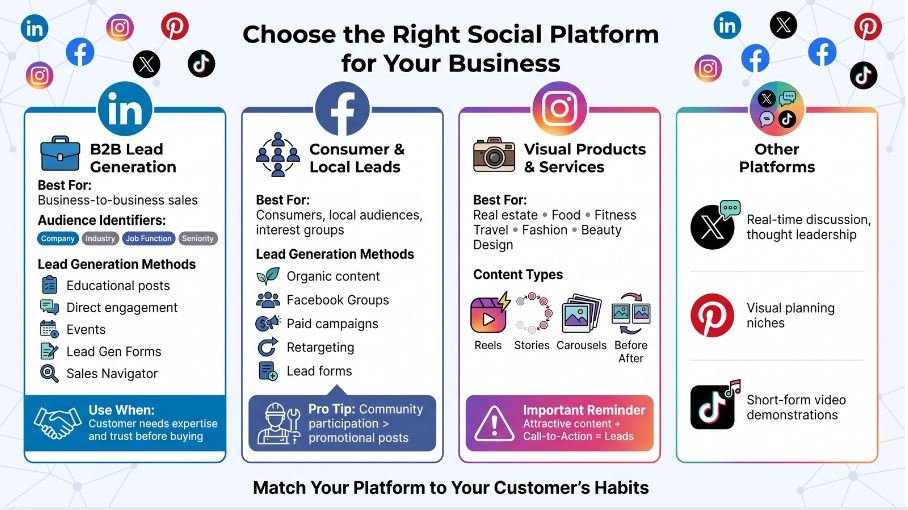
LinkedIn for B2B Lead Generation
LinkedIn is particularly useful for businesses selling to other businesses because users identify themselves by company, industry, job function, seniority, and professional interests.
That makes it easier to create content for a defined professional audience and identify potential decision-makers.
Businesses can generate LinkedIn leads through educational posts, company content, direct engagement, events, paid advertising, Lead Gen Forms, and carefully targeted prospecting.
LinkedIn Sales Navigator adds more advanced prospecting capabilities for sales teams that need to identify and follow specific leads or accounts.
LinkedIn works especially well when your potential customer needs expertise, trust, or substantial information before making a buying decision.
Facebook for Consumer and Local Lead Generation
Facebook can be useful for businesses targeting consumers, local audiences, communities, and interest-based groups.
Businesses can generate leads through organic content, Facebook Groups, paid campaigns, retargeting, and lead forms that allow prospects to provide information without navigating through a complicated conversion process.
For local businesses in particular, community participation can sometimes be more valuable than simply publishing promotional posts.
A contractor answering homeowner questions in a local group, for example, may create more genuine sales opportunities than the same contractor posting advertisements several times a week.
Instagram for Visual Products and Services
Instagram is a natural fit when visual presentation plays an important role in the buying process.
Real estate, home improvement, food, fitness, travel, fashion, beauty, design, and other visually oriented businesses can demonstrate their work rather than simply describe it.
Reels, Stories, carousels, before-and-after examples, demonstrations, and customer results can help attract attention and establish credibility.
But attractive content alone is not lead generation.
The content still needs a logical next step, such as visiting a landing page, requesting information, sending a message, or accessing a useful resource.
X and Other Social Platforms
X can be useful for businesses and individuals whose audiences value real-time discussion, industry commentary, news, or thought leadership.
Other platforms may be more appropriate for particular audiences. Pinterest can be valuable in highly visual planning-oriented niches, while TikTok can provide substantial reach for businesses capable of explaining or demonstrating something effectively through short-form video.
The important question is not which social network is largest.
It is:
Where are the people most likely to buy what you offer?
Start there.
Create Content Around Problems Your Prospects Want Solved
Lead-generating content begins with the prospect rather than the product.
Instead of asking, “What should we post today?” ask:
What problem is our ideal customer trying to solve?
That change in perspective can dramatically improve the usefulness of your content.
Suppose an accounting firm wants to attract small-business owners.
A generic post saying “We provide accounting services for small businesses” gives people little reason to engage.
A post explaining “Five bookkeeping mistakes that can create problems at tax time” addresses an existing concern and demonstrates expertise at the same time.
The same principle applies across industries.
Useful social content might include:
- How-to explanations
- Common mistakes
- Checklists
- Comparisons
- Frequently asked questions
- Short demonstrations
- Case studies
- Original observations
- Industry changes
- Customer problems and solutions
The content does not need to sell your product directly.
Its first job is to make the right person stop and pay attention.
Match Content to the Prospect’s Buying Stage
Not everyone who sees your social media content is equally close to becoming a customer.
Someone encountering your business for the first time may need basic educational information. Someone who already understands the problem may be comparing approaches. Another person may be actively evaluating products or vendors.
That means a strong social media strategy should contain content for different levels of buying intent.
An educational post might attract someone at the beginning of the process.
A comparison or case study may appeal to someone evaluating possible solutions.
A demonstration, consultation offer, free trial, or product comparison may work better for someone closer to making a decision.
This is why social media works best when it connects to a broader lead generation funnel rather than operating as an isolated marketing activity.
Give Interested Prospects a Clear Next Step
Useful content creates attention. Lead generation requires another step.
Once someone becomes interested, what should that person do?
The answer should be obvious.
Depending on your business and the prospect’s level of intent, an appropriate call to action might be:
- Download the checklist
- Read the complete guide
- Register for the webinar
- Compare the options
- Request more information
- Start a free trial
- Send us a message
- Schedule a demonstration
- Join the email list
Avoid forcing a major commitment too early.
Someone who has just discovered your business through an educational LinkedIn post may not be ready to schedule a sales call. A useful checklist, newsletter, webinar, or related guide may be a more appropriate next step.
The closer your call to action matches the prospect’s current intent, the more natural the conversion feels.
Use Lead Magnets When They Provide Genuine Value
A lead magnet gives prospects something useful in exchange for contact information.
Social media audiences generally respond best when that resource promises a clear, practical benefit without requiring a large commitment.
Examples include:
- Checklists
- Templates
- Worksheets
- Short guides
- Calculators
- Cheat sheets
- Webinar registrations
- Short video training
- Industry benchmarks
A good lead magnet should solve a specific problem or make a task easier.
For example, “Download Our Marketing Ebook” is vague.
“Use This 10-Point Landing Page Checklist Before Launching Your Next Campaign” tells the prospect exactly what the resource does.
The lead magnet should also be closely related to what your business ultimately sells. Attracting large numbers of people who have little chance of becoming customers may increase your lead count without improving your results.
For a deeper look at this strategy, see what a lead magnet is and how it works.
Optimize Your Social Profiles for Lead Generation
Before investing heavily in content or advertising, make sure your profile tells visitors what your business does and what they should do next.
A prospect who visits your profile should be able to quickly understand:
- Who do you help?
- What problem do you solve?
- Why should someone pay attention to you?
- What should the visitor do next?
Your profile should also provide the most relevant available path to your website, landing page, offer, or other conversion destination.
Do not automatically send every visitor to your homepage.
If someone arrives from a campaign about a specific problem, a page addressing that problem is usually a more logical destination than a general homepage.
The fewer unnecessary steps between interest and action, the easier it becomes for prospects to move forward.
Engage With Potential Customers Instead of Just Publishing
Social media is a conversation channel, not simply a publishing platform.
Businesses often spend nearly all their social media time creating their own posts while overlooking opportunities to interact with potential customers.
Useful engagement can include:
- Answering questions
- Responding to comments
- Commenting thoughtfully on relevant posts
- Participating in industry discussions
- Contributing useful information in groups
- Engaging with prospects’ content
- Following up when someone expresses interest
Avoid generic comments designed only to attract attention.
A useful comment adds information, asks a thoughtful question, provides another perspective, or helps solve the problem being discussed.
Over time, these interactions create familiarity.
That familiarity can make a future conversation considerably warmer than contacting someone who has never encountered you before.
Use Direct Outreach Carefully
Social media also creates opportunities for direct prospecting, particularly in B2B markets.
The key is relevance.
Sending the same sales message to hundreds of people immediately after connecting may produce activity, but it rarely builds trust.
A better approach is to identify prospects carefully and look for legitimate reasons to start conversations.
That could mean commenting on something they published, responding to a question, referencing a relevant company development, or sharing a resource that genuinely relates to their situation.
Personalization should go beyond inserting someone’s first name into a template.
Good outreach demonstrates that there is a reason you contacted that particular person.
If outbound prospecting is part of your strategy, understanding the difference between inbound and outbound lead generation can help you decide how social outreach fits with your other acquisition channels.
Use Paid Social Advertising to Expand What Works
Organic social media can generate leads, but it usually takes time to build an audience and establish trust.
Paid advertising allows businesses to reach targeted audiences more quickly.
Social advertising can be used to promote:
- Lead magnets
- Webinars
- Product demonstrations
- Free trials
- Consultations
- Events
- Special offers
- Educational content
- Landing pages
Some platforms also provide native lead forms, allowing users to submit information without completing a separate form on your website.
That convenience can increase the number of submissions, but more leads do not necessarily mean better leads.
A very easy form may generate people with limited buying intent.
That is why paid campaigns should be evaluated on what happens after the form submission, not merely on how cheaply the lead was acquired.
If a campaign generates 100 inexpensive leads but none become customers, it may be less valuable than a campaign generating 25 better-qualified prospects.
Understanding what makes a high-quality lead becomes especially important when evaluating paid social campaigns.
Retarget People Who Have Already Shown Interest
Most prospects will not convert the first time they encounter your business.
Retargeting allows you to reach people who have previously interacted with your business, such as website visitors or users who have engaged with qualifying content or campaigns.
These audiences are often worth treating differently from completely new prospects because they already have some familiarity with your business.
For example, someone who visited a product page might receive an ad promoting a comparison, demonstration, or customer story.
Someone who consumed introductory educational content might instead receive another useful resource.
The objective is not to show the same advertisement repeatedly.
It is to provide a sensible next step based on what the prospect already appears to know or care about.
Send Social Media Traffic to the Right Landing Page
Generating clicks is not enough.
The page receiving those clicks needs to continue the conversation that started on social media.
If an advertisement promises a specific checklist, the landing page should immediately reinforce that promise.
If a LinkedIn post discusses a particular business problem, the linked page should address that same problem rather than forcing the visitor to search your website for relevant information.
A strong landing page generally keeps the visitor focused on one primary action.
Unnecessary navigation, unrelated offers, excessive form fields, or a mismatch between the social post and landing page can create friction at exactly the moment a prospect is showing interest.
The transition from social platform to website should feel like the next part of the same conversation.
Track Leads, Not Just Likes and Followers
Social platforms provide plenty of metrics.
Not all of them tell you whether your lead generation strategy is working.
Likes, impressions, followers, comments, and video views can help you understand how people interact with your content, but they should not be mistaken for business results.
For lead generation, more useful metrics include:
- Number of leads generated
- Conversion rate
- Cost per lead for paid campaigns
- Qualified leads generated
- Lead-to-customer conversion rate
- Customer acquisition cost
- Revenue generated by source
Use campaign tracking parameters where appropriate so you can identify which platforms, campaigns, and content are producing meaningful results.
Then look beyond the initial conversion.
A platform producing the most leads may not produce the best leads.
For example, one campaign might generate leads at a lower cost while another produces fewer leads that convert into customers at a much higher rate.
That is why cost per lead should be evaluated alongside lead quality and eventual customer acquisition.
Connect Social Leads to Your CRM or Lead Management Process
A lead can lose much of its value if nobody follows up.
Once a prospect provides contact information, there should be a clear process for recording the lead, identifying its source, assigning responsibility, and determining the next action.
For a small business, that process may be relatively simple.
Larger organizations may need a CRM, marketing automation system, lead scoring process, and defined handoff between marketing and sales.
Whatever system you use, social media leads should not live in a separate silo.
They should become part of the same lead management process used for prospects coming from search, advertising, referrals, email, and other channels.
Our guide to CRM lead management explains how a CRM can help organize leads and follow-up activity.
Common Social Media Lead Generation Mistakes
Several mistakes can undermine an otherwise good strategy.
Trying to Be Everywhere
Maintaining weak accounts across six platforms is rarely better than building a strong presence on the one or two platforms most relevant to your audience.
Concentrate your resources where they have the best chance of producing business results.
Posting Without a Conversion Path
Content can receive substantial engagement without generating leads.
Make sure interested prospects have an appropriate next step when one is warranted.
Not every post needs a sales-oriented call to action, but your overall strategy needs a clear path from attention to conversion.
Promoting Too Often
If nearly every post asks people to download, register, buy, book, or subscribe, your audience may begin ignoring the content.
Provide useful information even when there is no immediate conversion attached.
Trust makes later offers more effective.
Measuring Activity Instead of Results
More posts do not necessarily produce more leads.
More leads do not necessarily produce more customers.
Measure the results that matter to the business rather than assuming increased social activity automatically means improved lead generation.
Ignoring Lead Quality
This is particularly important with paid campaigns and low-friction lead forms.
Do not judge a campaign solely by the number of leads or the lowest cost per lead.
Track which sources produce prospects who actually progress through your sales process.
Using the Same Approach on Every Platform
A LinkedIn post, Instagram Reel, Facebook Group discussion, and short post on X operate in different environments.
The underlying idea can often be reused, but the presentation should fit the platform and audience.
A Simple Social Media Lead Generation Process
You do not need a complicated system to get started.
Begin with these steps:
- Define your ideal customer. Know who you want to reach and what problems matter to them.
- Choose one or two platforms. Focus on the places where those prospects are most likely to spend time.
- Create useful content. Address questions, problems, mistakes, decisions, and concerns relevant to potential customers.
- Offer a logical next step. Give interested people a reason to identify themselves without demanding too much too soon.
- Capture and track the lead. Make sure you know where the prospect came from and what action they took.
- Follow up appropriately. Continue the conversation based on the prospect’s needs and level of interest.
- Measure business results. Determine which platforms, content, offers, and campaigns actually produce qualified prospects and customers.
- Improve what works. Invest more heavily in the combinations producing meaningful results and stop spending resources on activity that does not contribute to your pipeline.
The process is straightforward. The difficult part is executing it consistently and resisting the temptation to chase every new platform or tactic.
Frequently Asked Questions
What is the best social media platform for lead generation?
There is no single best platform for every business. LinkedIn is often a strong choice for B2B prospecting, while Facebook and Instagram can work well for many consumer and local businesses. The best platform is the one that gives you practical access to the people most likely to become customers.
Can you generate leads from social media without paying for ads?
Yes. Businesses can generate organic leads through useful content, profile optimization, community participation, direct engagement, referrals, and relevant outreach. Organic strategies usually require more time and consistency than paid campaigns, but advertising is not required to generate social media leads.
Do you need a large social media following to generate leads?
No. Audience relevance is generally more important than raw follower count. A smaller audience containing potential customers can be much more valuable than a large audience with little interest in what your business sells.
What type of social media content generates leads?
Content that addresses a specific customer problem, question, decision, or concern is a strong starting point. Tutorials, checklists, case studies, comparisons, demonstrations, frequently asked questions, and useful industry insights can all attract potential customers when paired with an appropriate next step.
Should social media leads go directly into a CRM?
If you use a CRM, social leads should generally be incorporated into your normal lead management process so their source, status, interactions, and follow-up can be tracked. This also makes it easier to compare social media with other lead sources.
How do you know whether social media leads are good leads?
Look beyond the number of form submissions. Track whether leads meet your qualification criteria, respond to follow-up, progress through your sales process, and eventually become customers. Comparing lead-to-customer conversion rates across acquisition sources can reveal whether social media is attracting the right people.
How much should you spend on social media lead generation?
There is no universal budget that works for every business. Advertising costs vary substantially by platform, industry, audience, competition, offer, and campaign objective. Start with an amount that allows you to gather meaningful data, then evaluate cost per qualified lead and customer acquisition rather than increasing spending based only on lead volume.
Key Takeaways
Social media can be an effective lead generation channel, but publishing content alone is not a lead generation strategy.
Start by identifying where your ideal customers spend time. Create content around the problems and decisions that matter to them. Then provide an appropriate next step that turns anonymous attention into an identifiable prospect.
Organic content, direct engagement, lead magnets, paid advertising, native lead forms, landing pages, and retargeting can all contribute to the process. You do not need to use every tactic.
What matters is creating a clear path:
Right audience -> useful content -> relevant offer -> captured lead -> appropriate follow-up -> measurable business result
Most importantly, judge social media by the quality and business value of the leads it produces, not by follower counts, likes, impressions, or activity alone.
A smaller social media presence that consistently produces qualified prospects is far more valuable than a large audience that never enters your sales pipeline.