
Every business wants more customers. Very few have a system to consistently create them.
Most companies rely on referrals, word of mouth, or random bursts of marketing activity. When sales dip, they scramble. When things are busy, they stop marketing altogether. The result? Unpredictable revenue and constant pressure.
Lead generation changes that.
Instead of hoping customers appear, you build a structured process that attracts the right people, captures their information, nurtures their interest, and turns them into buyers — on purpose.
In this guide, you’ll learn not just what lead generation is, but how modern businesses use it to create predictable growth. From foundational definitions to advanced strategy, you’ll understand the complete system and how to make it work for you.
What Is a Lead?
A lead is a person or business that has shown interest in what you offer by sharing their contact information with you. Understanding the different types of leads and their readiness to buy helps you focus your time and resources on the right prospects.
Definition of a Lead
A lead is someone who has expressed interest in your products or services and provided you with a way to contact them. This could be through filling out a form, signing up for a newsletter, downloading a resource, or requesting more information.
The key difference between a lead and a random website visitor is action. When someone gives you their email address, phone number, or other contact details, they move from being an anonymous browser to a potential customer you can reach out to.
Leads enter your sales funnel at various stages. Some are just learning about your brand, while others are actively comparing solutions and ready to make a purchase decision.
Types of Leads (Cold, Warm, Hot)
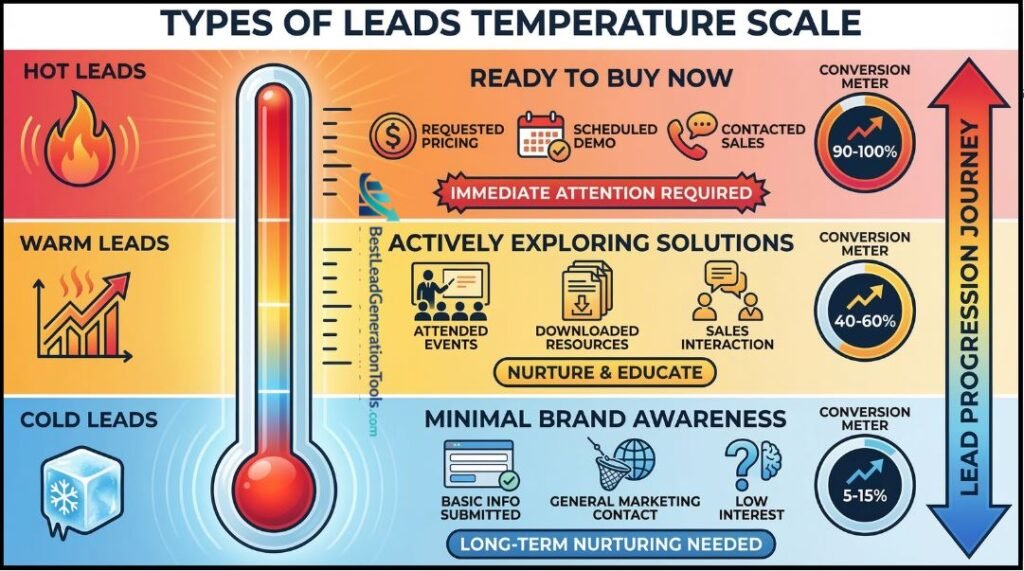
Leads fall into three temperature categories based on their level of engagement and readiness to buy.
Cold leads have minimal awareness of your brand and little interest in buying right now. They might have filled out a form to access general content or landed on your contact list through broad marketing efforts. These leads need significant nurturing before they consider making a purchase.
Warm leads have engaged with your brand multiple times and shown genuine interest. They might have attended a webinar, downloaded several resources, or interacted with your sales team. These prospects are aware of their problem and are exploring potential solutions.
Hot leads are ready to make a buying decision soon. They’ve requested pricing information, scheduled a demo, or directly contacted your sales team about purchasing. These leads require immediate attention because they’re comparing options and close to converting.
MQL vs SQL (Brief Introduction)
Marketing qualified leads (MQLs) and sales qualified leads (SQLs) represent two distinct stages in your lead qualification process.
An MQL is a lead that marketing has identified as more likely to become a customer compared to other leads. They’ve engaged with your content, fit your target audience profile, and shown interest through actions like downloading whitepapers or attending webinars. However, they’re not ready to talk to sales yet.
An SQL is a lead that’s ready for direct sales outreach. They’ve been vetted by both marketing and sales teams and have demonstrated clear buying intent. SQLs typically want pricing details, product demonstrations, or specific answers about how your solution solves their problem.
The transition from MQL to SQL happens when a lead meets specific criteria your teams have agreed upon, such as budget confirmation, timeline identification, or decision-maker engagement. For a closer look at how these stages differ, see our guide to MQL vs. SQL.
Why Not All Leads Are Equal
The quality of your leads matters more than the quantity. A small list of highly engaged prospects will generate better results than thousands of uninterested contacts.
Lead qualification helps you identify which prospects deserve your immediate attention. Factors like budget, authority, need, and timeline determine whether a lead is worth pursuing now or needs more nurturing.
Some leads will never convert no matter how much effort you invest. They might lack the budget, not have decision-making power, or simply be gathering information for future reference. Recognizing these patterns early saves you time and resources.
Your best leads match your ideal customer profile, have an urgent need for your solution, and possess the authority and budget to make a purchase. Understanding what separates high-quality leads from poor-fit prospects can help you focus resources on opportunities with greater potential.
What Is Lead Generation?
Lead generation is about finding people who might want to buy from you and getting their contact information so you can turn that interest into sales. It makes selling easier because you focus on people who actually want what you offer instead of reaching out to everyone.
Formal Definition
Lead generation is the process of attracting potential customers and converting them into leads by capturing their contact information. A lead is someone who has shown interest in your product or service by taking an action like filling out a form, downloading a guide, or signing up for a free trial.
The process works by creating experiences that make people want to learn more about what you sell. When someone gives you their email address or phone number, they become a lead in your sales funnel.
Your goal is to collect enough information to understand if someone is a good fit for your business. This usually includes basic details like name, email, company, and job title.
Lead Generation vs Sales
Lead generation and sales are different parts of getting customers, but they work together. Lead generation happens first and focuses on finding interested people and collecting their contact details. Sales happens after and focuses on turning those interested people into paying customers.
Think of lead generation as filling up a bucket with potential buyers. Sales is reaching into that bucket and closing deals. Your marketing team usually handles lead generation by creating content, running ads, and building landing pages. Your sales team takes over once a lead is qualified and ready for direct conversation.
The handoff between these two functions is critical. Marketing finds and nurtures leads until they show enough interest to talk to sales. Sales then uses personalized outreach like calls and demos to close the deal.
Lead Generation vs Demand Generation (Brief Intro)
Demand generation is broader than lead generation. It focuses on building awareness and interest in your product or service across your entire target market. Lead generation is one part of demand generation that specifically captures contact information.
Demand generation includes activities like brand awareness campaigns, educational content, and community building. These efforts might not collect contact details right away but they create interest over time.
Lead generation is more direct. It uses tactics like gated content and contact forms to capture specific people who are ready to engage. You might run a podcast for demand generation but offer a downloadable checklist for lead generation. Both strategies work together to build your pipeline.
How Lead Generation Works (High-Level Overview)
Lead generation follows a clear path from first contact to final sale. You attract visitors, present them with valuable offers, collect their information, build relationships through follow-up, close deals, and track what works.
This section provides the high-level overview. For a more detailed look at how these activities fit together, see how a complete lead generation system works.
Traffic
Traffic is the starting point of all lead generation. You need people visiting your website, landing pages, or other digital properties before you can convert them into leads.
There are two main types of traffic: paid and organic. Paid traffic comes from advertisements on platforms like Google Ads, Facebook, or LinkedIn. Organic traffic comes from search engines, social media posts, or direct visits.
Common traffic sources include:
- Search engine optimization (SEO)
- Pay-per-click advertising (PPC)
- Social media marketing
- Content marketing
- Email campaigns
- Referrals and partnerships
The quality of your traffic matters more than quantity. Targeted outreach produces better results because visitors who match your ideal customer profile are more likely to convert. You want people who actually need what you offer, not just random visitors.
If you’re deciding where those visitors should come from, our guide to traffic sources for lead generation compares the major channels and the role each can play.
Offer
Your offer is what convinces visitors to share their contact information. It needs to provide clear value that solves a specific problem or addresses a need.
Strong offers include ebooks, whitepapers, free trials, demos, consultations, webinars, templates, or discount codes. The best offers relate directly to your product or service while being useful on their own.
Many educational offers function as lead magnets, providing something useful in exchange for a prospect’s contact information.
Your offer must match where the visitor is in their buying journey. Someone just learning about their problem needs educational content. Someone ready to buy wants pricing information or a demo.
Make your offer specific and actionable. “Get our guide” is weak. “Download the 2026 B2B Lead Generation Playbook” tells visitors exactly what they’ll receive.
The perceived value of your offer should exceed the cost of sharing contact information. People guard their email addresses, so your offer needs to be worth it.
Capture
Capturing lead information happens when visitors exchange their contact details for your offer. This typically occurs through forms on landing pages.
Your forms should only ask for information you actually need. Short forms convert better than long ones. For most offers, a name and email address are enough to start.
Form best practices:
- Use clear, action-oriented button text
- Explain what happens after submission
- Keep fields to a minimum
- Make the form mobile-friendly
- Use inline validation to catch errors
Landing pages dedicated to a single offer convert better than general website pages. Remove navigation menus and other distractions that might pull visitors away from completing the form.
Not every visitor will fill out a form. Tools that identify anonymous website visitors can help you capture leads who browse your site without submitting information.
Nurture
Nurturing transforms contacts into qualified leads ready to buy. Most people aren’t ready to purchase immediately after downloading an offer.
Lead nurturing builds relationships through consistent, valuable communication. You send targeted emails, share relevant content, and provide information that helps leads make decisions.
Email automation makes nurturing scalable. You can set up sequences that send the right message at the right time based on lead behavior and characteristics.
Effective nurturing includes:
- Educational content addressing common questions
- Case studies showing results
- Product information and comparisons
- Industry insights and trends
- Invitations to events or demos
Personalization increases engagement. Use the information you know about leads to send messages that match their interests and needs. A lead who downloaded content about email marketing should receive different follow-up than someone interested in social media.
Convert
Conversion happens when a nurtured lead becomes a customer. This is where your sales team typically takes over from marketing.
The handoff between marketing and sales needs clear criteria. Marketing qualified leads (MQLs) show interest through engagement. Sales qualified leads (SQLs) have been vetted and are ready for direct sales contact.
Your sales team uses the information gathered during lead generation and nurturing to personalize their approach. They know what content the lead consumed, which pages they visited, and what problems they’re trying to solve.
Timing matters for conversion. Reaching out when a lead is actively researching solutions produces better results than contacting them months later. Lead scoring can help prioritize prospects using fit, engagement, and other signals relevant to your sales process.
Not every lead converts immediately. Some need more time, information, or internal approval. Keep engaging with unconverted leads until they’re ready or clearly not a fit.
Measure
Measuring your lead generation performance shows what’s working and what needs improvement. You can’t optimize what you don’t track.
Key metrics to monitor:
| Metric | What It Tells You |
|---|---|
| Cost per lead | How much you spend to acquire each lead |
| Conversion rate | Percentage of visitors who become leads |
| Lead quality | How many leads meet your qualification criteria |
| Time to conversion | How long it takes leads to become customers |
| ROI | Revenue generated compared to costs |
Analytics tools track visitor behavior, form submissions, email opens, and sales outcomes. This data reveals which traffic sources, offers, and nurturing sequences produce the best results.
Test different elements of your lead generation process. Try new headlines, form lengths, email subject lines, or offer types. Small changes can significantly impact conversion rates.
Review your metrics regularly and adjust your strategy based on what the data shows. Double down on what works and fix or eliminate what doesn’t.
Types of Lead Generation
Lead generation strategies fall into several main categories based on how you reach potential customers and whether you pay for that reach. Understanding these different types helps you choose the right mix of tactics for your business goals and budget.
Inbound
Inbound lead generation happens when potential customers find you through helpful content and meaningful engagement. You attract people who are already looking for solutions like yours.
This approach includes creating blog posts, guides, videos, and resources that answer questions your target audience is asking. When someone searches for information related to your product or service, they discover your content and decide to learn more.
Common inbound methods include:
- Search engine optimization (SEO) to rank higher in Google
- Content marketing like blog articles and ebooks
- Social media posts and community engagement
- Email newsletters that provide value
The main benefit is that inbound leads often convert better because they came to you by choice. SEO and organic visibility are important components of this approach.
These leads typically cost less over time compared to paid methods. However, inbound takes longer to build momentum since you need to create content and establish authority first.
Outbound
Outbound lead generation takes a direct approach by reaching out to potential customers rather than waiting for them to find you. You identify prospects who fit your ideal customer profile and contact them directly.
This method includes cold calling, sending cold emails, and direct mail campaigns. The goal is to start a conversation with people who may not be actively searching for your solution but could benefit from it.
Outbound can produce results more quickly than inbound because you control when and how you reach prospects.
The challenge is that outbound requires more effort per lead. You need strong research, personalized messaging, and persistence. Success depends on reaching the right people at the right time with a message that resonates with their needs.
For a deeper comparison of these approaches, see inbound vs. outbound lead generation.
Paid
Paid lead generation uses advertising budgets to drive traffic to your website or landing pages. You pay platforms like Google, Facebook, or LinkedIn to show your message to specific audiences.
These campaigns can include search ads that appear when people look for certain keywords, display ads on websites, or social media ads targeted by demographics and interests. You typically pay per click or per thousand impressions.
Paid methods offer several advantages:
- Fast results compared to organic strategies
- Precise audience targeting options
- Easy to scale up or down based on budget
- Measurable return on investment
The key to success is creating compelling ad copy with clear calls-to-action and sending traffic to optimized landing pages. Your offer needs to be strong enough to convince visitors to share their contact information.
Paid advertising works well when you need leads quickly or want to test new markets. The downside is that costs can add up quickly, and leads stop coming when you stop paying.
Organic
Organic lead generation attracts prospects without paying for ads or placements. You earn attention through quality content, search rankings, and authentic relationships built over time.
This includes ranking in search results through SEO, getting shares and engagement on social media posts, and building an email list of subscribers who signed up willingly.
Organic methods require consistent effort and patience. You need to publish valuable content regularly, engage with your audience, and optimize your website for search engines. Results take time to build but can continue producing traffic long after individual pieces of content are published.
The biggest benefit is sustainability. Once your content ranks or your community grows, it can continue generating leads without ongoing ad spend.
Referral
Referral-based lead generation leverages your existing customers and network to bring in new prospects. People who already know and trust your business recommend you to others.
This happens through formal referral programs where you reward customers for successful referrals, or through natural word-of-mouth when satisfied customers tell friends and colleagues about you.
Effective referral tactics include:
- Customer referral programs with incentives like discounts or cash rewards
- Loyalty programs that encourage repeat business and recommendations
- Partnership arrangements with complementary businesses
- Making it easy for customers to leave reviews and testimonials
Referrals benefit from existing trust. When someone you know recommends a product or service, that recommendation can reduce some of the uncertainty involved in considering an unfamiliar company.
Why Lead Generation Is Critical for Business Growth
A steady stream of qualified leads creates the foundation for sustainable business success. Lead generation gives you greater visibility into your sales pipeline, enables growth at scale, helps reduce dependence on unpredictable sources of business, and provides insights that can inform better decisions.
Predictability
Lead generation transforms your sales process from guesswork into a more measurable system. When you have a consistent flow of new prospects entering your pipeline, you can make more informed revenue forecasts and plan business operations accordingly.
You can estimate how many leads you need to hit your sales targets. If you know that 10% of your leads become customers and your average sale is $5,000, you can calculate how many leads would be required to generate $50,000 in revenue if those assumptions hold.
This predictability extends beyond just numbers. You gain insight into which marketing channels deliver the best results, when prospects are most likely to convert, and how long your sales cycle typically lasts. Your team can allocate resources more effectively when they know what to expect.
Predictable lead generation helps you:
- Set realistic sales quotas
- Budget marketing spend with greater confidence
- Staff your sales team appropriately
- Plan inventory and service capacity
Scalability
Lead generation strategies give you the ability to grow your business without proportionally increasing manual effort. Once you establish systems that work, you can expand them to reach more potential customers.
Digital lead generation can scale particularly well. A blog post, landing page, or automated email campaign can continue contributing to lead generation after the initial work has been completed.
You can test new channels and tactics without disrupting your existing operations. If your content marketing generates steady leads, you can layer on paid advertising or social media outreach to accelerate growth. Each successful channel adds to your total lead volume.
Automation tools multiply your scaling potential. Email sequences nurture many leads simultaneously. Forms capture information around the clock. Analytics track performance across campaigns so you can determine where additional resources may produce the greatest value.
Revenue Stability
Relying entirely on referrals or chance encounters can leave your revenue vulnerable to market shifts and seasonal changes. A structured lead generation system gives your business additional ways to create new opportunities.
When you have multiple lead sources, you’re less dependent on any single channel or customer segment. If one source slows down, others may continue producing results.
Your existing customers won’t stay forever. People change jobs, businesses close, and needs evolve. Regular lead generation can help replace customers you lose naturally while creating opportunities for growth.
You can also adjust your lead generation efforts based on business needs. During slower periods, you can increase activity to help fill gaps. When you’re at capacity, you can maintain visibility while developing future opportunities.
Data-Driven Decision Making
Lead generation provides valuable insights into your audience that can inform broader business and marketing decisions. Every interaction with a potential customer reveals information about what attracts attention, generates interest, and moves prospects forward.
You learn which messages resonate with your target market. The content that generates the most leads can reveal what problems your prospects care about most. Low-performing campaigns show you what may need to be improved.
Tracking lead behavior reveals the path prospects take before buying. You can see which pages they visit, what content they download, and how long they consider before making a decision. This knowledge helps you optimize the customer journey.
Key metrics that guide decisions:
- Cost per lead across different channels
- Conversion rates at each stage of your funnel
- Lead quality scores and qualification criteria
- Time from first contact to closed sale
Your lead data can also show which customer segments produce stronger results, helping you focus resources on attracting similar prospects.
Common Lead Generation Channels
Different channels work better for different businesses, and understanding where to focus your efforts helps you reach potential customers more effectively. Each channel requires specific strategies and delivers results at different speeds.
SEO
SEO brings people who are actively searching for solutions directly to your website. When you create content that answers questions your potential customers are asking, search engines can rank your pages and send relevant traffic your way.
This channel takes time to build but can create lasting results. You need to identify keywords your target audience uses, create helpful content around those topics, and optimize your pages so search engines understand what you offer.
The main advantage is that these leads come to you already interested in the subject you’re addressing. Someone searching for “email marketing software for small business” has clearer intent than someone who encounters an unrelated advertisement.
Focus on creating content that solves real problems. Blog posts, guides, comparison pages, and resource libraries can attract potential customers at different stages of their research process.
PPC
Paid search advertising puts your business in front of people at the moment they search for relevant terms. You bid on keywords, create ads, and pay each time someone clicks through to your landing page.
This channel can deliver results quickly. The challenge is managing costs while maintaining lead quality.
Google Ads and Bing Ads are common platforms for search advertising. You set a budget, choose your keywords, write ad copy, and create landing pages designed to capture contact information.
Key metrics to track:
- Cost per click
- Conversion rate
- Cost per lead
- Return on ad spend
The best PPC campaigns target search terms that indicate relevant intent. Broad keywords may bring traffic, while more specific commercial searches can indicate that someone is further along in the buying process.
Social Media
Social platforms let you reach potential customers where they spend their time browsing and engaging. LinkedIn can be useful for B2B audiences, while platforms such as Facebook and Instagram can provide access to consumer audiences.
You can generate leads organically by sharing valuable content or run paid campaigns targeting specific demographics and interests.
Social media lead generation typically uses lead forms built into the platform or directs people to landing pages. Form length and qualification requirements should reflect the type of lead you are trying to generate.
Email works in different ways throughout lead generation. You can send outbound messages to appropriately identified prospects or build an email list through your website and nurture those subscribers.
Cold email outreach reaches prospects directly in their inbox. You research your target audience, identify appropriate contacts, write relevant messages, and follow up with people who show interest.
Email newsletters and campaigns nurture existing leads. When someone downloads a resource or signs up for your content, automated email sequences can educate them about your solution and move them closer to becoming customers.
Successful email lead generation requires careful targeting and value. Outreach needs to be relevant, while marketing emails need useful content that people want to receive.
Partnerships
Working with complementary businesses gives you access to audiences that already know another brand.
Co-marketing campaigns, joint webinars, referral programs, and integration partnerships can all generate leads through shared audiences. The key is finding partners whose customers have a logical reason to be interested in what you offer.
A project management software company might partner with a time-tracking tool. A marketing agency might team up with a web development firm. These relationships work because the audiences and services complement one another.
Partnership leads can also benefit from the credibility of the referring organization, giving prospects some context before they encounter your business.
The Evolution of Lead Generation
Lead generation has shifted from manual outreach and paper lists to digital systems that can track behavior, automate communication, and help businesses prioritize prospects. Each era brought new tools and challenges that changed how businesses connect with potential customers.
Traditional Methods
Before the internet, businesses relied heavily on direct mail, cold calling, print advertising, referrals, and trade shows to find leads. Sales teams worked through phone books and purchased mailing lists to reach prospects.
Trade shows let companies meet potential customers face-to-face. Sales teams could demonstrate products and collect business cards. Print ads in newspapers and magazines helped build awareness, although measuring their direct impact was often difficult.
Cold calling was another major prospecting method. Sales representatives contacted potential buyers directly, while direct-mail campaigns sent brochures, catalogs, and offers to selected audiences.
Referrals were particularly valuable because recommendations from existing customers introduced an element of trust.
These methods could work, but tracking performance and connecting individual activities to eventual sales was more difficult than it is with modern digital systems.
Digital Transformation
The internet changed how businesses generate and manage leads. A company website became a destination prospects could visit at any time to research products, services, and solutions.
Email marketing reduced the cost and delay associated with direct mail while making engagement more measurable. Search engines allowed potential customers to discover businesses while actively researching their needs.
Social media platforms created additional ways to reach and engage audiences. LinkedIn became important for many B2B companies, while consumer-focused platforms offered extensive audience targeting.
Content marketing also became an important part of lead generation. Blogs, videos, downloadable guides, and other resources can attract people who want information before they are ready to buy.
Marketing automation tools now help businesses track activity, nurture leads, and prioritize prospects based on defined criteria.
Privacy-First Era Preview
Privacy laws and changing technology continue to reshape how businesses collect and use customer data.
Requirements vary by jurisdiction and activity, but organizations increasingly need to pay close attention to consent, transparency, data handling, and the rules governing marketing communications.
This increases the importance of first-party data collected directly through interactions with prospects and customers.
Lead generation therefore increasingly depends on a clear value exchange. People should understand what they are providing and what they will receive in return.
AI and machine learning are also changing how businesses analyze permitted data, automate workflows, personalize communications, and prioritize prospects. These capabilities can be useful, but they do not eliminate the need for sound targeting, appropriate data practices, and human judgment.
Key Metrics in Lead Generation
Tracking the right numbers helps you determine whether your lead generation program attracts appropriate prospects, converts them efficiently, and moves them toward becoming customers.
Conversion Rate
Conversion rate measures the percentage of people who complete a desired action at a particular stage of your funnel.
You calculate it by dividing the number of conversions by the number of relevant opportunities to convert and multiplying by 100.
Track conversion rates at multiple stages:
- Visitor to lead
- Lead to marketing qualified lead
- Marketing qualified lead to sales qualified lead
- Sales qualified lead to customer
Each stage can reveal where prospects are dropping off.
Conversion rates should be interpreted in context because they vary by industry, traffic source, offer, audience, funnel stage, and how a conversion is defined.
Cost Per Lead
Cost per lead (CPL) shows how much you spend to acquire each lead. Divide the relevant marketing spend by the number of leads generated.
But don’t automatically optimize for the lowest cost per lead.
An inexpensive lead that never becomes qualified can be less valuable than a more expensive lead with strong buying potential.
Calculate CPL by channel and consider it alongside lead quality and downstream conversion. This gives you a more useful picture than cost alone. For a deeper look at the calculation and how to interpret it, see our cost per lead guide.
Lead Quality
Lead quality determines whether prospects match your ideal customer profile and demonstrate meaningful buying potential.
Lead scoring can help measure quality more consistently by considering factors such as:
- Demographic or firmographic fit: Company size, industry, job title
- Behavioral signals: Pages viewed, content downloaded, email engagement
- Explicit interest: Demo requests, pricing page visits, contact form submissions
Marketing qualified leads meet criteria showing sufficient fit or engagement for continued marketing attention. Sales qualified leads have progressed far enough to warrant direct sales involvement according to your organization’s qualification process.
The percentage of MQLs that become SQLs can help reveal how closely marketing and sales agree about lead quality.
Pipeline Velocity
Pipeline velocity measures how quickly qualified opportunities move through your sales pipeline and generate revenue.
One commonly used formula is:
Pipeline Velocity = (Number of Opportunities × Average Deal Value × Win Rate) / Sales Cycle Length
The metric can help you examine how opportunity volume, deal size, win rate, and sales-cycle length affect the rate at which revenue moves through the pipeline.
Track velocity by lead source when you have enough reliable data. Different channels may produce prospects with different sales cycles and conversion characteristics.
Improving velocity requires examining each funnel stage. Where do prospects stall? Between initial contact and first meeting? Between proposal and close?
Understanding your lead generation funnel can help you identify where prospects are progressing smoothly and where additional optimization may be needed.
Conclusion
Lead generation isn’t a marketing tactic.
It’s a growth system.
When you build a structured process that consistently attracts the right audience, captures meaningful interest, nurtures relationships, and qualifies opportunities, sales becomes less dependent on random activity. Revenue becomes more measurable, and growth becomes more intentional.
The businesses that scale aren’t the ones that occasionally “run campaigns.” They’re the ones that build infrastructure: systems that generate demand, filter for quality, and move buyers forward with purpose.
You now understand the foundation of that system.
From here, the next step isn’t to try everything at once. It’s to build strategically:
- Choose the right traffic sources.
- Create offers aligned with buyer intent.
- Design funnels that convert.
- Measure what matters.
- Improve continuously.
Lead generation is not about chasing contacts.
It’s about building a repeatable process for attracting, qualifying, and developing potential customers.