
Many businesses don’t have a lead generation problem. They have a lead qualification problem.
Their marketing team celebrates hundreds of new leads each month while the sales team complains that none of them are ready to buy. Sales reps waste time chasing people who downloaded a free guide six months ago, while serious buyers slip away because nobody followed up quickly enough.
The difference between an MQL and an SQL is what separates organized, high-converting sales pipelines from chaotic ones that waste time and lose revenue. Once you understand how these two lead types work, it becomes much easier to know which leads need nurturing, which leads are ready for sales, and how to move prospects through your funnel more efficiently.
In this guide, you’ll learn exactly what MQLs and SQLs are, how they’re different, what signals matter most, and how businesses use lead scoring and qualification frameworks to convert more leads into customers.
If you are new to the topic, it helps to first understand how the overall lead generation process works.
Quick Answer: MQL vs SQL Explained
An MQL is a lead who has shown interest in your business but is still researching solutions. An SQL is a lead who has demonstrated clear buying intent and is ready for direct sales contact.
The difference matters because not every lead should be treated the same way. Some people need education and nurturing before they are ready to buy. Others are already comparing vendors, reviewing pricing, and looking for a solution now. When businesses fail to separate these lead types properly, sales teams waste time chasing unready prospects while serious buyers sometimes slip away unnoticed.
What Is an MQL?
A marketing-qualified lead (MQL) is someone who has engaged with your marketing content but is not ready for a sales conversation yet. These leads are still in the research phase of the buying journey.
MQLs are exploring their problem and trying to understand what solutions are available. They often read blog posts, download guides, watch webinars, or subscribe to email newsletters. They are interested, but they are not actively preparing to make a purchase decision yet.
You can think of MQLs as people who are learning and evaluating. They are raising their hand to say, “This topic matters to me,” but they still need more information and trust before talking to sales.
Your marketing team should nurture MQLs with educational content, case studies, and helpful resources that keep them engaged over time. Some MQLs eventually become customers, while others simply are not ready yet.
What Is an SQL?
A sales-qualified lead (SQL) is a prospect who has moved beyond research and is showing clear signs they may be ready to buy.
These leads are no longer casually exploring solutions. They are evaluating vendors, comparing options, and looking for answers that help them make a purchase decision. SQLs often request demos, ask about pricing, inquire about integrations, or review product comparisons and case studies.
SQLs are high-value opportunities because they have stronger buying intent and a clearer timeline. In many cases, they already understand their problem and are actively searching for the best solution.
This is where speed becomes important. When someone reaches SQL status, your sales team should follow up quickly while interest and urgency are still high.
The Main Difference Between MQLs and SQLs
MQLs and SQLs sit at different stages of the lead generation funnel and require different communication strategies.
The simplest way to think about it is this:
MQLs are researching. SQLs are preparing to buy.
MQLs sit near the top and middle of the sales funnel, where people are still learning and exploring. SQLs sit near the bottom of the funnel, where prospects are narrowing down vendors and making decisions.
Another simple comparison is this:
MQLs are window shopping. SQLs are checking their wallet and asking for the price.
Key differences include:
- Intent level: MQLs show interest while SQLs show buying intent
- Content engagement: MQLs consume educational content while SQLs engage with pricing pages, demos, and case studies
- Sales readiness: MQLs need nurturing while SQLs need direct sales conversations
- Timeline: MQLs may not have a defined timeline while SQLs are often evaluating solutions for a near-term decision
Most businesses use lead scoring, behavioral tracking, and qualification frameworks to determine when a lead moves from MQL to SQL status.
What Does MQL Mean?
An MQL, or marketing-qualified lead, is a person who has shown meaningful interest in your business but is not ready for a direct sales conversation yet. These leads are still in the research and evaluation stage of the buying journey.
They know they have a problem or goal, and they are actively looking for information that can help them understand possible solutions. Instead of asking for pricing or scheduling demos, MQLs are usually consuming educational content such as blog posts, guides, webinars, videos, and email newsletters.
MQLs are important because they represent potential future customers. Businesses that identify and nurture MQLs effectively often create a much larger pipeline of future sales opportunities over time. Companies that ignore or mishandle MQLs frequently struggle with inconsistent lead generation and lower long-term conversion rates.
The goal at this stage is not to pressure the lead into buying immediately. The goal is to build trust, answer questions, and stay visible while the prospect continues researching their options.
Definition of a Marketing Qualified Lead
A marketing-qualified lead is a prospect who has engaged with your marketing in ways that suggest genuine interest in your product or service. These leads typically match your target audience and show repeated engagement with your content, but they have not yet demonstrated strong buying intent.
In other words, they are interested, but they are still learning.
An MQL might be trying to better understand their problem, compare different approaches, or research possible solutions before deciding whether to speak with a sales team. They are gathering information and evaluating options rather than actively preparing to make a purchase.
Most businesses use lead scoring systems and engagement tracking to determine when a lead reaches MQL status. This helps marketing teams focus attention on contacts who are more likely to become customers in the future.
Common Signs a Lead Is an MQL
MQLs tend to follow recognizable engagement patterns that separate them from casual website visitors.
They often return to your website multiple times over days or weeks, consuming educational content across different pages and formats. Their behavior shows sustained interest rather than random browsing.
Common indicators include:
- Multiple visits to your website within a short period
- Reading several blog posts or guides on related topics
- Downloading educational resources like ebooks or checklists
- Opening and clicking links in your email campaigns
- Attending webinars or watching recorded presentations
- Following your business on social media
- Submitting forms for informational content
What MQLs usually are not doing is requesting pricing, booking demos, or asking detailed implementation questions. Those actions typically signal a lead is moving closer to SQL status.
Examples of MQL Actions
The exact actions that qualify someone as an MQL depend on your business and sales cycle, but certain behaviors consistently signal marketing-qualified interest.
Common MQL actions include:
- Downloading an ebook, whitepaper, or industry report
- Signing up for a newsletter to continue learning about a topic
- Registering for a webinar or online workshop
- Using a free calculator, assessment, or planning tool
- Visiting multiple educational pages during one session
- Returning to your site several times within a few weeks
- Engaging with your brand across email and social channels
For example, a B2B software company might classify someone as an MQL after they download a guide about improving lead management and later return to read several related articles. An agency might treat a lead as an MQL after they attend a webinar and repeatedly engage with email content over the next month.
The key idea is that MQLs show consistent interest and engagement, but they are still researching rather than actively preparing to buy.
What Does SQL Mean?
An SQL, or sales-qualified lead, is a prospect who has shown strong buying intent and is ready for direct conversations with your sales team. These are the leads most likely to become customers in the near future.
Unlike MQLs who are still researching and learning, SQLs have moved into evaluation and decision-making mode. They are no longer just exploring ideas or gathering general information. They are actively comparing solutions, reviewing vendors, and looking for the best option for their business.
This is the stage where leads become real sales opportunities.
SQLs are important because they represent the highest-value leads in your pipeline. These prospects often have a clear problem, a potential budget, internal discussions already happening, and a timeline for choosing a solution. Businesses that identify and respond to SQLs quickly usually close more deals and shorten their sales cycles.
Businesses that focus on generating high-quality leads instead of simply increasing lead volume often create more efficient sales pipelines and better long-term conversion rates.
Speed matters at this stage. Many SQLs are evaluating multiple vendors at the same time. Slow follow-up can easily cost you the deal.
Definition of a Sales Qualified Lead
A sales-qualified lead is a prospect who has been reviewed and determined ready for direct sales engagement based on their behavior, buying intent, and overall fit.
These leads typically match your ideal customer profile and have demonstrated actions that suggest they may be preparing to make a purchase decision. Instead of casually consuming educational content, SQLs begin focusing on solution-specific information such as pricing, integrations, onboarding, implementation, and product comparisons.
In simple terms, an SQL is no longer asking:
“What kinds of solutions exist?”
They are asking:
“Is your solution the right choice for us?”
Most businesses use lead scoring systems, behavioral tracking, and qualification frameworks to identify when a lead reaches SQL status. Once a lead crosses that threshold, the sales team should engage quickly while buying interest is high.
Common Signs a Lead Is an SQL
SQLs display behaviors that signal active evaluation and purchase readiness. Their actions typically become more focused, specific, and solution-oriented.
Common SQL indicators include:
- Requesting a product demo or consultation
- Visiting pricing pages multiple times
- Asking detailed questions about features or integrations
- Downloading product comparison guides
- Reviewing case studies or customer success stories
- Responding to emails with business-specific questions
- Asking about implementation timelines or onboarding
- Involving additional stakeholders or decision-makers
These behaviors matter because they reveal intent.
For example, repeated visits to a pricing page often signal budget consideration. Reading case studies suggests the lead is evaluating risk and looking for proof that your solution works. Questions about integrations or onboarding usually indicate the prospect is imagining how your product would fit into their existing workflow.
SQLs are no longer casually browsing. They are actively evaluating whether your solution fits their business needs, budget, and timeline.
Examples of SQL Actions
SQLs take actions that show genuine purchase consideration rather than general curiosity.
For example, a software buyer might request a demo and include details about their company size, budget range, and implementation timeline. That behavior suggests they are preparing for a real buying decision rather than simply researching the market.
Another SQL might email your sales team asking whether your platform integrates with their CRM or marketing automation software. Questions like these often signal implementation planning, which is a strong buying indicator.
In B2B sales, SQLs frequently begin involving multiple stakeholders in the process. A lead who asks to schedule a meeting with additional team members or decision-makers is often moving deeper into vendor evaluation and internal discussions.
Other strong SQL actions include:
- Requesting custom pricing or proposals
- Asking about contract terms
- Comparing your solution against competitors
- Discussing onboarding timelines
- Asking security or compliance questions
- Exploring enterprise or team-level features
These are the types of leads sales teams should prioritize immediately because they are often much closer to making a purchasing decision.
MQL vs SQL: Side-by-Side Comparison
| Category | MQL | SQL |
|---|---|---|
| Buyer Intent | Researching solutions | Actively evaluating vendors |
| Funnel Stage | Awareness and consideration | Decision stage |
| Content Consumed | Blogs, guides, webinars | Pricing, demos, case studies |
| Sales Readiness | Not ready for sales | Ready for direct sales contact |
| Primary Goal | Learn and explore | Compare and purchase |
| Team Owner | Marketing | Sales |
| Typical Actions | Downloads resources | Requests demos or pricing |
| Timeline | Undefined or long-term | Near-term buying window |
The Simplest Way to Think About It
MQLs are still learning about their problem and possible solutions. SQLs have moved into evaluation mode and are trying to decide which solution to choose.
Another simple way to think about it is this:
MQLs are researching. SQLs are preparing to buy.
How Leads Move From MQL to SQL
Leads do not become sales-ready overnight. The transition from MQL to SQL happens gradually as a prospect moves from curiosity and research into active evaluation and buying consideration.
At the MQL stage, people are usually focused on understanding their problem and exploring possible solutions. As they continue engaging with your content, their behavior begins to change. They stop consuming only educational material and start looking for information that helps them compare vendors, evaluate pricing, and plan implementation.
This shift is what moves a lead from marketing-qualified to sales-qualified.
For businesses, recognizing this transition quickly is extremely important. By the time a lead reaches SQL status, they are often evaluating multiple vendors at the same time. Delayed follow-up can easily result in lost opportunities and lower conversion rates.
The Typical Lead Qualification Process
The qualification process usually begins when someone first engages with your marketing content. They might download a guide, subscribe to your newsletter, attend a webinar, or visit several educational pages on your website.
At this stage, the lead is still researching. They are gathering information, trying to better understand their problem, and learning what types of solutions exist. Businesses typically classify these contacts as MQLs once they show consistent engagement and match the target customer profile.
As the lead continues interacting with your brand, their behavior often becomes more focused and intentional. Instead of only reading blog posts or guides, they begin exploring pricing pages, case studies, integrations, product comparisons, and implementation details.
This is a critical shift.
The lead is no longer simply asking:
“What solutions are available?”
They are beginning to ask:
“Which solution should we choose?”
Once those buying signals become strong enough, the lead moves into SQL territory and becomes ready for direct sales engagement.
Lead Scoring and Behavioral Triggers
Most businesses use lead scoring systems to identify when a lead is transitioning from MQL to SQL.
Lead scoring assigns point values to different actions and characteristics. The goal is to measure both engagement level and buying intent.
For example:
- Opening an email might add 2 points
- Downloading an ebook might add 10 points
- Visiting a pricing page might add 25 points
- Requesting a demo might add 50 points
Businesses also score demographic and firmographic fit. A lead from a target industry or company size may receive additional points because they better match the ideal customer profile.
As the score increases, the lead moves closer to SQL status.
What matters most is not just activity, but the type of activity.
A person casually reading blog posts is very different from someone comparing pricing plans, researching integrations, or asking implementation questions. These actions signal a shift from general interest to active evaluation.
Common behavioral triggers that often move a lead into SQL status include:
- Requesting a product demo or consultation
- Visiting pricing pages multiple times
- Downloading competitor comparison guides
- Asking questions about onboarding or implementation
- Discussing budget or purchase timelines
- Involving additional stakeholders in conversations
These behaviors suggest the lead is no longer simply learning. They are actively preparing to make a buying decision.
When Marketing Hands Leads to Sales
The handoff from marketing to sales is one of the most important moments in the lead generation process.
When this transition happens too early, sales teams waste time chasing leads that are not ready to buy. When it happens too late, highly interested prospects may lose momentum or choose a competitor first.
Strong businesses create clear qualification criteria that determine exactly when a lead becomes sales-ready. Once a lead reaches SQL status, the handoff should happen quickly and automatically whenever possible.
Speed matters.
By the time a lead requests a demo, asks about pricing, or begins evaluating implementation details, they are often speaking with multiple vendors simultaneously. Fast follow-up dramatically improves the chances of starting meaningful sales conversations before competitors do.
Most companies use CRM systems and marketing automation tools to handle this process. Once a lead crosses a scoring threshold or triggers certain behaviors, the system automatically routes the lead to the appropriate sales representative.
The best lead generation systems also create strong communication between marketing and sales teams. Marketing needs feedback about which MQLs eventually become customers, while sales teams need visibility into the content and behaviors that led prospects to become SQLs in the first place.
When both teams share data and work from the same qualification framework, lead quality and conversion rates usually improve significantly.
Why the Difference Between MQLs and SQLs Matters
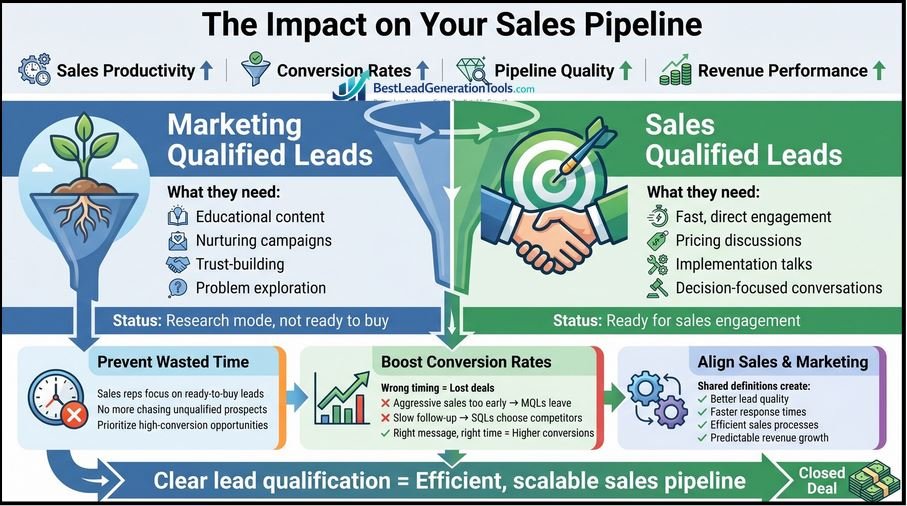
The difference between MQLs and SQLs affects far more than lead organization. It impacts sales productivity, conversion rates, pipeline quality, and overall revenue performance.
When businesses fail to separate these lead types properly, problems quickly spread across the entire sales process. Sales teams spend time chasing leads that are not ready to buy, while high-intent prospects sometimes wait too long for follow-up and choose competitors instead.
Strong lead qualification helps businesses focus the right resources on the right opportunities at the right time. Conversely, poor lead qualification is one of the biggest reasons why lead generation fails.
MQLs need education, nurturing, and trust-building. SQLs need fast, direct engagement focused on solving specific business problems. Treating both groups the same way usually creates lower conversions, wasted time, and frustrated teams.
Companies that clearly define MQLs and SQLs often build more efficient pipelines, improve sales performance, and generate more predictable revenue growth.
Preventing Sales Teams From Wasting Time
One of the biggest benefits of separating MQLs from SQLs is improved sales efficiency.
Sales representatives perform best when they focus on leads that are genuinely ready for conversations about pricing, implementation, timelines, and purchasing decisions. Every hour spent chasing unqualified leads is an hour not spent closing real opportunities.
Without clear qualification criteria, sales teams often receive leads that are still in research mode. These prospects may be interested in the topic, but they are not yet ready for direct sales engagement. As a result, reps waste time on conversations that go nowhere while more qualified opportunities sit untouched.
Over time, this creates frustration across the organization. Sales teams begin distrusting marketing-generated leads, and marketing teams feel pressured to generate higher lead volume instead of better lead quality.
Clear MQL and SQL definitions solve this problem by helping sales teams prioritize the leads most likely to convert.
Improving Conversion Rates
MQLs and SQLs require very different communication strategies.
MQLs respond best to educational content that builds trust and helps them better understand their problems and possible solutions. SQLs respond better to fast, personalized conversations focused on implementation, business impact, pricing, and decision-making.
When businesses use the wrong approach at the wrong stage, conversion rates suffer.
For example, pushing aggressive sales conversations too early can drive away MQLs who are still researching. On the other hand, slow follow-up with SQLs can kill buying momentum and allow competitors to enter the conversation first.
Timing matters throughout the entire qualification process.
Businesses that properly separate MQLs and SQLs can deliver more relevant communication at each stage of the funnel. This usually leads to stronger engagement, better sales conversations, and higher conversion rates overall.
Aligning Sales and Marketing Teams
Clear qualification criteria also improve alignment between marketing and sales teams.
Without shared definitions, marketing and sales often operate with different expectations. Marketing may believe they are generating qualified leads, while sales may view those same leads as unready or low quality.
This disconnect creates friction and makes it difficult to improve pipeline performance.
Shared MQL and SQL definitions create accountability on both sides. Marketing becomes responsible for generating leads that match agreed qualification standards, while sales becomes responsible for timely follow-up and effective lead conversion.
Strong alignment also improves reporting and forecasting. Both teams can track how leads move through the funnel, where conversion bottlenecks exist, and which marketing efforts generate the highest-quality opportunities.
When marketing and sales work from the same qualification framework, businesses typically see:
- Better lead quality
- Faster response times
- More efficient sales processes
- Higher conversion rates
- More predictable revenue growth
Clear lead qualification is not just a marketing exercise. It is a core part of building an efficient and scalable sales pipeline.
Common Mistakes Companies Make With MQLs and SQLs
Many businesses struggle with lead qualification because they make a few common mistakes that slow down sales and reduce conversions.
Common problems include:
- Sending leads to sales before they are truly ready
- Using vague or inconsistent qualification criteria
- Ignoring behavioral buying signals
- Treating all leads the same way regardless of funnel stage
- Following up with SQLs too slowly
- Failing to align marketing and sales teams around shared definitions
Even small qualification mistakes can create major pipeline problems over time. Sales teams waste time chasing low-intent leads, while highly interested prospects may lose momentum or choose competitors before meaningful conversations begin.
The most effective businesses use clear qualification frameworks, lead scoring systems, and strong communication between marketing and sales teams to ensure leads are handled appropriately at every stage of the funnel.
How to Define MQL and SQL Criteria for Your Business
Businesses define MQLs and SQLs by combining engagement data, customer fit, and buying intent signals. The goal is to identify which leads are still researching and which are ready for direct sales conversations.
Demographic and Firmographic Fit
Businesses often evaluate factors such as:
- job title
- company size
- industry
- location
to determine whether a lead matches the ideal customer profile.
Behavioral Signals
Actions like:
- downloading resources
- visiting pricing pages
- requesting demos
- asking implementation questions
help businesses measure buying intent.
Lead Scoring
Many companies use lead scoring systems that assign points to specific behaviors and characteristics. Once a lead crosses a scoring threshold, they move from MQL to SQL status.
Best Tools for Tracking and Managing MQLs and SQLs
Most businesses rely on software tools and a structured lead generation system to track lead behavior, score engagement, automate follow-up, and manage the transition from MQL to SQL. Without the right systems in place, it becomes much harder to identify buying intent, prioritize leads, and keep sales and marketing teams aligned.
The exact tools you need depend on your business size, sales cycle, and marketing strategy, but most companies use a combination of CRM platforms, lead scoring tools, and marketing automation software to manage qualified leads effectively.
Smaller businesses often rely on affordable lead generation tools to manage nurturing, scoring, and follow-up workflows.
CRM Platforms
CRM platforms help businesses organize lead data, track customer interactions, and manage sales pipelines. They also make it easier to see when leads move from early research stages into active buying consideration.
Popular CRM platforms include HubSpot, Salesforce, Pipedrive, and Zoho CRM.
These tools typically allow businesses to:
- Track lead activity across websites and emails
- Monitor lead progression through the sales funnel
- Assign leads to sales representatives
- Record sales conversations and follow-up activity
- Automate lead routing and notifications
For businesses trying to improve lead qualification and pipeline visibility, a strong CRM is usually the foundation of the entire process.
If you want a deeper comparison of CRM platforms, you may also find these guides helpful:
- Best CRM Tools for Lead Generation
- HubSpot vs Salesforce
- Best CRM Software for Small Business Lead Management
Lead Scoring Tools
Lead scoring tools help businesses measure buying intent by assigning point values to different actions and behaviors.
For example, opening an email may add a few points, while requesting a demo or visiting a pricing page may add significantly more. Once a lead crosses a scoring threshold, the system can automatically classify the lead as sales-qualified.
Many CRM and marketing automation platforms include built-in lead scoring features, while some businesses use dedicated lead scoring software for more advanced qualification systems.
Lead scoring tools are especially useful for:
- Prioritizing high-intent leads
- Identifying sales-ready prospects faster
- Reducing wasted sales outreach
- Automating qualification workflows
If you want to explore this topic further, related guides may include:
- Best Lead Scoring Software
- How to Build a Lead Scoring System
- Best Tools for Lead Qualification
Marketing Automation Platforms
Many businesses use specialized B2B lead generation tools to track engagement, automate nurturing, and identify sales-ready leads.
Marketing automation tools help businesses nurture MQLs until they are ready for sales conversations.
These platforms automate tasks such as:
- Email sequences
- Lead nurturing campaigns
- Behavioral tracking
- Follow-up reminders
- Segmentation and personalization
Popular platforms include ActiveCampaign, HubSpot Marketing Hub, Mailchimp, and Marketo.
Automation platforms are especially valuable for businesses with longer sales cycles because they help maintain engagement while leads continue researching solutions. Instead of manually following up with every prospect, businesses can create automated workflows that deliver the right content at the right stage of the funnel.
For example, an MQL who downloads an ebook might automatically receive:
- Educational blog content
- Case studies
- Webinar invitations
- Product comparison resources
As engagement increases, the lead can eventually move into SQL status and trigger a sales handoff automatically.
If you are comparing platforms, these related articles may also help:
- Best Marketing Automation Tools
- ActiveCampaign vs HubSpot
- Best Email Automation Platforms for Lead Nurturing
Analytics and Funnel Tracking Tools
Analytics and funnel tracking tools help businesses understand which marketing efforts generate the highest-quality leads.
These tools track:
- Traffic sources
- Content engagement
- Conversion paths
- Funnel drop-off points
- MQL-to-SQL conversion rates
Popular platforms include Google Analytics, HubSpot Analytics, and specialized attribution tools.
This data helps businesses improve qualification strategies over time. For example, a company may discover that webinar leads convert to SQLs at a much higher rate than ebook downloads, allowing them to invest more heavily in webinars moving forward.
Businesses that consistently analyze funnel performance are often much better at identifying which lead generation strategies actually produce revenue instead of just generating traffic.
MQL vs SQL Example Scenario
To better understand how MQLs and SQLs work in practice, it helps to look at a real-world lead journey from beginning to end.
Imagine a marketing director at a 150-person B2B software company searching for ways to improve her company’s lead management process. During her research, she finds a blog post about lead qualification and downloads an ebook titled “The Complete Guide to Lead Management.”
At this point, she becomes a lead in the company’s CRM system.
Over the next two weeks, she continues engaging with the company’s content. She opens several nurture emails, reads additional blog posts about lead scoring and sales funnels, and registers for a webinar focused on improving lead conversion rates.
Her behavior shows clear interest, but she is still in research mode.
She is trying to better understand:
- How lead qualification works
- What tools businesses use
- Which strategies improve conversion rates
- Whether her current process has weaknesses
At this stage, the company classifies her as an MQL because she matches the ideal customer profile and has shown meaningful engagement with educational content. However, she has not yet shown strong buying intent.
As the weeks continue, her behavior begins to change.
Instead of consuming only educational content, she starts exploring solution-specific pages. She visits the pricing page multiple times, reads customer case studies, and downloads a comparison guide that evaluates several competing platforms.
A few days later, she replies to a nurture email with questions about CRM integrations and onboarding timelines. Shortly afterward, she submits a request for a live product demo and mentions that her team hopes to implement a new system within the next quarter.
This is the moment where the lead transitions from MQL to SQL.
Her actions now show:
- Active vendor evaluation
- Internal business discussions
- Implementation planning
- Purchase timeline consideration
- Clear buying intent
The company’s lead scoring system automatically increases her score based on these high-intent actions. Once she crosses the SQL threshold, the CRM routes the lead directly to a sales representative for immediate follow-up.
Within a few hours, the sales rep reviews her engagement history inside the CRM. He can see:
- Which resources she downloaded
- Which pages she visited
- Which emails she opened
- Which topics she engaged with most
This context helps the rep personalize the conversation instead of starting cold.
During the demo call, the discussion focuses less on education and more on implementation, pricing, team adoption, and business goals. The lead is no longer trying to understand whether lead qualification matters. She is trying to determine whether this specific solution is the right fit for her company.
This example highlights the core difference between MQLs and SQLs.
MQLs are still researching and learning. SQLs are actively evaluating solutions and preparing to make purchasing decisions.
Final Thoughts on MQL vs SQL
Understanding the difference between MQLs and SQLs helps businesses improve lead quality, prioritize sales efforts, and create more efficient pipelines.
MQLs are still researching and learning. SQLs are actively evaluating solutions and preparing to make purchasing decisions. Recognizing the difference allows marketing and sales teams to engage leads more effectively at every stage of the funnel.
Businesses that use clear qualification criteria, lead scoring systems, and strong sales and marketing alignment often generate better conversion rates and more predictable revenue growth.
The goal is not simply to generate more leads. It is to identify the right leads, engage them at the right time, and guide them through the buying process more effectively.