
What Is a Lead Generation Funnel? How It Works and Why Most Funnels Fail
Most websites don’t have a traffic problem.
They have a conversion problem.
Visitors arrive, browse for a few seconds, and leave without taking action. No email signup, no inquiry, no sale.
The reason is simple. There’s no structured system guiding them from curiosity to commitment.
A lead generation funnel solves this. It turns scattered traffic into a predictable flow of qualified prospects and gives your marketing a clear, repeatable path to growth.
Once you understand how it works, you’ll start to see exactly where your current strategy is breaking down and how to fix it.
What Is a Lead Generation Funnel
If your website is getting traffic but not producing leads, the problem usually is not visibility. It is structure.
A lead generation funnel is the system that guides visitors from their first interaction with your business to the point where they are ready to take action. Instead of leaving things to chance, it creates a clear path that moves people step by step toward becoming a qualified lead.
Lead Generation Funnel Definition and Core Concept
A lead generation funnel is a structured process that attracts visitors, captures their contact information, and qualifies them based on their interest and intent.
It works by turning broad attention at the top into focused opportunity at the bottom. Many people may discover your content, but only a smaller group will engage, and an even smaller group will be ready to move forward. The funnel helps you identify and prioritize those high-intent prospects.
Each stage of the funnel serves a specific purpose.
At the top, your goal is to attract attention and build awareness through helpful and relevant content.
In the middle, you capture contact information by offering something valuable in exchange, such as a guide, template, or webinar.
At the bottom, you nurture and qualify those leads so you can identify who is ready to take the next step.
When built correctly, this system replaces guesswork with a repeatable process. Instead of hoping the right people reach out at the right time, you create a predictable way to generate and qualify leads on a consistent basis.
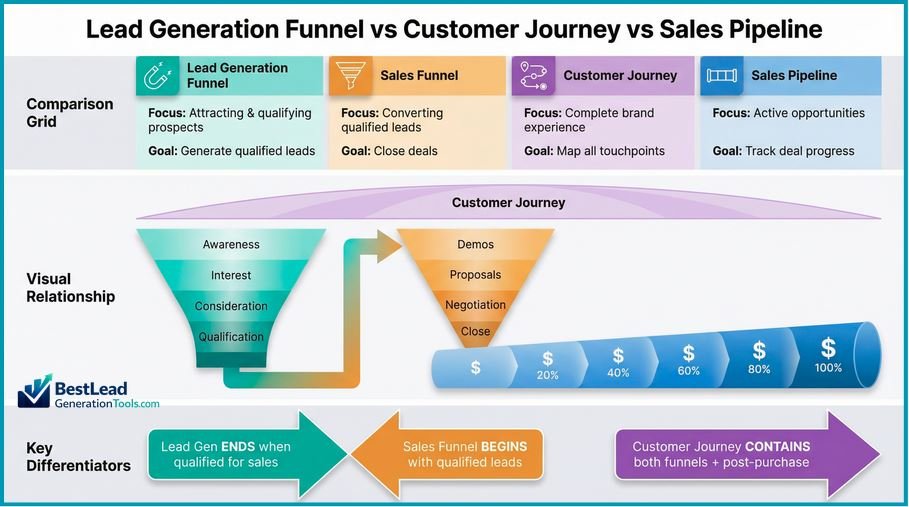
Lead Generation Funnel vs Customer Journey vs Sales Pipeline
These terms are often used interchangeably, but they represent different parts of the same overall system.
The lead generation funnel focuses on attracting and qualifying new prospects. It is responsible for turning unknown visitors into leads who are ready for a sales conversation.
The sales funnel begins after that point. It focuses on converting qualified leads into customers through demos, proposals, and direct communication.
The customer journey is broader than both. It includes every interaction someone has with your business, from their first exposure to your brand to their experience after becoming a customer.
The sales pipeline is a tool used by your sales team to track active opportunities. It shows where each deal stands and how close it is to closing.
Understanding these differences helps you see how each piece fits together. Your lead generation funnel feeds your sales pipeline, and both operate within the larger customer journey.
| Term | Focus | Key Goal |
|---|---|---|
| Lead Generation Funnel | Attracting and qualifying prospects | Generate qualified leads |
| Sales Funnel | Converting qualified leads | Close deals |
| Customer Journey | Complete brand experience | Map all touchpoints |
| Sales Pipeline | Active opportunities | Track deal progress |
Why Lead Generation Funnels Matter for Business Growth
Without a clear funnel, your marketing feels unpredictable.
You may get traffic, but it does not turn into leads. You may generate leads, but they do not convert into customers. Results come and go, and it is difficult to understand what is working and what is not.
This is where many businesses get stuck. They are putting in effort, but they are not seeing consistent outcomes.
A lead generation funnel changes that. It gives your marketing structure, visibility, and direction. Instead of relying on chance, you create a system that guides people from first contact to meaningful action.
When that system is working, growth becomes easier to understand and easier to improve.
How Funnels Create Predictable Lead Flow
A funnel shows you how people move through your marketing. You can see where they enter, what they engage with, and where they drop off.
This clarity allows you to connect your efforts to real results. You are no longer guessing which campaigns are working or which leads are worth pursuing.
Over time, patterns begin to emerge. You may find that a certain type of content consistently attracts engaged visitors, or that a specific offer converts more effectively than others.
With this insight, you can begin to forecast outcomes. If a certain amount of traffic produces a certain number of leads, you can plan your growth with greater confidence.
Instead of relying on inconsistent spikes, you build a steady and predictable flow of qualified prospects.
The Role of Funnels in Scalable Marketing Systems
As your funnel improves, your marketing becomes more efficient.
You are not just generating more leads. You are generating better leads and handling them more effectively.
Segmentation allows you to group people based on their behavior and interests. This makes your messaging more relevant and increases engagement.
Automation supports this process by handling repetitive tasks such as follow up, nurturing, and lead scoring. Leads receive the right information at the right time without requiring constant manual effort.
This combination of structure and automation allows you to grow without adding unnecessary complexity.
You can also identify bottlenecks more quickly. When something is not working, the data points you to the exact stage that needs improvement.
This turns your funnel into a system you can refine over time instead of something you have to rebuild from scratch.
Setting the Stage for the Funnel
Once you understand why funnels matter, the next step is to see how they actually work.
Every lead generation funnel follows a progression. People become aware of a problem, explore possible solutions, and eventually decide what action to take.
Each of these stages requires a different approach.
To understand how to build and improve your funnel, you need to understand what happens at each stage and what your role is in guiding people forward.
That process begins at the top of the funnel, where attention turns into awareness.
Overview of the Lead Generation Funnel Stages
The lead generation funnel breaks down into three main stages that guide prospects from initial awareness to purchase readiness. Each stage serves a specific purpose in moving potential customers closer to becoming qualified leads for your sales team.
Top of Funnel TOFU Explained
TOFU focuses on attracting new visitors who don’t yet know about your solution. Your primary goal is to build visibility and trust by meeting prospects where they already spend time online.
At this stage, you create educational content that answers early questions and addresses common problems your target audience faces. This includes blog posts optimized for search engines, social media content, paid advertising, videos, and podcasts.
You’re not asking for much commitment yet. The content should be freely accessible and help prospects understand their challenges better. Think of TOFU as planting seeds rather than harvesting crops.
Your metrics at this stage track website visitors, social media reach, and content engagement. These numbers tell you if your message is reaching the right people in the right places.
Middle of Funnel MOFU Explained
MOFU converts anonymous visitors into known leads through value exchange. Prospects at this stage know they have a problem and are actively looking for solutions.
You offer lead magnets like guides, templates, webinars, or assessments in exchange for contact information. Each asset should provide real value that justifies a prospect sharing their email address and other details.
Landing pages become critical here. Keep them simple with clear offers, short forms, and strong calls to action. Your CTA should state exactly what the prospect gets and when they’ll receive it.
Email nurture campaigns start working once you capture contact data. These automated sequences build trust by delivering relevant information based on what prospects downloaded or which pages they visited. Lead scoring helps you identify which contacts show the highest engagement and purchase intent.
Bottom of Funnel BOFU Explained
BOFU concentrates on proving why your product is the best choice for prospects who are ready to make a decision. Sales enablement takes center stage as you demonstrate specific value.
Product demos show exactly how your solution solves the prospect’s problem. Consultations provide customized recommendations and ROI discussions tailored to their situation. Customer testimonials, case studies, and reviews offer social proof that reduces purchase risk.
Free trials and special offers lower the barrier to getting started. Make the next step as easy as possible with one-click scheduling, transparent pricing, and simple signup processes.
Your CTA at this stage should be direct and action-oriented. Instead of “Learn More,” use “Start Your Free Trial” or “Book Your Demo.” Conversion rate matters most here, so remove any friction that might prevent a prospect from moving forward.
Top of Funnel TOFU Attracting the Right Audience
If the wrong people enter your funnel, nothing else works.
You can have the best landing pages, the best emails, and the best offer, but none of it matters if your traffic is not aligned with your ideal customer. The top of funnel is where you either set yourself up for success or create problems that follow you through every stage.
This stage is not about getting more traffic. It is about getting the right traffic.
What Happens at the Awareness Stage
At the awareness stage, people are not looking to buy. They are trying to understand a problem, explore options, or find basic information.
In many cases, they do not even know what solution they need yet. They are asking broad questions and looking for clear explanations.
Your role is to meet them at that moment with useful, relevant content. You are not selling. You are helping them make sense of their situation.
When you do this well, two things happen. You earn attention, and you begin to build trust. That trust becomes the foundation for everything that follows in your funnel.
Best Traffic Sources for TOFU Lead Generation
Not all traffic sources produce the same quality of visitors. Some bring in people who are curious. Others bring in people who are actively searching for answers.
Organic search is one of the strongest sources because it captures intent. When someone searches for a specific question, they are already engaged in the problem you solve.
Social media allows you to reach people based on interests and behaviors. It is effective for building awareness and starting conversations, but it often requires strong content to capture attention quickly.
Paid advertising gives you control over targeting and speed. You can reach specific audiences and test different messages, but you need clear targeting to avoid wasting budget on low-quality clicks.
Other channels such as video platforms, podcasts, and affiliate partnerships can also bring in valuable traffic when aligned with your audience.
The key is not to be everywhere. It is to focus on the channels that consistently bring in people who match your ideal customer profile.
Content Types That Perform Best at TOFU
At the top of the funnel, content needs to be useful first and persuasive second.
Your goal is to answer questions, simplify complex ideas, and help people understand their problem more clearly.
Blog posts work well because they capture search traffic and provide direct answers. Each post should focus on a specific question or topic and deliver clear value.
Long-form guides help establish authority. When someone finds a resource that fully explains a topic, they are more likely to trust the source and return for more information.
Visual and interactive formats can increase engagement. Videos explain concepts quickly. Infographics simplify information. Quizzes and tools provide personalized insights.
Lead magnets such as ebooks, templates, and webinars can also be introduced at this stage, but they must feel genuinely helpful. If the value is not clear, people will not exchange their contact information.
Every piece of content should guide the reader toward a next step, even if that step is simply reading another article or exploring a related topic.
Key Metrics to Track at the Top of the Funnel
The purpose of TOFU is not just visibility. It is qualified visibility.
Traffic volume shows how many people are finding your content, but it does not tell you if they are the right people. You need to look deeper.
Engagement metrics such as time on page, pages per session, and content interaction show whether your content is resonating.
Click-through rate reveals whether people are taking the next step after consuming your content. This could be clicking a link, downloading a resource, or visiting another page.
Lead capture rate shows how effectively your content turns visitors into leads.
Instead of focusing on isolated numbers, look for patterns. Which topics attract the most engaged visitors? Which channels produce leads instead of just traffic?
When you focus on quality over quantity, your entire funnel becomes more efficient. The right people enter at the top, and everything downstream becomes easier to optimize.
Middle of Funnel MOFU Converting Visitors into Leads
Traffic alone does not build a business. Leads do.
The middle of your funnel is where casual visitors either take a step forward or disappear. This is the point where interest turns into action. If this stage is weak, your funnel leaks potential customers before they ever reach a buying decision.
Your goal here is simple. Give people a reason to raise their hand and say they are interested.
How Lead Magnets Drive Conversions
Most visitors are not ready to talk to sales. They are still learning, comparing options, and trying to understand what will work for them.
A lead magnet bridges that gap.
It offers something valuable in exchange for contact information. This could be a guide, a template, a webinar, or a case study. The key is relevance. The offer must match what the visitor is already thinking about.
If someone is researching solutions, give them something that helps them evaluate options. If they are trying to solve a specific problem, give them a tool they can use right away.
When the value is clear, people are willing to share their information. When it is not, they leave.
Landing Pages and Lead Capture Forms Best Practices
Your landing page has one job. Convert interest into action.
Anything that distracts from that goal reduces your chances of capturing a lead. Keep the message focused and the layout simple.
Start with a clear headline that explains the benefit of your offer. Follow it with short, specific points that show what the visitor will gain. Make the next step obvious.
Your form should only ask for what you need at this stage. Name and email are often enough. Every additional field creates friction.
Placement matters as well. The form should be visible without forcing the visitor to search for it. The call to action should be direct and easy to understand.
Small improvements in clarity and simplicity can make a significant difference in conversion rates.
Building Trust and Authority During Consideration Stage
At this stage, people are asking a different question. They are no longer asking what the problem is. They are asking who they can trust to solve it.
Your job is to answer that question with evidence.
Testimonials that show real results build credibility. Case studies that explain how a problem was solved provide proof. Clear comparisons help visitors understand where you stand against alternatives.
The more specific you are, the more convincing you become. Vague claims do not build trust. Clear examples do.
Consistency also matters. When your content, messaging, and follow-up align, it reinforces confidence. When they do not, it creates doubt.
Trust is what moves someone from interest to serious consideration.
Key Metrics to Track at the Middle of the Funnel
The middle of the funnel is where performance becomes measurable.
Conversion rate tells you how many visitors are turning into leads. If this number is low, your offer, page, or targeting needs improvement.
Cost per lead shows how efficiently you are generating those leads. It helps you understand whether your efforts are sustainable.
Click-through rate and time on page reveal how people interact with your content. These metrics show whether your message is clear and engaging.
Form abandonment rate highlights friction. If people start filling out your form but do not complete it, something is getting in the way.
Beyond these numbers, focus on lead quality. Are the people entering your funnel a good fit for what you offer? Are they engaging with your content after they sign up?
When you attract the right visitors and give them a clear reason to act, this stage becomes the engine that drives your entire funnel forward.
Bottom of Funnel (BOFU): Converting Leads into Customers
Leads do not become customers on their own. They need clarity, confidence, and a clear next step.
By the time someone reaches the bottom of your funnel, they are no longer exploring the problem. They are deciding which solution to choose. If you fail here, it is not because of a lack of interest. It is because something is missing.
Your role at this stage is to remove doubt and make the decision feel simple.
What Happens at the Decision Stage
At the decision stage, your prospects are close to taking action. They understand their problem and have likely reviewed multiple options.
Now they are asking practical questions. Will this work for me? Is it worth the cost? Can I trust this company?
This is where uncertainty can slow or stop the process. Even small concerns can prevent someone from moving forward.
Your job is to address those concerns directly. Show how your solution works, explain the value clearly, and make the path forward easy to follow.
When you do this well, the decision becomes logical instead of risky.
Common Conversion Actions in Lead Generation Funnels
At this stage, people need more than information. They need proof and experience.
Product demos allow them to see how your solution works in a real situation. Free trials give them the opportunity to test it themselves. Consultations provide personalized guidance based on their specific needs.
Case studies show what results look like in practice. The more specific the outcomes, the more convincing they become.
Clear pricing and simple offers also play an important role. When people understand what they are getting and what it costs, it reduces hesitation.
Each of these actions moves the prospect closer to a final decision by increasing confidence and reducing uncertainty.
The Role of Email Nurturing and CRM Systems
Follow-up is where many funnels break down.
A lead may be interested, but if they do not hear from you at the right time, that interest fades. Consistent and relevant follow-up keeps the conversation moving.
Email is one of the most effective ways to do this. Messages should reflect what the lead has already shown interest in. Reference the content they viewed or the actions they took.
A CRM system supports this process by tracking behavior and organizing your leads. It helps you understand where each person is in their decision process and what they need next.
When your follow-up feels relevant and timely, it builds confidence. When it feels generic or delayed, it creates distance.
Key Metrics to Track at the Bottom of the Funnel
The bottom of the funnel is where results become clear.
Conversion rate shows how many leads turn into customers. This is one of the most important indicators of how well your funnel is working.
Time to conversion reveals how long it takes for a lead to make a decision. Longer timelines can signal confusion or unresolved concerns.
Engagement with bottom-funnel content shows where interest is strong and where it drops off. If people are not completing demos or reviewing key materials, something needs attention.
Track specific actions such as demo bookings, trial signups, and completed purchases. These metrics show how effectively your funnel turns intent into outcomes.
When this stage is optimized, your funnel becomes more than a system for generating leads. It becomes a reliable path to revenue.
Common Lead Generation Funnel Leaks and Bottlenecks
Most lead generation funnels do not fail all at once.
They leak.
Small breakdowns at each stage quietly drain your leads, reduce your conversions, and limit your growth. The frustrating part is that these leaks are often hard to see unless you know exactly where to look.
If your funnel is not producing the results you expect, the issue is usually not the entire system. It is a specific point where people lose interest, get confused, or fail to take the next step.
This section will help you identify where that breakdown is happening so you can fix it with clarity instead of guesswork.
Top of Funnel Traffic and Targeting Issues
If the wrong people enter your funnel, everything that follows becomes harder.
At the top of the funnel, the most common problem is not a lack of traffic. It is a lack of relevant traffic. When your content or ads reach people who are not a good fit, they may click, but they will not engage or convert.
This leads to high bounce rates, low engagement, and wasted budget.
Common causes include targeting audiences who are not aligned with your offer, using broad or unfocused keywords, and creating content that attracts curiosity instead of intent.
If you are seeing strong traffic numbers but low engagement or very few leads, this is usually where the problem begins.
When you improve targeting and align your content with the right audience, the quality of everything downstream improves.
Middle of Funnel Conversion Problems
This is where interest should turn into action. When it does not, your funnel starts losing real opportunities.
Visitors may be reading your content and spending time on your site, but they are not taking the next step. They are not filling out forms, downloading resources, or joining your email list.
This often happens when the value of your offer is unclear or when the process feels too complicated.
Long forms, weak calls to action, slow page load times, and generic messaging all create friction. Even small points of confusion can cause someone to leave instead of continuing.
Another common issue is mismatched follow-up. When your emails or content do not reflect what the visitor is actually interested in, engagement drops quickly.
If you are getting traffic but very few leads, or if people start filling out forms but do not complete them, your leak is likely in this stage.
Simplifying your pages, clarifying your offer, and aligning your messaging with user intent can dramatically improve results here.
Bottom of Funnel Sales and Follow-Up Gaps
This is where strong leads are either converted or lost.
By the time someone reaches the bottom of your funnel, they have already shown interest. They understand the problem and are considering solutions. If they do not convert, it is usually because something is slowing them down or creating doubt.
One of the most common issues is slow or inconsistent follow-up. When a lead requests information and does not receive a timely response, momentum is lost. Interest fades quickly.
Another issue is a lack of personalization. If your outreach feels generic or disconnected from what the lead has already done, it weakens trust.
Poor handoffs between marketing and sales can also create problems. When important context is missing, conversations feel repetitive and less effective.
If leads are entering your funnel but not turning into customers, this is where to focus your attention.
Faster response times, clearer communication, and more personalized follow-up can significantly increase your conversion rates at this stage.
How to Identify Where Your Funnel Is Breaking Down
You do not need to guess where your funnel is leaking. The patterns are usually clear once you know what to look for.
If you have high traffic but low engagement, your issue is likely at the top of the funnel.
If you have strong engagement but low lead capture, the problem is usually in the middle of the funnel.
If you have leads but few conversions, the issue is almost always at the bottom of the funnel.
Each stage builds on the one before it. When one part is weak, it affects everything that follows.
Once you identify the exact point where people are dropping off, your next steps become much simpler. Instead of trying to fix everything at once, you can focus on improving the part of your funnel that will have the greatest impact.
How to Optimize Each Stage of the Lead Generation Funnel
Once you know where your funnel is breaking down, optimization becomes focused and effective.
Instead of making random changes, you improve the exact stage that is limiting your results. Each part of your funnel has a different job, and each requires a different approach.
The goal is simple. Strengthen each stage so the entire system works together.
Optimizing Traffic and Targeting at TOFU
If your top of funnel is weak, everything downstream suffers.
The priority here is not more traffic. It is better traffic. You want visitors who are aligned with your offer and actively interested in what you provide.
Start by refining your targeting. Focus on specific audiences based on factors such as industry, intent, and behavior. Broad targeting brings volume, but it often reduces quality.
Your content should match what your audience is searching for. Answer real questions. Address real problems. When your content aligns with intent, engagement improves naturally.
Test different headlines, topics, and formats to see what attracts the right visitors. Look at which channels produce engaged users instead of just clicks.
If a traffic source brings visitors who leave quickly and never convert, it is not helping your funnel.
When you improve targeting and content alignment, you bring in people who are far more likely to move forward.
Improving Conversion Rates at MOFU
The middle of the funnel is where interest turns into action. Small improvements here can produce large gains.
Start by reducing friction. Your forms should be simple and easy to complete. Only ask for information you truly need at this stage.
Your offer must be clear and valuable. If visitors do not immediately understand what they are getting and why it matters, they will not take action.
Your landing pages should focus on one goal. Remove distractions. Use clear headlines and direct calls to action that guide the visitor toward the next step.
Personalization also plays a major role. Segment your audience based on behavior and interests. Send content that matches what they have already engaged with.
Test different versions of your pages and offers. Even small changes in wording, layout, or structure can significantly improve conversion rates.
When this stage is optimized, more of your traffic turns into qualified leads.
Increasing Close Rates at BOFU
At the bottom of the funnel, the focus shifts from interest to decision.
Your leads are close to taking action, but they need clarity and confidence before they commit. Your role is to remove any remaining uncertainty.
Personalization becomes critical. Tailor your communication based on what the lead has done and what they need. Refer to their specific situation whenever possible.
Make your process simple and easy to follow. Clear pricing, easy scheduling, and straightforward next steps reduce hesitation.
Use proof to reinforce your message. Case studies, testimonials, and real results show that your solution works in practice.
Pay close attention to where deals slow down. If leads hesitate after a demo or stop responding after receiving pricing, that signals a specific issue that needs to be addressed.
Faster follow-up also makes a difference. When you respond quickly and consistently, you maintain momentum and increase the likelihood of conversion.
When this stage is strong, your funnel becomes a reliable driver of revenue instead of a source of missed opportunities.
B2B vs B2C Lead Generation Funnel Differences
The way your funnel works depends on who you are trying to reach.
While the structure of a funnel stays the same, the way people move through it can be very different. Understanding these differences helps you set the right expectations and use the right approach at each stage.
How Buyer Behavior Changes the Funnel
If you are selling to businesses, decisions usually take more time.
Multiple people may be involved, each with different concerns. Some focus on cost, others on performance, and others on long term impact. Because of this, your funnel needs to provide more information, more proof, and more opportunities for engagement.
At the top of the funnel, your content needs to educate and build credibility. People are looking for clear explanations and reliable insights.
In the middle of the funnel, your offers should help prospects evaluate options. Case studies, detailed guides, and comparisons become more important.
At the bottom of the funnel, trust and clarity are critical. Demos, consultations, and personalized communication help move decisions forward.
If you are selling directly to consumers, the process is usually faster.
Decisions are often made by one person and are influenced by clarity, ease, and perceived value. People want to understand what they are getting and how it helps them without going through a long process.
At the top of the funnel, your content needs to capture attention quickly and clearly communicate relevance.
In the middle of the funnel, your offers should be simple and easy to act on. The fewer steps required, the better.
At the bottom of the funnel, removing friction is the priority. Clear pricing, simple checkout, and strong calls to action help people move forward without hesitation.
Adapting Your Funnel Strategy
The key is not to change the structure of your funnel, but to adjust how you execute each stage.
If your sales cycle is longer, your funnel needs more touchpoints, more education, and more follow up.
If your sales cycle is shorter, your funnel needs speed, clarity, and simplicity.
In both cases, the goal remains the same. Guide people from awareness to action in a way that matches how they make decisions.
When your funnel aligns with your audience, each stage becomes more effective and your results become more consistent.
Key Metrics to Track Across the Entire Funnel
If you cannot measure your funnel, you cannot improve it.
Metrics are not just numbers. They show you where your funnel is working, where it is slowing down, and where it is breaking. When you understand what to track, you stop guessing and start making informed decisions.
The goal is not to track everything. It is to track what reveals how people move through your funnel.
Traffic and Engagement Metrics
The top of your funnel is about attracting the right audience and holding their attention.
Traffic tells you how many people are entering your funnel, but it does not tell you if they are a good fit. Engagement shows whether your content is connecting with them.
Key indicators include time on page, pages per session, and how often people interact with your content.
If traffic is high but engagement is low, your targeting or content alignment needs attention. You may be attracting visitors who are curious but not genuinely interested.
If both traffic and engagement are strong, you are bringing in the right audience and setting your funnel up for success.
Conversion Metrics
The middle of your funnel is where interest turns into action.
Conversion rate shows how many visitors become leads. This is one of the clearest indicators of how effective your offers and pages are.
Cost per lead shows how efficiently you are generating those leads. It helps you understand whether your strategy is sustainable over time.
Form completion and drop off rates reveal friction. If people start the process but do not finish, something is getting in the way.
If engagement is strong but conversions are low, your issue is usually in your offer, your messaging, or the simplicity of your process.
When this stage improves, your funnel begins to produce consistent and qualified leads.
Revenue and Conversion Metrics
The bottom of your funnel is where leads become customers.
Conversion rate at this stage shows how many leads take the final step. This reflects how well you are building trust, communicating value, and removing doubt.
Time to conversion reveals how long it takes for a lead to make a decision. Longer timelines can indicate hesitation or unclear messaging.
Customer acquisition cost shows how much it takes to turn a lead into a customer. Customer lifetime value shows the long term return from that relationship.
If you are generating leads but not closing them, your focus should be on follow up, personalization, and clarity in your offer.
When this stage is working, your funnel becomes a reliable source of revenue.
Using Metrics to Identify and Fix Funnel Leaks
Each metric tells part of the story, but the real value comes from how they connect.
If traffic is strong but engagement is weak, your issue is at the top of the funnel.
If engagement is strong but leads are low, your issue is in the middle of the funnel.
If leads are coming in but conversions are low, your issue is at the bottom of the funnel.
These patterns allow you to identify exactly where your funnel needs attention.
Once you know where the breakdown is happening, your next step becomes clear. You focus on improving that stage instead of trying to fix everything at once.
When you use metrics this way, your funnel becomes easier to manage, easier to optimize, and far more predictable.
Quick Funnel Health Checklist
Use this checklist to quickly identify where your funnel may need attention.
Top of Funnel Check
- Are you getting consistent traffic from the right sources
- Are visitors spending time on your content
- Are they clicking through to other pages
If traffic is high but engagement is low, your targeting or content needs refinement.
Middle of Funnel Check
- Are visitors converting into leads
- Are your forms being completed without drop off
- Are your offers clear and valuable
If people are engaging but not converting, your offer or page experience needs improvement.
Bottom of Funnel Check
- Are leads turning into customers
- Are you following up quickly and consistently
- Are prospects engaging with demos, trials, or consultations
If leads are not converting, your issue is likely in follow up, trust, or clarity.
Overall Funnel Check
- Do you know where people are dropping off
- Are you tracking key metrics across each stage
- Are you improving one stage at a time instead of guessing
When you can answer these questions with confidence, your funnel becomes easier to manage and far more effective.
Example of a Lead Generation Funnel in Action
To see how all of this works together, it helps to walk through a real scenario.
Instead of thinking about the funnel as a concept, think about how a single person moves through it step by step. At each stage, their intent changes, and your role is to guide them forward.
Step by Step Funnel from First Click to Conversion
A potential customer searches for a question related to their problem. They find your article and click through to your website.
This is the top of the funnel. They are not looking to buy yet. They are trying to understand their situation and find useful information.
They begin reading your content. It answers their question clearly and introduces related ideas. Because the content matches their intent, they stay longer and explore additional pages.
At this point, interest begins to build.
As they continue, they come across a resource that offers deeper insight into their problem. This could be a guide, a template, or a case study. They decide it is worth downloading.
This is the middle of the funnel. They are now willing to exchange their contact information because they see value in what you are offering.
After opting in, they receive follow up emails that provide more useful information. Each message builds on what they have already learned and helps them understand possible solutions.
Over time, their focus shifts. They are no longer just learning. They are comparing options and considering what to do next.
Eventually, they are presented with a clear next step such as a demo, a consultation, or a trial.
This is the bottom of the funnel. They are close to making a decision, but they need clarity and confidence before moving forward.
Because the process has been consistent and relevant, they feel comfortable taking action. They move from being a visitor to becoming a qualified lead, and then to becoming a customer.
How Each Stage Connects
Each step in this process builds on the one before it.
At the top of the funnel, the goal is to attract attention and provide value. When that is done well, it creates interest.
At the middle of the funnel, the goal is to capture that interest and turn it into a relationship. Clear offers and relevant follow up make this possible.
At the bottom of the funnel, the goal is to help the prospect make a decision. Trust, clarity, and simplicity are what move them forward.
If any part of this process is weak, the flow breaks down. If the content does not match intent, visitors leave early. If the offer is unclear, they do not convert into leads. If follow up is inconsistent, they do not become customers.
When each stage is aligned, the process feels natural. People move forward because each step gives them exactly what they need at that moment.
This is what a well built lead generation funnel looks like in practice.
How Lead Generation Funnels Fit Into a Larger System
Most funnels do not fail because of a single problem.
They fail because the system around them is disconnected.
You may have strong traffic, but no clear follow up. You may capture leads, but your sales process does not align with what those leads expect. You may generate interest, but lose momentum before a decision is made.
When the pieces do not work together, results become inconsistent.
A lead generation funnel is only one part of a larger system. To make it work effectively, every stage needs to connect with what comes next.
Connecting Your Funnel to Your Marketing and Sales Process
Your funnel should not operate in isolation. It should connect directly to how you attract, nurture, and convert leads.
At the top of the funnel, your content and traffic sources bring people in. These efforts need to align with your messaging and target audience. If they do not, the rest of the funnel becomes harder to manage.
At the middle of the funnel, your lead capture and email sequences should reflect what the visitor has already engaged with. When your messaging stays consistent, trust builds more easily.
At the bottom of the funnel, your sales process needs to match the expectations created earlier. If your messaging changes or becomes unclear, it creates hesitation.
When each stage connects smoothly, the experience feels natural. When it does not, people lose confidence and drop out.
Why Systems Thinking Improves Funnel Performance
When you look at your funnel as part of a system, you start to see patterns instead of isolated problems.
If leads are not converting, the issue may not be at the bottom of the funnel. It could be that expectations were not set clearly earlier in the process.
If engagement is low, the problem may not be your content alone. It could be a mismatch between your traffic sources and your audience.
This perspective allows you to make better decisions. Instead of reacting to individual issues, you improve how each part of your funnel works together.
Creating a More Reliable and Scalable System
When your funnel is connected to a larger system, it becomes easier to manage and improve.
Automation helps maintain consistency by handling follow up, segmentation, and lead scoring. This ensures that each lead receives the right message at the right time.
Your CRM helps track behavior and organize your leads so you understand where they are in the process and what they need next.
As your system improves, your funnel becomes more predictable. You can identify bottlenecks more quickly, make targeted improvements, and scale what is working.
Instead of relying on isolated tactics, you build a process that supports consistent growth.
Conclusion What Makes a High-Converting Lead Generation Funnel
A high converting funnel is not built by chance. It is built by understanding how each stage works and making sure every step moves people forward.
When your funnel is aligned, the process becomes clear. The right people enter at the top. They find value in your content. They take action in the middle. They gain confidence at the bottom. Each step supports the next.
When it is not aligned, the breakdown is just as clear. Traffic does not engage. Visitors do not convert. Leads do not become customers. The system loses momentum.
The difference comes down to structure, clarity, and consistency.
Key Takeaways for Building Effective Funnels
Focus on bringing in the right audience. Quality matters more than volume. The better your targeting, the easier everything becomes.
Give people a clear reason to take the next step. Your content and offers should solve real problems and make the path forward obvious.
Build trust through useful information and real proof. People move forward when they feel confident in what you are offering.
Remove friction wherever possible. Simplify forms, clarify messaging, and make decisions easier to act on.
Follow up consistently. Interest fades quickly without timely and relevant communication.
Test and improve each stage. Small changes can lead to meaningful results when applied in the right place.
Next Steps to Improve Your Lead Generation System
Start by identifying where your funnel is losing momentum. Look at your traffic, your lead capture, and your conversion rates to find the stage that needs attention.
Make targeted improvements instead of trying to change everything at once. Focus on the point where people are dropping off and fix that first.
Refine your lead magnets so they provide immediate and practical value. When your offer is strong, conversions become easier.
Improve your follow-up process so leads stay engaged. Clear and consistent communication helps move people toward a decision.
Use automation to support your system, but keep your messaging relevant and focused on the needs of your audience.
When each stage is working as it should, your funnel becomes more than a marketing tool. It becomes a reliable system for generating leads, building relationships, and driving consistent growth.