
Not every website visitor has the same reason for showing up.
One person may be researching a problem for the first time. Another may already know what solution they need and be comparing products, prices, or providers. Both visitors can be valuable, but they should not be treated the same way.
High-intent traffic comes from people who show signs that they are actively evaluating a solution or preparing to take action. Low-intent traffic comes from people who are primarily learning, exploring, or researching without an immediate decision in mind.
For lead generation, understanding that difference is especially important. More traffic does not automatically mean more leads, and more leads do not automatically mean more customers. Attracting visitors whose intent matches what your business offers can often matter more than simply increasing website traffic.
This guide explains how high-intent and low-intent traffic differ, how to recognize buyer intent, which keywords tend to signal stronger intent, and how to use both types of traffic as part of a lead generation strategy.
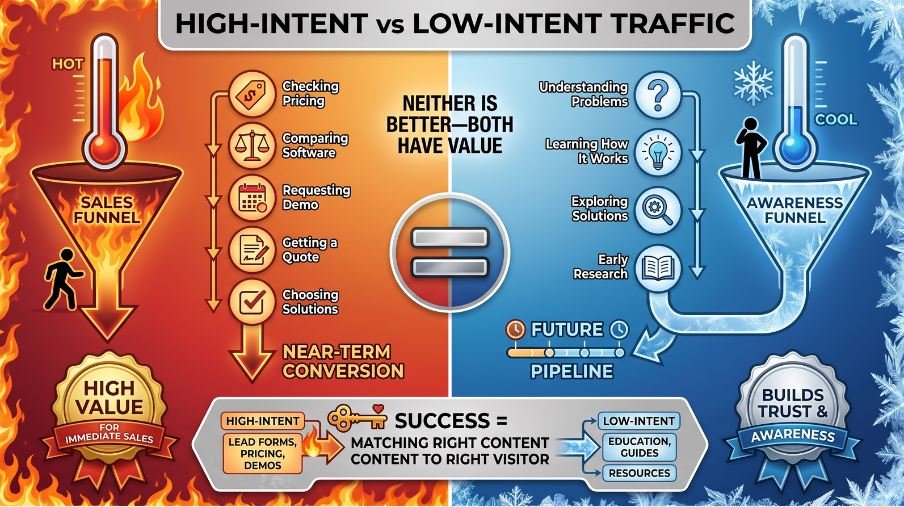
Quick Answer: What Is the Difference Between High-Intent and Low-Intent Traffic?
High-intent traffic comes from visitors who appear closer to taking a meaningful action, such as comparing software, checking pricing, requesting a demo, getting a quote, or choosing between solutions.
Low-intent traffic generally comes from visitors who are earlier in the research process. They may be trying to understand a problem, learn how something works, or explore possible solutions without being ready to choose one.
Neither type of traffic is inherently better.
High-intent traffic is generally more valuable when your goal is generating leads or sales in the near term. Low-intent traffic can help you reach prospects earlier, build trust, and create a pipeline of potential customers who may convert later.
The key is knowing which type of visitor you are attracting and giving that visitor the right content and next step.
What Is High-Intent Traffic?
High-intent traffic comes from people who demonstrate signs that they are actively evaluating solutions or preparing to make a decision.
Instead of searching for broad information, these visitors tend to have a more specific goal.
For example, compare these searches:
- “what is lead generation”
- “best B2B lead generation tools”
- “lead generation software for small business”
- “Apollo vs ZoomInfo”
- “lead generation software pricing”
The first search is primarily educational. The others suggest that the searcher has progressed further toward evaluating a solution.
High intent does not necessarily mean someone will buy immediately. It means the person’s search or behavior suggests greater decision readiness.
Common Signs of High-Intent Traffic
High-intent visitors often reveal themselves through both their search queries and their behavior after reaching your website.
Common signals include:
- Searching for “best,” “review,” “vs,” “alternative,” “pricing,” or “cost”
- Looking for software or services for a specific use case
- Visiting product, pricing, comparison, or buyer-guide pages
- Returning to the website several times
- Comparing multiple solutions
- Reading case studies or detailed product information
- Requesting a demo, consultation, or quote
- Starting a free trial or creating an account
No individual behavior guarantees that someone will become a customer. Intent is better understood as a collection of signals rather than a single action.
Once a visitor becomes a lead, those signals can also become useful inputs for lead scoring, which provides a more systematic way to determine which prospects deserve the most attention.
Examples of High-Intent Lead Generation Keywords
Some keyword patterns are particularly useful for identifying people who are evaluating solutions.
“Best” searches
Examples:
- best lead generation tools
- best B2B lead generation software
- best lead generation tools for small business
Someone making these searches probably already understands the basic problem and is now looking for possible solutions.
Comparison searches
Examples:
- Apollo vs ZoomInfo
- HubSpot vs Salesforce
- Leadpages vs Unbounce
Comparison searches are particularly valuable because the searcher is often trying to narrow a shortlist.
Alternative searches
Examples:
- HubSpot alternatives
- alternatives to ZoomInfo
- cheaper Apollo alternatives
These searches can indicate that someone already understands a product category and may even have experience with a particular solution.
Pricing and cost searches
Examples:
- HubSpot pricing
- lead generation software cost
- B2B lead generation software pricing
Pricing searches often indicate that a prospect is considering whether a solution fits the company’s budget.
Use-case searches
Examples:
- CRM with lead scoring for small business
- lead generation software for real estate agents
- B2B prospecting tools for SaaS companies
Specificity matters. A searcher who knows the type of tool, feature, industry, or use case they need is usually further along than someone searching for a broad definition.
What Is Low-Intent Traffic?
Low-intent traffic generally comes from people who are still learning about a topic, problem, or possible solution.
Examples might include:
- what is lead generation
- how does lead generation work
- what is a sales funnel
- how to generate more leads
- what makes a good sales lead
These visitors can eventually become customers, but their current search does not strongly suggest that they are ready to choose a product or service.
That distinction matters.
Trying to sell aggressively to someone who is still learning about a problem can be ineffective. The better approach is usually to answer the question thoroughly and provide a logical path to the next stage of research.
Low Intent Does Not Mean Low Value
It would be a mistake to conclude that low-intent traffic is worthless.
Informational content can introduce your website to prospects long before they begin evaluating products. If your content answers their questions well, they may return when their needs become more specific.
Low-intent content can also:
- Build topical authority
- Increase organic search visibility
- Introduce prospects to your brand
- Attract email subscribers
- Educate potential buyers
- Create internal pathways toward more decision-oriented content
Consider someone who searches “what is lead generation.”
That person may not need software today. But after learning the fundamentals, the next questions could be how to create a lead generation system, which strategies to use, and eventually which tools can help automate the process.
Low-intent traffic becomes particularly valuable when your website provides that progression rather than treating each article as an isolated destination.
High-Intent vs Low-Intent Traffic: The Key Differences
The biggest difference between high-intent and low-intent traffic is not simply the keyword someone uses. It is where that person appears to be in the decision process.
| Factor | High-Intent Traffic | Low-Intent Traffic |
|---|---|---|
| Primary goal | Evaluate or choose a solution | Learn or explore |
| Typical searches | Best, pricing, review, vs, alternative | What, why, how, guide |
| Decision readiness | Higher | Lower |
| Best content | Comparisons, reviews, buyer guides, product pages | Explainers, how-to guides, educational articles |
| Typical next step | Demo, trial, quote, purchase, deeper evaluation | Read, learn, subscribe, explore |
| Nurturing required | Usually less | Usually more |
These are useful guidelines rather than rigid rules.
A search beginning with “how to,” for example, is not automatically low intent. Someone searching “how to choose lead generation software” may be much closer to a decision than someone searching “how does lead generation work.”
That is why search intent should be evaluated from the complete query and the problem the searcher is trying to solve.
Why High-Intent Traffic Matters for Lead Generation
Lead generation websites ultimately need visitors to take action.
That might mean completing a form, requesting a consultation, downloading a resource, signing up for a trial, or purchasing a product.
High-intent traffic matters because these visitors have usually completed more of the research process before arriving.
Someone searching “what is lead scoring” needs an explanation.
Someone searching “best lead scoring software for small business” needs help choosing a tool.
Those searches deserve different pages because the searchers have different needs.
Traffic Quality and Lead Quality Are Related, but They Are Not the Same
This distinction is important.
Traffic intent describes how ready a visitor appears to be to take action before becoming a lead. Lead quality describes the value and suitability of a prospect after that person becomes a lead.
High-intent traffic can improve the likelihood of generating high-quality leads, but high intent alone does not make someone qualified.
For example, a visitor might urgently want your software but work for a company that is too small, lack the necessary budget, or need features your product does not provide.
Conversely, an ideal potential customer might discover your company while conducting early-stage research and not be ready to talk with sales for several months.
Intent is therefore one piece of lead quality, not a replacement for qualification.
How High-Intent and Low-Intent Traffic Fit Into the Lead Generation Funnel
Traffic intent and funnel stage are closely related, but they are not exactly the same concept.
A lead generation funnel describes the broader path people take from becoming aware of a problem to considering solutions and eventually making a decision.
Intent describes the signals they demonstrate along that path.
Early-stage visitors often display lower intent because they are gathering information. As their problem becomes clearer and they begin evaluating solutions, their searches and website behavior typically become more specific.
A simplified journey might look like this:
Early research:
“What is lead generation?”
Problem or strategy research:
“How to improve B2B lead generation”
Solution research:
“Lead generation software for B2B companies”
Evaluation:
“Best B2B lead generation tools”
Comparison:
“Apollo vs ZoomInfo”
Decision:
“ZoomInfo pricing”
The important lesson is not that every prospect follows this exact path. Many do not.
The point is that your content should provide useful next steps as intent changes.
How to Identify High-Intent Keywords
You do not need to guess whether a keyword has commercial intent. The language of the query often provides useful clues.
Commercial Investigation Keywords
Commercial investigation occurs when someone knows that solutions exist and is evaluating the available choices.
Common modifiers include:
- best
- top
- review
- comparison
- vs
- alternatives
- affordable
For BestLeadGenerationTools.com, examples could include:
- best lead generation tools
- best lead qualification software
- lead scoring software comparison
- Apollo vs ZoomInfo
- HubSpot alternatives for lead generation
These keywords are valuable because they allow you to help visitors make a decision rather than simply explain a concept.
Transactional Keywords
Transactional searches indicate that someone wants to complete a specific action.
Depending on the business, these may include:
- buy
- sign up
- free trial
- demo
- get quote
- schedule
- pricing
- cost
For software, “pricing,” “demo,” and “free trial” can be more meaningful than traditional ecommerce terms such as “buy now.”
Context matters.
Problem-Aware and Use-Case Keywords
Some of the most useful searches do not contain obvious commercial modifiers.
Consider:
- software to qualify B2B leads
- tool to prioritize sales leads
- CRM for managing website leads
- how to choose lead generation software
These searchers have identified a specific problem and are looking for a way to solve it.
The more clearly a search query defines the problem, required feature, audience, or use case, the more likely it is to represent meaningful commercial intent.
Search Intent Is More Than TOFU, MOFU, and BOFU
It is tempting to classify every keyword as top of funnel, middle of funnel, or bottom of funnel and stop there.
Those labels are useful for planning content, but real search behavior is more complicated.
Two people can read the same article with very different intentions. A marketing manager researching lead scoring for next year’s budget may behave differently from a business owner who needs software this week.
Likewise, informational searches are not always TOFU, and “best” searches are not always immediately BOFU.
Use funnel stages as a framework, but pay attention to the actual problem behind the search.
Ask:
What does this person appear to know already, what are they trying to accomplish now, and what information would logically help them take the next step?
That produces better content than simply assigning every keyword to a funnel label.
How to Turn Low-Intent Traffic Into Higher-Intent Traffic
You cannot force someone to become ready to buy.
What you can do is make it easier for visitors to continue their research when their needs evolve.
Use Internal Links to Create a Natural Next Step
Internal linking is one of the simplest ways to do this.
Someone reading an introductory article should not have to return to Google to figure out what to learn next.
If a reader is learning what lead generation is, you can direct them toward building a system or understanding the funnel.
If someone is learning how leads are evaluated, you can direct them toward lead scoring or qualification.
If someone is ready to choose technology, you can direct them toward a lead generation software buyer’s guide or relevant tool comparison.
The internal link should answer the reader’s next likely question. That is more useful than adding links merely because two pages happen to contain similar keywords.
Match the Call to Action to the Visitor’s Intent
A low-intent visitor may not be ready for “Buy Now” or “Request a Demo.”
A better next step could be:
- Read a related guide
- Download a checklist
- Subscribe for useful resources
- Compare approaches
- Learn how to solve the next part of the problem
Higher-intent visitors can receive stronger decision-oriented calls to action, such as:
- Compare tools
- View pricing
- Start a trial
- Request a demo
- Get a quote
Matching the call to action to intent reduces friction and gives the visitor a reasonable next step.
Use Comparison Content and Buyer Guides at the Right Time
Once someone begins evaluating solutions, educational content alone may no longer be enough.
Comparison articles, reviews, software roundups, and buyer guides help visitors answer questions such as:
- Which tool is best for my situation?
- What features actually matter?
- How much should I expect to spend?
- Which tools fit my company size?
- What are the trade-offs?
- How do I compare competing products?
This is where high-intent content becomes especially important.
A useful comparison should help the reader make a decision, not simply push the product with the highest affiliate commission.
Common Search Intent Mistakes
Understanding intent is useful partly because it helps you avoid attracting the wrong traffic or serving the wrong content.
Chasing Traffic Instead of Business Results
A keyword with large search volume can look attractive, but traffic alone does not tell you whether that keyword contributes to your business.
A page receiving 10,000 informational visits could generate fewer qualified leads than a comparison page receiving 500 visits.
That does not make the informational article unsuccessful. It means the two pages serve different purposes and should be evaluated differently.
Useful metrics can include:
- Conversion rate
- Leads generated
- Qualified leads generated
- Revenue per visitor
- Assisted conversions
- Movement to higher-intent pages
Traffic is an input. It is not the final business outcome.
Assuming Every Informational Keyword Has Low Commercial Value
Informational content can influence purchasing decisions even when it does not generate an immediate conversion.
Someone researching “how to choose lead generation software” may be much closer to purchasing than the informational wording suggests.
Look at the complete query rather than categorizing keywords solely according to modifiers such as “how,” “what,” or “why.”
Ignoring Bottom-of-Funnel Content
Websites sometimes publish dozens of informational articles while providing very little help to visitors who are ready to compare solutions.
That leaves a gap.
People evaluating products need reviews, comparisons, pricing information, alternatives, use-case pages, and buyer guides.
If your site educates someone about a problem but cannot help when that person reaches the decision stage, you may end up sending a valuable visitor back to Google.
Creating the Wrong Content for the Search Intent
Even a good article can struggle when it answers a different question from the one the searcher asked.
Someone searching for “best lead generation software” probably wants to compare products. A long article explaining the history and definition of lead generation does not satisfy that need.
Likewise, someone searching “what is lead qualification” generally needs an explanation before being shown a list of software.
Before creating a page, look at the search query and ask what type of answer would actually help that person.
Should You Focus on High-Intent or Low-Intent Traffic?
For most lead generation websites, the answer is both.
The balance depends on your goals.
If you need leads and revenue quickly, high-intent traffic deserves greater attention because those visitors are already closer to action.
If you are building long-term organic visibility, low-intent informational content can help you reach prospects earlier and develop topical authority.
The strongest strategy connects the two.
Educational content attracts people while they are learning. More specialized content helps them define their needs. Comparisons and buyer guides help them evaluate solutions. Product and pricing information helps them make a final decision.
The objective is not to turn every visitor into a buyer immediately.
It is to make sure your website has something genuinely useful to offer when the visitor is ready for the next step.
Final Thoughts
High-intent traffic and low-intent traffic play different roles in lead generation.
High-intent visitors are typically closer to evaluating a solution and taking action. Low-intent visitors are generally earlier in the process and need information before they are ready to make a decision.
The mistake is treating one as valuable and the other as worthless.
Instead, build content for both and connect the pieces logically.
Use educational content to answer early questions. Use internal links to help interested readers continue their research. Use comparison pages, reviews, buyer guides, and software pages when visitors begin evaluating solutions.
Most importantly, measure more than traffic.
A smaller audience of people with the right needs and strong intent can be far more valuable than a large audience that has little reason to take the next step.
Frequently Asked Questions
What is high-intent traffic?
High-intent traffic comes from visitors whose searches or website behavior suggest they are actively evaluating a solution or preparing to take action. Common signals include visiting pricing pages, comparing products, searching for reviews or alternatives, requesting demos, and looking for solutions to specific problems.
What is low-intent traffic?
Low-intent traffic generally comes from people who are still learning or exploring. These visitors may be researching a problem, learning terminology, or trying to understand possible approaches without being ready to choose a product or service.
Is low-intent traffic bad for lead generation?
No. Low-intent traffic can introduce potential customers to your business early in their research. Educational content can build trust, attract organic search traffic, and create opportunities to move interested visitors toward more specific content as their needs develop.
Which keywords usually indicate high intent?
Keywords containing terms such as “best,” “review,” “vs,” “alternative,” “pricing,” “cost,” “demo,” and “free trial” often indicate stronger commercial intent. Specific searches describing a use case, feature requirement, industry, or problem can also indicate high intent even when they do not contain obvious buying terms.
Is high-intent traffic the same as high-quality leads?
No. High-intent traffic describes visitors who appear closer to taking action. Lead quality describes how suitable and valuable a prospect is after becoming a lead. A high-intent visitor can still be a poor fit for your business, while an excellent potential customer may initially arrive through a low-intent informational search.
How can you identify buyer intent?
Look at both search queries and website behavior. Specific product searches, comparisons, pricing research, repeated visits, product-page activity, case-study downloads, demo requests, and similar actions can indicate increasing buyer intent. No single signal proves someone is ready to buy, so intent is best evaluated using several signals together.