
Lead generation can feel deceptively simple.
Choose a traffic source. Create an offer. Build a landing page. Capture some contact information. Follow up with the leads.
But businesses often do all of those things and still struggle to generate a steady flow of qualified prospects.
The problem is usually not that lead generation itself does not work. The problem is that one or more parts of the process are disconnected, poorly targeted, or measured against the wrong goal.
You might be attracting plenty of visitors who will never buy. Your offer may not give the right people a compelling reason to respond. Your forms may capture contacts without determining whether they are qualified. Or marketing may generate leads without a clear process for what happens next.
This guide focuses on why lead generation efforts fail and how to identify the part of your process that needs attention.
If you want a step-by-step explanation of how the complete process fits together, start with our guide to how a lead generation system works.

Quick Answer: Why Does Lead Generation Fail?
Lead generation usually fails when businesses focus on isolated tactics instead of the quality and continuity of the entire process.
The most common problems include:
- Targeting the wrong audience
- Relying too heavily on one traffic source
- Attracting traffic with little buying intent
- Using an offer that does not match the audience
- Creating too much friction during lead capture
- Generating contacts without qualifying them
- Focusing on lead volume instead of lead quality
- Failing to nurture prospects who are not ready to buy
- Poor coordination between marketing and sales
- Measuring activity instead of revenue outcomes
- Scaling campaigns before fixing the underlying process
The solution is not automatically to generate more leads.
First determine where the system is breaking.
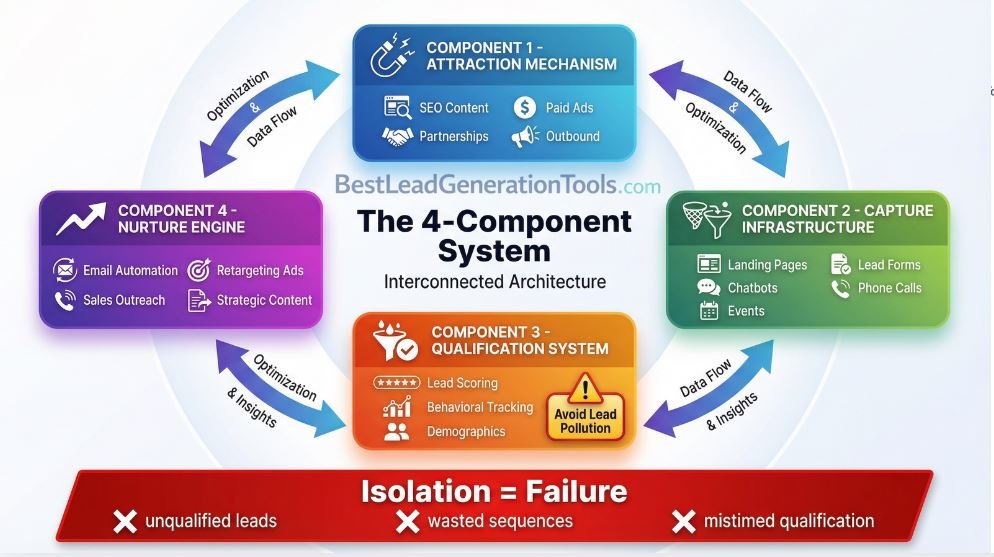
1. You Are Treating Lead Generation as a Collection of Tactics
This is one of the most fundamental lead generation problems.
A business launches paid ads. Someone else publishes blog posts. A landing page collects email addresses. Sales representatives follow up when they have time.
Each activity may work individually, but nothing connects them.
Lead generation should function as a process in which one step supports the next.
A simplified path looks like this:
Audience -> Traffic -> Offer -> Lead Capture -> Qualification -> Nurturing -> Sales
A problem anywhere along that path affects everything that follows.
For example, attracting the wrong audience creates poor-quality leads. Poor qualification sends those leads to sales. Sales then wastes time pursuing people who were unlikely to buy in the first place.
The sales team may conclude that marketing is generating bad leads, while marketing points to growing lead volume and assumes sales is failing to close them.
Both teams are looking at symptoms rather than the system.
How to Fix It
Map the actual journey a prospect takes through your business.
Identify:
- Where prospects come from
- What message attracts them
- What offer converts them into leads
- What information you collect
- How you determine whether they are qualified
- What happens immediately after conversion
- When sales becomes involved
- How leads who are not ready to buy are nurtured
You should be able to explain what happens from first contact to sales handoff without relying on vague steps such as “someone follows up.”
If you cannot, your first problem may be the lack of a defined system rather than the performance of any individual marketing tactic.
2. You Are Attracting the Wrong Audience
Traffic does not create business value simply because it exists.
A campaign can generate thousands of visitors and still fail if those visitors have little connection to what you sell.
The same problem occurs when targeting is too broad.
A company selling specialized software for established B2B sales teams, for example, gains little from attracting large numbers of freelancers, students, or very small businesses if those audiences are unlikely to become customers.
The traffic numbers may look impressive while the pipeline remains weak.
Signs Your Targeting May Be the Problem
Look for patterns such as:
- A large percentage of leads do not fit your ideal customer profile
- Prospects regularly lack the budget for your solution
- Leads are asking for products or services you do not provide
- Sales frequently disqualifies leads immediately
- One traffic source generates many leads but few customers
- Your content attracts an audience substantially different from your buyers
This is why lead quality matters more than raw lead volume.
Our guide to what makes a high-quality lead explains how to distinguish prospects with genuine sales potential from contacts that inflate your lead count without improving your pipeline.
How to Fix It
Start with your best existing customers.
Look for common characteristics such as their industry, company size, job role, needs, buying triggers, budget, and the problems they were trying to solve.
Then compare those characteristics with the people your marketing currently attracts.
If there is a large mismatch, improving targeting should come before increasing traffic.
3. Your Traffic Sources Do Not Match Your Goals
Not all traffic behaves the same way.
Someone searching Google for a specific solution may have very different intent from someone who casually encounters a social media post.
Likewise, a cold prospect receiving an outbound email has a different relationship with your company than a returning visitor comparing products.
Problems arise when businesses expect every traffic source to produce the same type of lead.
Traffic Intent Matters
Consider the difference between someone searching:
“what is lead scoring?”
and someone searching:
“best lead scoring software.”
The first search suggests an educational need. The second suggests the person may be evaluating solutions.
Both visitors can be valuable, but they should not necessarily receive the same offer or follow the same path.
Understanding high-intent vs. low-intent traffic can help you decide what kind of conversion you should reasonably expect from different visitors.
How to Fix It
Evaluate traffic sources based on what happens after the click.
Instead of asking only:
Which source generates the most visitors or cheapest leads?
also ask:
Which source generates prospects who qualify and eventually become customers?
A source that produces fewer leads may be much more valuable if those leads consistently fit your target market and progress through your pipeline.
4. You Depend Too Heavily on One Lead Source
A lead generation strategy becomes vulnerable when nearly all opportunities come from one channel.
- Paid advertising can become more expensive.
- Search rankings can change.
- Social platforms can reduce organic reach.
- Email performance can decline.
- Referral sources can disappear.
The problem is not that any one of these channels is inherently unreliable. The problem is depending on one channel so heavily that a change outside your control can disrupt your entire pipeline.
How to Fix It
Build diversification gradually rather than trying every channel at once.
Your mix might eventually include:
- Organic search and content
- Paid search or social advertising
- Partnerships and referrals
- Social media
- Outbound prospecting
The appropriate combination depends on your audience, budget, sales cycle, and business model.
Our comparison of inbound vs. outbound lead generation can help you determine how those broader approaches fit together.
The goal is not to use every available channel. It is to avoid building your entire acquisition strategy around a single point of failure.
5. Your Offer Does Not Match the Audience
Sometimes the traffic is good but the offer is wrong.
A visitor needs a reason to exchange contact information for whatever you are offering.
That value exchange might be:
- A useful guide
- A checklist or template
- A webinar
- A free trial
- A product demonstration
- A consultation
- A quote
- A calculator or other tool
But the offer has to match both the problem and the buying stage of the audience.
Someone beginning to research a problem may be interested in a practical guide but unwilling to schedule a sales call.
Someone actively comparing vendors may have little interest in downloading a beginner ebook but may readily request pricing or a demonstration.
How to Fix It
Ask three questions about every offer:
Who is this for?
What problem does it help solve?
What level of commitment is reasonable for someone at this stage?
If you cannot answer those questions clearly, the offer may be too generic.
If lead magnets are an important part of your strategy, our guide to what a lead magnet is explains how the value exchange works and how lead magnets fit into the broader acquisition process.
6. Your Lead Capture Process Creates Too Much Friction
A strong offer can still fail when claiming it is unnecessarily difficult.
Long forms, confusing landing pages, unclear calls to action, poor mobile experiences, slow pages, technical errors, and unnecessary questions can all prevent interested prospects from converting.
The opposite can also create problems.
If your form asks for almost no information when qualification is important, you may generate more contacts while giving your sales team little ability to determine which ones deserve attention.
The goal is not always the shortest possible form.
The goal is appropriate friction.
How to Fix It
Match the information you request to the value of the offer and the prospect’s stage in the buying process.
A person downloading an introductory guide may only need to provide basic contact information.
Someone requesting a consultation for an expensive B2B service may reasonably be asked about company size, needs, timeline, or other qualification factors.
Review your landing pages and forms for:
- Unnecessary fields
- Weak or vague calls to action
- Poor mobile usability
- Confusing instructions
- Technical errors
- Unclear privacy expectations
- A mismatch between the traffic source and landing-page message
Then test the complete process yourself from the perspective of a new visitor.
7. You Are Optimizing for More Leads Instead of Better Leads
Lead volume is easy to measure.
That makes it tempting to treat it as the primary measure of success.
But generating 500 leads is not necessarily better than generating 100.
What matters is what happens to those leads.
Suppose Campaign A generates 500 leads and Campaign B generates 150.
If Campaign A produces five customers while Campaign B produces 20, the smaller campaign may be far more valuable even though its cost per lead is higher.
This is why cost per lead can be misleading when viewed by itself.
How to Fix It
Connect lead-generation metrics to outcomes further down the funnel.
Track measures such as:
- Percentage of leads that qualify
- Opportunities created by source
- Lead-to-customer conversion rate
- Customer acquisition cost
- Revenue generated by source
- Customer value by acquisition channel
Your goal is not simply to reduce the cost per lead. It is to acquire customers at economics that make sense for your business.
A cheap lead that never buys is not necessarily a bargain.
8. You Have No Consistent Qualification Process
Generating a contact and generating a legitimate sales opportunity are not the same thing.
Without qualification criteria, marketing may send every lead to sales.
Sales representatives then spend time deciding which contacts deserve attention instead of talking with prospects who have genuine potential.
This also creates conflict between teams.
Marketing believes it delivered leads. Sales believes those leads were poor.
Often the real problem is that nobody agreed on what a qualified lead should look like.
How to Fix It
Establish criteria that reflect your actual customers.
Depending on the business, these might include:
- Fit with your ideal customer profile
- Relevant need or problem
- Company size
- Job role or purchasing authority
- Budget
- Timeline
- Behavioral engagement
- Buying intent
Then define what happens to different types of leads.
Some should go directly to sales.
Some should remain in nurturing.
Some may not be appropriate prospects at all.
A documented lead qualification process helps marketing and sales apply the same standards instead of relying on individual judgment.
If you generate enough leads that prioritization becomes difficult, lead scoring can add another layer. But scoring should support good qualification criteria, not replace them.
9. You Generate Leads but Have No Nurture Strategy
Not every qualified prospect is ready to buy today.
That does not make the lead worthless.
Some prospects need time to research. Others are waiting for budget approval, comparing alternatives, or solving another priority first.
If your process consists of capturing a lead, making one or two sales attempts, and abandoning the contact, you may be losing viable future customers.
At the other extreme, sending the same generic promotional emails to every lead is not much of a nurture strategy either.
How to Fix It
Match follow-up to what you know about the prospect.
Early-stage leads may benefit from educational material.
Prospects evaluating solutions may need comparison content, case studies, demonstrations, or answers to common objections.
Decision-stage prospects may need pricing details, implementation information, proof, or reassurance about risk.
The important principle is simple:
Give the prospect a useful next step rather than treating every interaction as an immediate sales opportunity.
Marketing automation can make this easier, but automation should support relevance rather than simply increasing the number of messages you send.
10. Marketing and Sales Do Not Agree on What a Good Lead Is
This problem deserves separate attention because it can undermine an otherwise strong lead-generation program.
Marketing is often rewarded for generating leads.
Sales is rewarded for generating revenue.
Those goals can conflict when the two teams use different definitions of quality.
Marketing may celebrate 1,000 new leads while sales complains that only a small fraction are worth contacting.
Neither side can evaluate performance fairly until they agree on what qualifies a lead for sales attention.
How to Fix It
Create shared definitions for important stages.
For example:
Lead: A person who has provided contact information.
Marketing Qualified Lead (MQL): A lead that meets agreed marketing criteria based on fit, engagement, or both.
Sales Qualified Lead (SQL): A prospect that meets the criteria for direct sales attention.
The exact definitions should reflect your business rather than a generic template.
Our guide to MQL vs. SQL explains these stages in more detail.
Marketing should also receive feedback about what happens after leads reach sales.
- Which sources produce opportunities?
- Which leads are consistently rejected?
- Which characteristics appear among customers?
That information should flow back into targeting, offers, qualification, and future campaigns.
11. You Are Measuring Activity Instead of Business Results
Lead generation produces many numbers.
- Website traffic.
- Clicks.
- Form submissions.
- Email opens.
- Cost per click.
- Cost per lead.
All can be useful.
None tells the whole story.
A campaign can improve nearly every top-of-funnel metric and still produce poor business results.
How to Fix It
Measure the process from acquisition through customer conversion.
At minimum, try to understand:
Traffic source -> Lead -> Qualified lead -> Opportunity -> Customer
Then compare performance by channel, campaign, audience, and offer.
This helps answer questions such as:
- Which sources produce the most qualified leads?
- Which offers generate contacts but few opportunities?
- Where do prospects stop progressing?
- Which campaigns generate actual customers?
- How much does it cost to acquire those customers?
- Which customers produce the greatest value?
If leads are entering your pipeline but failing to become customers, that is a different problem from failing to generate leads in the first place. Our guide to why leads are not converting focuses specifically on diagnosing what happens after lead capture.
12. You Are Scaling Before the Process Works
More traffic magnifies whatever is already happening.
If your targeting is strong, your offer converts, your qualification process works, and good leads become customers, additional traffic can create growth.
If those things are broken, additional traffic creates more waste.
This is why increasing an advertising budget is not automatically the solution to disappointing lead-generation results.
You may simply pay more money to produce more of the same problem.
How to Fix It
Before scaling, establish that the underlying process works at a smaller level.
Ask:
- Are we attracting the audience we intended to reach?
- Are those visitors responding to the offer?
- Are the resulting leads reasonably qualified?
- Do we know what happens to them after capture?
- Are good leads progressing toward sales?
- Can we identify which sources produce customers?
- Are the acquisition economics sustainable?
Once you can answer those questions with actual data, scaling becomes a much more informed decision.
How to Diagnose a Lead Generation Problem
When lead generation is underperforming, avoid changing everything at once.
Start at the beginning of the process and identify the first major breakdown.
You Are Not Getting Enough Relevant Traffic
Investigate:
- Audience targeting
- Search visibility
- Advertising reach
- Channel selection
- Content-market fit
The problem is probably attraction.
You Get Traffic but Few Leads
Investigate:
- Offer relevance
- Message match
- Landing pages
- Calls to action
- Forms
- Trust
- Page usability
The problem is probably capture.
You Generate Leads but Most Are Poor Fits
Investigate:
- Target audience
- Traffic sources
- Offer positioning
- Qualification criteria
- Form questions
The problem is probably lead quality or qualification.
You Generate Good Leads but They Do Not Progress
At this point, lead generation itself may not be the primary problem.
Investigate:
- Response time
- Sales handoff
- Follow-up
- Buyer readiness
- Nurturing
- Trust
- Sales process
That is where the distinction between lead generation and lead conversion becomes important.
You Cannot Tell Where the Problem Is
Then measurement is the first problem to fix.
If you cannot follow prospects from traffic source through lead capture and eventual sales outcome, you do not have enough information to determine what should change.
What a Healthy Lead Generation Process Looks Like
A healthy process does not mean every visitor becomes a lead or every lead becomes a customer.
It means each stage has a clear purpose and connects logically to the next.
You know:
- Who you want to attract.
- Where those people come from.
- What offer is appropriate for them.
- How you capture their information.
- What makes a lead qualified.
- What happens after the lead enters your system.
- When sales should become involved.
- Which sources ultimately produce customers.
Most importantly, you can identify where performance deteriorates and make changes based on evidence rather than guesswork.
That is what turns isolated lead-generation tactics into a repeatable process.
Frequently Asked Questions
Why does lead generation not work for some businesses?
Lead generation often underperforms when businesses target the wrong audience, use offers that do not match buyer intent, create too much friction, fail to qualify leads, or have no consistent process connecting marketing with sales.
The problem is usually not a single tactic. It is often a breakdown between multiple stages of the process.
How do I know if my lead generation strategy is failing?
Look beyond total lead volume.
Warning signs can include low-quality leads, high disqualification rates, rising acquisition costs without corresponding revenue, large differences in lead quality between sources, inconsistent follow-up, or an inability to determine which campaigns produce customers.
Why am I getting traffic but no leads?
If relevant visitors reach your website but rarely become leads, investigate the offer and capture process.
Your offer may not match visitor intent, the value may be unclear, your call to action may be weak, or the form may create unnecessary friction.
If the traffic itself is poorly targeted, however, improving the landing page may not solve the problem.
Why am I getting leads but no customers?
That is usually a lead-conversion problem rather than a pure lead-generation problem.
Start by examining lead quality, qualification, buyer readiness, response time, nurturing, trust, sales handoff, and the stages where qualified prospects stop progressing.
Should I focus on lead quantity or lead quality?
Both matter, but quantity without sufficient quality can waste marketing and sales resources.
Track how leads progress after capture. A source producing fewer leads can be more valuable if a larger proportion of those leads qualify and become customers.
How can I make lead generation more predictable?
Document the process, define your target audience, track performance at each stage, establish qualification standards, create consistent follow-up procedures, and measure which sources produce customers.
Predictability comes from understanding and improving the process rather than continually adding disconnected tactics.
Final Thoughts: Fix the System Before You Add More Leads
When lead generation is disappointing, the instinct is often to do more.
- More ads.
- More content.
- More traffic.
- More landing pages.
- More leads.
But volume does not repair a broken process.
If you attract the wrong people, more traffic brings more wrong people.
If your offer does not match the audience, more visitors see the same weak offer.
If you do not qualify leads, greater volume gives sales more contacts to sort through.
If marketing and sales are disconnected, additional leads create a larger handoff problem.
Start by identifying the first place where your lead-generation process stops working as intended.
Fix that problem.
Measure the result.
Then move to the next bottleneck.
Once the process consistently attracts the right people and turns their interest into qualified opportunities, increasing volume has a much better chance of producing the result you actually want: more customers.