
The four basic steps of lead generation are identify your target audience, create a relevant offer, capture lead information, and nurture those leads toward the next step.
This four-step framework provides a simple way to understand how a business turns potential customers into leads and develops those relationships over time.
In practice, lead generation can be divided into more or fewer stages depending on how the process is defined. What matters is not the number of steps, but whether your process connects the right audience with the right offer and gives interested prospects a clear path forward.
Quick Answer: What Are the Four Steps of Lead Generation?
The four steps are:
- Identify your target audience: Determine who you want to reach and what problems they are trying to solve.
- Create a relevant offer: Give those prospects a useful reason to engage with your business.
- Capture lead information: Collect enough information to continue the relationship.
- Nurture and qualify leads: Follow up with relevant information while determining which prospects may be ready for the next step.
Together, these steps move someone from being part of a potential audience to becoming an identifiable prospect your business can continue communicating with.
If you are new to the subject, our guide to what lead generation is and how it works provides a broader introduction.
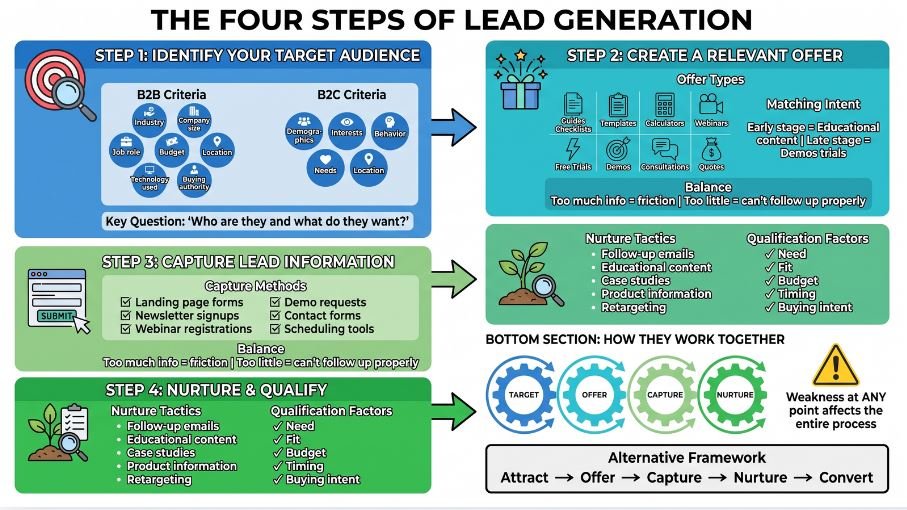
Step 1: Identify Your Target Audience
Effective lead generation starts with knowing who you are trying to reach.
A business can generate substantial traffic and still produce poor results if the people arriving are unlikely to need its products or services.
For a B2B company, identifying the right audience might involve factors such as:
- Industry
- Company size
- Job role
- Business problem
- Location
- Budget
- Technology currently being used
- Buying authority
For a B2C company, relevant characteristics might include demographics, interests, location, needs, purchasing behavior, or the specific problem the product solves.
The objective is not necessarily to make your audience as narrow as possible. It is to understand it well enough to distinguish potentially valuable prospects from people who are unlikely to become customers.
Understand What Your Audience Is Trying to Accomplish
Knowing who someone is tells you only part of the story.
You also need to understand what that person wants.
Someone beginning to research a problem may need educational information. Someone comparing solutions may want product comparisons, pricing information, case studies, or demonstrations.
Those differences affect the traffic you attract, the content you create, and the offers you present.
Our guide to high-intent vs. low-intent traffic explains how a prospect’s level of intent can affect the way you approach lead generation.
Step 2: Create a Relevant Offer
Once you know who you want to reach, you need to give those people a reason to engage.
That is the role of the offer.
An offer does not always mean a discount or sales promotion. In lead generation, it can be anything valuable enough to encourage a prospect to take the next step.
Depending on the business and the prospect’s stage in the buying process, that might include:
- A guide or checklist
- A Template
- A Calculator or assessment
- A Webinar
- A Free trial
- A Product demonstration
- A Consultation
- A Quote or estimate
The best offer depends on what the prospect needs at that particular moment.
Someone who has just discovered a problem may be interested in an educational guide but unwilling to schedule a sales call. Someone actively evaluating products may have little interest in a beginner’s ebook but may welcome a demonstration or free trial.
The offer and the prospect’s intent should fit each other.
Lead magnets are one common way to create this value exchange. If you want to explore that approach in more detail, see what a lead magnet is and how it works.
Step 3: Capture Lead Information
Interest alone does not necessarily create a lead.
The next step is giving interested prospects a way to identify themselves so the relationship can continue.
Lead capture can happen through:
- Landing page forms
- Newsletter signups
- Webinar registrations
- Free trial registrations
- Demo requests
- Contact forms
- Quote requests
- Scheduling tools
The information you collect should reflect what you actually need at that stage.
For an educational newsletter or downloadable guide, an email address may be enough. A B2B demonstration request might reasonably ask for a name, company, job role, and other information that helps determine whether the prospect is a good fit.
Asking for unnecessary information can create friction. Asking for too little can leave sales or marketing without enough information to respond appropriately.
The goal is to collect enough information to support the next step in the relationship, rather than collecting information simply because you can.
Where those prospects come from also matters. Organic search, paid advertising, social media, referrals, outbound prospecting, and other channels can produce very different types of visitors. Our guide to traffic sources for lead generation examines those channels in greater detail.
Step 4: Nurture and Qualify Your Leads
Capturing someone’s information does not mean that person is ready to buy.
Some leads may be researching a problem. Others may be comparing alternatives. Some may be close to making a decision, while others may never be a good fit for your business.
That is why the fourth step combines two related activities: nurturing and qualification.
Nurturing helps prospects continue moving through their decision process. Depending on the business, this could include follow-up emails, educational content, case studies, webinars, product information, retargeting, or direct contact.
Qualification asks a different question:
Is this lead a realistic potential customer, and are they ready for greater sales attention?
Businesses may evaluate factors such as need, company size, role, budget, timing, product fit, or demonstrated buying behavior.
Not every lead should receive the same follow-up. Someone who downloaded an introductory guide may need more education, while someone who repeatedly visits product and pricing pages may be signaling stronger buying intent.
For a deeper explanation of this part of the process, see what lead qualification is and why it matters.
Why Do Some Lead Generation Frameworks Have Five Stages Instead of Four?
There is no single universal number of lead generation stages.
The four-step model is useful because it provides a simple explanation of the core lead-generation process:
Identify -> Offer -> Capture -> Nurture and Qualify
A more detailed framework may separate some of these activities into individual stages and extend the process through the final conversion.
That is the approach we use in our comprehensive guide to how a lead generation system works:
Attract -> Offer -> Capture -> Nurture and Qualify -> Convert
In that five-stage model, attracting the audience is treated as its own stage rather than being included with audience identification, and converting qualified leads into customers is explicitly included as the final stage.
Neither framework changes the underlying principle.
A business must reach appropriate prospects, give them a reason to engage, capture their information, develop and evaluate those leads, and ultimately provide qualified prospects with a path toward becoming customers.
The four-step framework is a useful shorthand. The five-stage framework provides a more complete view of the entire customer acquisition system.
How the Four Steps Work Together
The four steps are most useful when treated as connected parts of a process rather than independent marketing activities.
Consider a B2B software company.
First, the company identifies marketing managers at small and midsize businesses as a relevant audience.
Next, it creates a useful campaign-planning template designed for those marketers.
A visitor discovers the resource and completes a form to receive it.
The company then follows up with additional information while learning more about the prospect’s needs and level of interest.
The progression looks like this:
Target Audience -> Relevant Offer -> Lead Capture -> Nurture and Qualify
A weakness at any point can affect everything that follows.
An excellent offer presented to the wrong audience may produce few useful leads. A strong audience and offer can still underperform if the capture process creates unnecessary friction. And generating many leads accomplishes little if there is no effective follow-up afterward.
That is why successful lead generation depends less on any single tactic than on how well the individual steps work together.
What Happens After the Four Steps?
Lead generation does not necessarily end when a prospect becomes qualified.
Once a lead demonstrates sufficient fit and buying intent, the focus typically begins shifting toward conversion. Depending on the business, that may involve a sales conversation, product demonstration, proposal, free trial, consultation, or another buying step.
This distinction is useful because generating a lead and converting that lead into a customer are not the same thing.
If leads are entering your pipeline but failing to become customers, the problem may be happening after lead generation rather than at the top of the funnel. Our guide to why leads are not converting explains how to diagnose those problems.
Frequently Asked Questions
What is the first step in lead generation?
The first step is identifying the audience you want to reach. You need to understand who could realistically benefit from your product or service, what problems those people are trying to solve, and what might motivate them to engage with your business.
What is the most important step in lead generation?
No single step can compensate for serious problems elsewhere in the process. Strong targeting cannot rescue an irrelevant offer, and an excellent offer will not produce much business value if leads are captured but never followed up with appropriately. The steps work as a connected process.
Is lead generation the same as a sales funnel?
Not exactly. Lead generation focuses on attracting prospects and turning them into identifiable leads that can be developed and qualified. A funnel provides a broader way of viewing how prospects move through different levels of awareness, consideration, and buying intent. See our guide to the lead generation funnel for a more detailed explanation.
What happens after a lead is generated?
After a lead is captured, the business typically nurtures and qualifies that person. Qualified, sales-ready leads can then move toward a sales conversation or other conversion step, while leads that are not ready may continue receiving relevant information.
Final Thoughts
The four steps of lead generation provide a simple framework for understanding how potential customers become identifiable prospects:
- Identify the right audience.
- Create a relevant offer.
- Capture lead information.
- Nurture and qualify those leads.
The value of the framework is not the number four itself. Different businesses and marketing models may divide the process differently.
What matters is that each step has a clear purpose and connects logically with the next.
When targeting, offers, lead capture, and follow-up work together, lead generation becomes a repeatable process rather than a collection of disconnected marketing tactics.